Level:
Correct: 0
Incorrect: 0
Marks: 0/0
Exam Practice
Subject:
Topics:
AQA GCSE Chemistry Smart practice A mixed round aimed at your weak spots
Unit 1
Atomic structure and the periodic table
Unit 2
Bonding, structure, and the properties of matter
Unit 3
Quantitative chemistry
Unit 4
Chemical changes
Unit 5
Energy changes
Unit 6
The rate and extent of chemical change
Unit 7
Organic chemistry
Unit 8
Chemical analysis
Unit 9
Chemistry of the atmosphere
Unit 10
Using resources
Avg
score:
–
Topics
done:
0/124

Reaction profiles

Practise 26 exam-style questions on Reaction profiles for AQA GCSE Chemistry. Write your answer as you would in the exam and get it marked in seconds against the mark scheme, point by point, with an AI tutor on hand if you get stuck.

  • 26 questions
  • 1–6 marks each
  • Instant marking
  • No sign-up needed
20 questions, marked as you go

Sample questions with model answers

Here are 4 of the questions in this topic, each with a model answer, an explanation of why it earns the marks and the mark scheme an examiner would use.

Question 1

2 marks

The diagram shows the reaction profile for the combustion of methane.

What do the arrows labelled A and B represent?
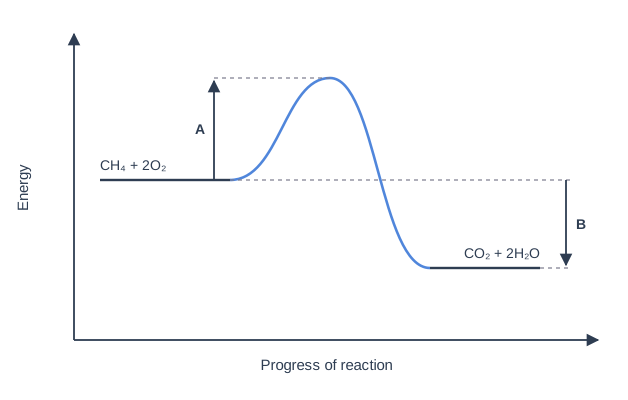
Reaction profile (energy against progress of reaction). The reactants (CH₄ + 2O₂) are higher in energy than the products (CO₂ + 2H₂O); the curve rises to a peak between them. An upward arrow labelled A goes from the reactants' energy level to the top of the peak. An arrow labelled B goes from the reactants' level down to the products' level.

Model answer

A is the activation energy. B is the overall energy change for the reaction (the energy released to the surroundings).

Explanation

The activation energy is measured from the reactants up to the peak of the curve. The overall energy change is the difference in energy between the reactants and the products.

Mark scheme
  1. 1 mark

    A: activation energy

  2. 1 mark

    B: overall energy change

    allow energy given out / released (to the surroundings); do not accept activation energy for B
Question 2

2 marks

Two reactions, X and Y, are carried out in the same volume of solution using the same number of moles of reactants. Reaction X has an overall energy change of −50 kJ/mol and reaction Y has an overall energy change of −200 kJ/mol.

Predict which reaction gives the bigger temperature rise. Explain your answer.

Model answer

Reaction Y gives the bigger temperature rise. Its overall energy change is −200 kJ/mol, so it transfers four times as much energy to the same volume of solution as reaction X.

Explanation

The overall energy change shows how much energy is released per mole. With the same amounts and the same volume of solution, more energy released means a bigger temperature rise.

Mark scheme
  1. 1 mark

    Y

  2. 1 mark

    it transfers more energy to the surroundings (per mole)

    allow its products are much lower in energy than its reactants

Question 3

3 marks

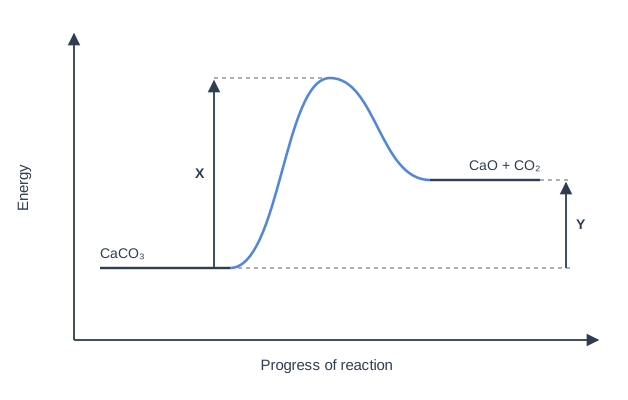
The diagram shows the reaction profile for the thermal decomposition of calcium carbonate.

Name the energy changes labelled X and Y. Explain whether the reaction takes in energy or gives out energy.

Reaction profile (energy against progress of reaction). The reactants (CaCO₃) are lower in energy than the products (CaO + CO₂); the curve rises to a peak between them. An upward arrow labelled X goes from the reactants' energy level to the top of the peak. An arrow labelled Y goes from the reactants' level up to the products' level.

Model answer

X is the activation energy and Y is the overall energy change. The reaction takes in energy (it is endothermic), because the products, CaO + CO₂, are at a higher energy level than the reactant, CaCO₃.

Explanation

In an endothermic reaction both arrows point upwards from the reactants: the activation energy goes up to the peak and the overall energy change goes up to the products.

Mark scheme
  1. 1 mark

    X: activation energy

  2. 1 mark

    Y: overall energy change

    allow energy taken in

  3. 1 mark

    it takes in energy, because the products are at a higher energy level than the reactants

    allow endothermic with this reason

Question 4

4 marks

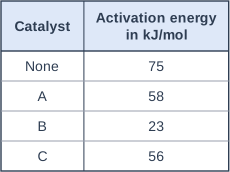
Hydrogen peroxide decomposes to form water and oxygen. The table shows the activation energy for the decomposition with no catalyst and with three different catalysts.

Predict which catalyst gives the fastest reaction and explain your answer. State how the catalysts affect the overall energy change of the reaction.

Table with columns "Catalyst", "Activation energy in kJ/mol". Catalyst: None; Activation energy in kJ/mol: 75 | Catalyst: A; Activation energy in kJ/mol: 58 | Catalyst: B; Activation energy in kJ/mol: 23 | Catalyst: C; Activation energy in kJ/mol: 56.

Model answer

Catalyst B gives the fastest reaction, because it lowers the activation energy the most, to 23 kJ/mol. With a lower activation energy, a greater proportion of colliding particles have enough energy to react, so there are more successful collisions per second. The catalysts do not change the overall energy change, because the reactants and products are the same in every case.

Explanation

A catalyst provides a different reaction pathway with a lower activation energy. It does not change the energies of the reactants or products, so the overall energy change stays the same.

Mark scheme
  1. 1 mark

    catalyst B

  2. 1 mark

    it gives the lowest activation energy (23 kJ/mol)

  3. 1 mark

    so more particles have enough energy to react when they collide / more successful collisions per second

  4. 1 mark

    the overall energy change is the same with every catalyst / is not changed

    allow the reactants and products have the same energies

Ready to try the rest? Every answer you write is marked against the mark scheme, so you can see exactly where the marks are.

AI Tutor Hints first, answers after you try

Hi! Stuck? Ask me for a hint and I’ll help you work it out. Once you’ve checked your answer I can explain exactly where the marks are.