
Level:
Correct: 0
Incorrect: 0
Marks: 0/0
Exam Practice
Subject:
Topics:
AQA GCSE Chemistry Smart practice A mixed round aimed at your weak spots
Unit 1
Atomic structure and the periodic table
Unit 2
Bonding, structure, and the properties of matter
Unit 3
Quantitative chemistry
Unit 4
Chemical changes
Unit 5
Energy changes
Unit 6
The rate and extent of chemical change
Unit 7
Organic chemistry
Unit 8
Chemical analysis
Unit 9
Chemistry of the atmosphere
Unit 10
Using resources
Avg
score:
–
Topics
done:
0/124

Graphite

Practise 18 exam-style questions on Graphite for AQA GCSE Chemistry. Write your answer as you would in the exam and get it marked in seconds against the mark scheme, point by point, with an AI tutor on hand if you get stuck.

  • 18 questions
  • 1–6 marks each
  • Instant marking
  • No sign-up needed
18 questions, marked as you go

Sample questions with model answers

Here are 4 of the questions in this topic, each with a model answer, an explanation of why it earns the marks and the mark scheme an examiner would use.

Question 1

1 mark

Which one of these describes the forces between the layers in graphite?
A Strong covalent bonds.
B Weak forces, with no covalent bonds.
C Ionic bonds.
D Metallic bonds.

Model answer

B: weak forces, with no covalent bonds between the layers.

Explanation

The strong covalent bonds in graphite are within the layers. Between the layers there are only weak forces, which is why the layers can slide over each other.

Mark scheme
  1. 1 mark

    B

    do not accept more than one letter
Question 2

2 marks

A student says: 'Graphite is soft, so it must have a low melting point.'

Explain why the student is wrong.

Model answer

Graphite is soft because there are only weak forces between its layers, so the layers slide over each other easily. But melting graphite means breaking the strong covalent bonds between the carbon atoms within the layers, which needs a lot of energy, so its melting point is very high.

Explanation

Softness and melting point depend on different bonds. Softness depends on the weak forces between layers; melting depends on the strong covalent bonds within layers.

Mark scheme
  1. 1 mark

    graphite is soft because its layers slide over each other (there are only weak forces between layers)

  2. 1 mark

    but to melt graphite the strong covalent bonds within the layers must be broken, which needs a lot of energy

Question 3

3 marks

The electrical conductivity of graphite is different in different directions:
along the layers: 2.4 × 10⁵ S/m
at right angles to the layers: 3.0 × 10² S/m

Calculate how many times greater the conductivity is along the layers. Suggest why graphite conducts much better along the layers than across them.

Model answer

2.4 × 10⁵ ÷ 3.0 × 10² = 800, so the conductivity is 800 times greater along the layers.
The delocalised electrons can move freely within each layer, but there are no covalent bonds between the layers, so it is much harder for electrons to move from one layer to the next.

Explanation

When dividing numbers in standard form, divide the numbers and subtract the powers: 2.4 ÷ 3.0 = 0.8 and 10⁵ ÷ 10² = 10³, giving 0.8 × 10³ = 800. The delocalised electrons belong to the layers, so charge flows most easily along them.

Mark scheme
  1. 1 mark

    2.4 × 10⁵ ÷ 3.0 × 10²

  2. 1 mark

    = 800 (times)

    correct answer with no working scores 2 marks

  3. 1 mark

    the delocalised electrons move freely along / within the layers, but cannot move easily from one layer to the next (because there are no covalent bonds between layers)

    allow electrons are delocalised within each layer

Question 4

4 marks

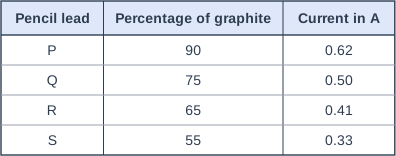
Pencil leads are a mixture of graphite and clay. A student measured the current through 5 cm lengths of four different pencil leads, P, Q, R and S, using the same battery. The table shows the results.

Describe the relationship between the percentage of graphite and the current, and explain it. Suggest why the student used the same length of pencil lead each time.

Table with columns "Pencil lead", "Percentage of graphite", "Current in A". Pencil lead: P; Percentage of graphite: 90; Current in A: 0.62 | Pencil lead: Q; Percentage of graphite: 75; Current in A: 0.50 | Pencil lead: R; Percentage of graphite: 65; Current in A: 0.41 | Pencil lead: S; Percentage of graphite: 55; Current in A: 0.33.

Model answer

The higher the percentage of graphite in the lead, the higher the current. Graphite conducts because it has delocalised electrons that move and carry charge, but clay does not conduct, so leads with more graphite have more delocalised electrons to carry the current. The student used the same length each time because the length of the lead also affects the current; changing it would make the test unfair.

Explanation

Only the variable being investigated (percentage of graphite) should change. The trend in the data is explained by the conducting part of the mixture, graphite, and its delocalised electrons.

Mark scheme
  1. 1 mark

    the higher the percentage of graphite, the higher the current

  2. 1 mark

    graphite has delocalised electrons that move and carry charge

  3. 1 mark

    clay does not conduct, so more graphite means more delocalised electrons to carry charge

    allow more graphite means more conducting material

  4. 1 mark

    the length affects the current, so it must be controlled to make it a fair test

    allow a longer lead would give a lower current

Ready to try the rest? Every answer you write is marked against the mark scheme, so you can see exactly where the marks are.

AI Tutor Hints first, answers after you try

Hi! Stuck? Ask me for a hint and I’ll help you work it out. Once you’ve checked your answer I can explain exactly where the marks are.