
Level:
Correct: 0
Incorrect: 0
Marks: 0/0
Exam Practice
Subject:
Topics:
AQA GCSE Chemistry Smart practice A mixed round aimed at your weak spots
Unit 1
Atomic structure and the periodic table
Unit 2
Bonding, structure, and the properties of matter
Unit 3
Quantitative chemistry
Unit 4
Chemical changes
Unit 5
Energy changes
Unit 6
The rate and extent of chemical change
Unit 7
Organic chemistry
Unit 8
Chemical analysis
Unit 9
Chemistry of the atmosphere
Unit 10
Using resources
Avg
score:
–
Topics
done:
0/124

Uses of nanoparticles (chemistry only)

Practise 21 exam-style questions on Uses of nanoparticles (chemistry only) for AQA GCSE Chemistry. Write your answer as you would in the exam and get it marked in seconds against the mark scheme, point by point, with an AI tutor on hand if you get stuck.

  • 21 questions
  • 1–6 marks each
  • Instant marking
  • No sign-up needed
20 questions, marked as you go

Sample questions with model answers

Here are 4 of the questions in this topic, each with a model answer, an explanation of why it earns the marks and the mark scheme an examiner would use.

Question 1

2 marks

Explain why nanoparticles are useful as catalysts.

Model answer

Nanoparticles have a very high surface area to volume ratio, so much more of the catalyst is at the surface where reactions happen. This means a smaller quantity of catalyst is needed to have the same effect.

Explanation

Catalysts work at their surface. Because nanoparticles have so much surface for their volume, a small mass of nanoparticle catalyst can do the job of a much larger mass of ordinary powder, which saves money and resources. Saying only 'large surface area' is not enough - it is the surface area compared with the volume or mass that matters.

Mark scheme
  1. 1 mark

    nanoparticles have a (very) high surface area to volume ratio

    allow large surface area for their mass / volume; ignore 'large surface area' alone

  2. 1 mark

    so a smaller quantity of catalyst is needed (for the same effect)

    allow more (catalyst) particles / atoms exposed at the surface for reacting particles to collide with; allow more effective than the same mass of larger particles
Question 2

2 marks

An ink used to print electronic circuits contains silver nanoparticles. When the printed ink is heated, the nanoparticles join together to make a conducting track. Silver nanoparticles join together at about 150 °C, but larger silver particles need temperatures above 600 °C.

Suggest why the nanoparticle ink can be used to print circuits on flexible plastic film, but an ink containing larger silver particles cannot.

Model answer

The nanoparticle ink only needs to be heated to about 150 °C to form a conducting track. Larger silver particles need over 600 °C, which would melt or damage the plastic film.

Explanation

Nanoparticles can have different properties from the bulk material, such as joining together at a much lower temperature. Applying the given information to the use is the key skill here: the plastic film limits how hot the ink can be heated.

Mark scheme
  1. 1 mark

    nanoparticle ink only needs heating to a low temperature (about 150 °C)

  2. 1 mark

    the plastic would melt / be damaged at the higher temperature (above 600 °C) needed for larger particles

    allow the plastic would burn / decompose / soften

Question 3

3 marks

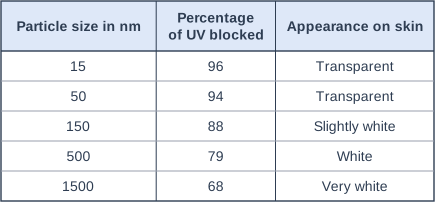
A company is developing a sun cream that gives good protection from ultraviolet (UV) radiation and does not leave a white layer on the skin. The table shows results for titanium dioxide particles of different sizes.

Which particle size should the company choose? Give two reasons for your answer using data from the table.

Table with columns "Particle size in nm", "Percentage of UV blocked", "Appearance on skin". Particle size in nm: 15; Percentage of UV blocked: 96; Appearance on skin: Transparent | Particle size in nm: 50; Percentage of UV blocked: 94; Appearance on skin: Transparent | Particle size in nm: 150; Percentage of UV blocked: 88; Appearance on skin: Slightly white | Particle size in nm: 500; Percentage of UV blocked: 79; Appearance on skin: White | Particle size in nm: 1500; Percentage of UV blocked: 68; Appearance on skin: Very white.

Model answer

15 nm. It blocks the highest percentage of UV, 96%, and it is transparent on the skin so it does not leave a white layer.

Explanation

Match the data to both requirements in the question: protection and appearance. The 15 nm particles are best on both counts; 50 nm particles are also transparent but block less UV.

Mark scheme
  1. 1 mark

    15 nm

  2. 1 mark

    blocks the highest percentage of UV (96%)

  3. 1 mark

    it is transparent on the skin / does not leave a white layer

    allow does not look white

Question 4

4 marks

Scientists are researching the use of iron nanoparticles to clean up polluted water underground. The nanoparticles are pumped into the ground, where they react with and break down harmful pollutants.

Suggest two advantages and two possible risks of using iron nanoparticles in this way.

Model answer

Advantages: the nanoparticles have a very high surface area to volume ratio, so they react quickly with the pollutants and only a small mass is needed; they are small enough to move through the soil, so the ground does not have to be dug up.
Risks: the nanoparticles could spread through the groundwater into drinking water, and they could harm organisms living in the soil.

Explanation

New applications of nanoparticles are an important area of research, and each one must be weighed up. The benefits come from their tiny size and high surface area to volume ratio; the risks come from the same small size, which makes them hard to contain or remove once released.

Mark scheme
  1. 1 mark

    advantage: high surface area to volume ratio so they react quickly / effectively with pollutants

    max 2 for advantages

  2. 1 mark

    advantage: only a small mass of iron is needed

  3. 1 mark

    advantage: small enough to move through soil / rock to reach the pollution, so the ground does not need to be dug up

    allow removes harmful pollutants from water that may be used for drinking

  4. 1 mark

    risk: nanoparticles could spread through the groundwater into drinking water / rivers

    max 2 for risks

  5. 1 mark

    risk: could harm organisms / microorganisms living in the soil or water

  6. 1 mark

    risk: difficult to recover / remove the nanoparticles afterwards

    allow long-term effects on the environment unknown

Ready to try the rest? Every answer you write is marked against the mark scheme, so you can see exactly where the marks are.

AI Tutor Hints first, answers after you try

Hi! Stuck? Ask me for a hint and I’ll help you work it out. Once you’ve checked your answer I can explain exactly where the marks are.