
Level:
Correct: 0
Incorrect: 0
Marks: 0/0
Exam Practice
Subject:
Topics:
AQA GCSE Chemistry Smart practice A mixed round aimed at your weak spots
Unit 1
Atomic structure and the periodic table
Unit 2
Bonding, structure, and the properties of matter
Unit 3
Quantitative chemistry
Unit 4
Chemical changes
Unit 5
Energy changes
Unit 6
The rate and extent of chemical change
Unit 7
Organic chemistry
Unit 8
Chemical analysis
Unit 9
Chemistry of the atmosphere
Unit 10
Using resources
Avg
score:
–
Topics
done:
0/124

Calculating rates of reactions

Practise 30 exam-style questions on Calculating rates of reactions for AQA GCSE Chemistry. Write your answer as you would in the exam and get it marked in seconds against the mark scheme, point by point, with an AI tutor on hand if you get stuck.

  • 30 questions
  • 1–6 marks each
  • Instant marking
  • No sign-up needed
20 questions, marked as you go

Sample questions with model answers

Here are 4 of the questions in this topic, each with a model answer, an explanation of why it earns the marks and the mark scheme an examiner would use.

Question 1

2 marks

Magnesium reacts with hydrochloric acid to produce hydrogen gas. In one experiment, 48 cm³ of hydrogen was produced in 60 seconds.

Calculate the mean rate of reaction. Give the unit.

Model answer

mean rate = volume of hydrogen ÷ time = 48 ÷ 60 = 0.8 cm³/s

Explanation

Divide the quantity of product by the time taken. The unit is the unit of volume divided by the unit of time, so cm³ ÷ s gives cm³/s.

Mark scheme
  1. 1 mark

    48 ÷ 60 = 0.8

    correct answer with no working scores full marks

  2. 1 mark

    cm³/s

    allow cm³ s⁻¹; unit mark is independent
Question 2

2 marks

In an experiment to measure the rate of reaction by loss in mass, a plug of cotton wool is placed in the neck of the conical flask.

Explain why.

Model answer

The cotton wool lets the gas escape from the flask, so the loss in mass can be measured, but it stops droplets of acid spraying out, so the mass lost is only due to the gas produced.

Explanation

If acid spray escaped, the mass would fall more than it should and the calculated rate would be too high. A bung would trap the gas, so no mass would be lost at all.

Mark scheme
  1. 1 mark

    it lets the gas escape

  2. 1 mark

    but stops acid / liquid spray escaping (so the mass lost is only due to the gas)

    allow stops liquid splashing out

Question 3

3 marks

Calcium carbonate reacts with hydrochloric acid in an open flask on a balance. In the first 120 seconds, the mass of the flask and contents decreased by 1.32 g because carbon dioxide escaped.

Calculate the mean rate of production of carbon dioxide in mol/s.
Relative atomic masses (Ar): C = 12, O = 16

Model answer

Mr of CO₂ = 12 + (2 × 16) = 44
moles of CO₂ = 1.32 ÷ 44 = 0.03 mol
mean rate = 0.03 ÷ 120 = 0.00025 mol/s (2.5 × 10⁻⁴ mol/s)

Explanation

The mass lost from the flask equals the mass of carbon dioxide that escaped. Convert this mass to moles using Mr, then divide by the time in seconds.

Mark scheme
  1. 1 mark

    Mr of CO₂ = 44

  2. 1 mark

    moles of CO₂ = 1.32 ÷ 44 = 0.03 (mol)

    allow ecf from incorrect Mr

  3. 1 mark

    rate = 0.03 ÷ 120 = 0.00025 (mol/s)

    allow 2.5 × 10⁻⁴; allow ecf; correct answer with no working scores 3 marks

Question 4

4 marks

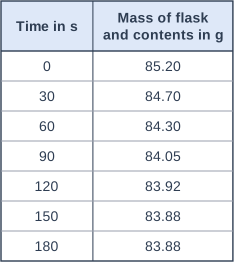
A student added marble chips to hydrochloric acid in a flask on a balance and recorded the mass of the flask and contents. The table shows the results.

Calculate the mean rate of reaction during the first 60 seconds. Give the unit. Explain why the mass of the flask and contents decreased.

Table with columns "Time in s", "Mass of flask and contents in g". Time in s: 0; Mass of flask and contents in g: 85.20 | Time in s: 30; Mass of flask and contents in g: 84.70 | Time in s: 60; Mass of flask and contents in g: 84.30 | Time in s: 90; Mass of flask and contents in g: 84.05 | Time in s: 120; Mass of flask and contents in g: 83.92 | Time in s: 150; Mass of flask and contents in g: 83.88 | Time in s: 180; Mass of flask and contents in g: 83.88.

Model answer

mass lost in first 60 s = 85.20 − 84.30 = 0.90 g
mean rate = 0.90 ÷ 60 = 0.015 g/s
The mass decreased because carbon dioxide gas was produced and escaped from the flask into the air.

Explanation

The quantity measured here is the mass of product lost, found by subtracting the mass at 60 s from the starting mass. Mass is lost because the reaction makes a gas that leaves the open flask.

Mark scheme
  1. 1 mark

    mass lost = 85.20 − 84.30 = 0.90 g

  2. 1 mark

    mean rate = 0.90 ÷ 60 = 0.015

    allow ecf from incorrect mass lost

  3. 1 mark

    g/s

    allow g s⁻¹

  4. 1 mark

    carbon dioxide (gas) is produced and escapes from the flask

    allow a gas escapes; do not accept hydrogen

Ready to try the rest? Every answer you write is marked against the mark scheme, so you can see exactly where the marks are.

AI Tutor Hints first, answers after you try

Hi! Stuck? Ask me for a hint and I’ll help you work it out. Once you’ve checked your answer I can explain exactly where the marks are.