Practise 31 exam-style questions on The Haber process (chemistry only) for AQA GCSE Chemistry. Write your answer as you would in the exam and get it marked in seconds against the mark scheme, point by point, with an AI tutor on hand if you get stuck.
31 questions
1–6 marks each
Instant marking
No sign-up needed
20 questions, marked as you go
Sample questions with model answers
Here are 4 of the questions in this topic, each with a model answer, an explanation of why it earns the marks and the mark scheme an examiner would use.
Question 1
2 marks
The raw materials for the Haber process are nitrogen and hydrogen.
Give a source of the nitrogen and a source of the hydrogen.
Model answer
Nitrogen is obtained from the air. Hydrogen is obtained from natural gas (methane).
Explanation
Air is about 78% nitrogen, so nitrogen is cheap and plentiful. Hydrogen is usually made by reacting methane from natural gas with steam, which makes it the more expensive raw material.
Mark scheme
1 mark
nitrogen: (from) the air
allow fractional distillation of liquid air
1 mark
hydrogen: (from) natural gas / methane
allow methane reacted with steam; allow electrolysis of water; do not accept from the air
Question 2
2 marks
Nitrogen and hydrogen are fed into the Haber process reactor in the ratio of 1 volume of nitrogen to 3 volumes of hydrogen.
Explain why this ratio is used.
Model answer
The equation shows that 1 mole of nitrogen reacts with 3 moles of hydrogen, and equal volumes of gases contain the same number of moles. Feeding the gases in a 1 : 3 ratio by volume means neither gas is in excess, so neither is wasted.
Explanation
For gases at the same temperature and pressure, volume ratios equal mole ratios. Matching the feed ratio to the equation gives the most efficient use of both raw materials.
Mark scheme
1 mark
it is the ratio in which they react / 1 mol N₂ reacts with 3 mol H₂ (and equal volumes of gas contain equal numbers of moles)
1 mark
so neither gas is in excess / wasted
Question 3
3 marks
N₂(g) + 3H₂(g) ⇌ 2NH₃(g)
A chemist has 50 dm³ of nitrogen. Calculate the volume of hydrogen needed to react with all of the nitrogen, and the volume of ammonia that would form if the reaction went to completion. All volumes are measured at the same temperature and pressure. Give a reason for your method.
Model answer
Equal volumes of gases at the same temperature and pressure contain the same number of moles, so the reacting volumes are in the ratio 1 : 3 : 2 from the equation. hydrogen needed = 3 × 50 = 150 dm³ ammonia formed = 2 × 50 = 100 dm³
Explanation
For gases, the mole ratio in the equation is also the volume ratio, as long as all volumes are measured at the same temperature and pressure. Notice that 200 dm³ of reactants would form only 100 dm³ of product, which is why high pressure favours ammonia.
Mark scheme
1 mark
hydrogen = 150 dm³
correct answer with no working scores full marks
1 mark
ammonia = 100 dm³
1 mark
equal volumes of gases (at the same temperature and pressure) contain the same number of moles, so the volume ratio is the mole ratio 1 : 3 : 2
Question 4
4 marks
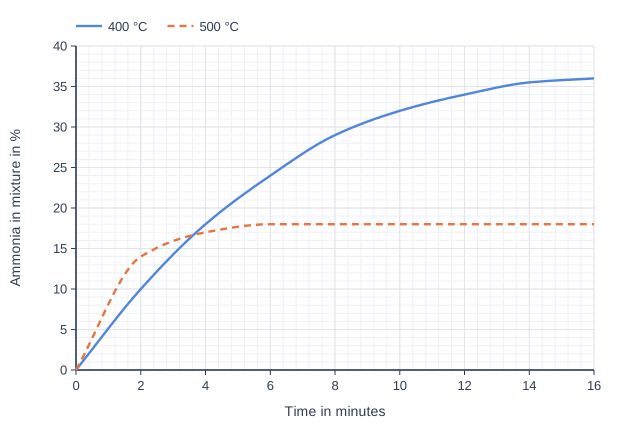
The graph shows how the percentage of ammonia in the reaction mixture changes with time at 400 °C and at 500 °C. The pressure is 200 atmospheres in both experiments.
Explain the differences between the two curves.
Model answer
At 500 °C the curve levels off after about 6 minutes, much sooner than at 400 °C, because the rate of reaction is higher at a higher temperature, so equilibrium is reached faster. However, at 400 °C the percentage of ammonia at equilibrium is higher (about 36% compared with 18%), because the forward reaction is exothermic, so a lower temperature shifts the position of equilibrium to the right.
Explanation
The steepness of the curve at the start shows the rate; the level the curve reaches shows the position of equilibrium. This graph shows the trade-off between rate and yield that decides the temperature used in industry.
Mark scheme
1 mark
at 500 °C the curve levels off sooner / equilibrium is reached faster
1 mark
because the rate of reaction is higher at a higher temperature
1 mark
at 400 °C the percentage of ammonia at equilibrium is higher (36% compared with 18%)
1 mark
because the forward reaction is exothermic, so a lower temperature shifts the equilibrium to the right
Ready to try the rest? Every answer you write is marked against the mark scheme, so you can see exactly where the marks are.
Ctrl + Enter to check
AI TutorHints first, answers after you try
Hi! Stuck? Ask me for a hint and I’ll help you work it out. Once you’ve checked your answer I can explain exactly where the marks are.