
Level:
Correct: 0
Incorrect: 0
Marks: 0/0
Exam Practice
Subject:
Topics:
AQA GCSE Chemistry Smart practice A mixed round aimed at your weak spots
Unit 1
Atomic structure and the periodic table
Unit 2
Bonding, structure, and the properties of matter
Unit 3
Quantitative chemistry
Unit 4
Chemical changes
Unit 5
Energy changes
Unit 6
The rate and extent of chemical change
Unit 7
Organic chemistry
Unit 8
Chemical analysis
Unit 9
Chemistry of the atmosphere
Unit 10
Using resources
Avg
score:
–
Topics
done:
0/124

Mixtures

Practise 23 exam-style questions on Mixtures for AQA GCSE Chemistry. Write your answer as you would in the exam and get it marked in seconds against the mark scheme, point by point, with an AI tutor on hand if you get stuck.

  • 23 questions
  • 1–6 marks each
  • Instant marking
  • No sign-up needed
20 questions, marked as you go

Sample questions with model answers

Here are 4 of the questions in this topic, each with a model answer, an explanation of why it earns the marks and the mark scheme an examiner would use.

Question 1

2 marks

Air is a mixture of gases, mainly nitrogen and oxygen. Magnesium burns in air to form magnesium oxide, just as it does in pure oxygen, although more slowly.

Explain why the oxygen in air has the same chemical properties as pure oxygen.

Model answer

Air is a mixture, so the oxygen is not chemically combined with the nitrogen or other gases. The oxygen molecules in air are exactly the same as those in pure oxygen, so they react in the same way.

Explanation

In a mixture each substance keeps its own chemical properties because no bonds form between the different substances. The reaction is slower in air only because the oxygen is more spread out (it is about 21% of air), not because it has changed.

Mark scheme
  1. 1 mark

    the oxygen is not chemically combined with the other gases in air / air is a mixture

  2. 1 mark

    so the oxygen molecules are unchanged / are the same as in pure oxygen

    allow the chemical properties of each substance in a mixture are unchanged
Question 2

2 marks

A student uses simple distillation, heated by a Bunsen burner, to obtain water from ink.

Give two precautions the student should take to carry out the distillation safely.

Model answer

Add anti-bumping granules to the flask so that the ink boils smoothly, and do not heat the flask until it is dry. The student should also wear eye protection.

Explanation

Liquids heated in a flask can boil violently ('bump'), so anti-bumping granules are used. Heating to dryness can crack the flask, and a sealed apparatus could build up pressure. Precautions must be specific - 'be careful' does not score.

Mark scheme
  1. 1 mark

    add anti-bumping granules (so the liquid boils smoothly)

    max 2

  2. 1 mark

    do not heat the flask until it is dry

  3. 1 mark

    wear eye protection / safety goggles

  4. 1 mark

    make sure the apparatus is not sealed / the end of the condenser is open (so pressure cannot build up)

  5. 1 mark

    turn on the cold water to the condenser before heating

  6. 1 mark

    clamp the flask securely

    ignore 'be careful' or 'take care with the Bunsen'

Question 3

3 marks

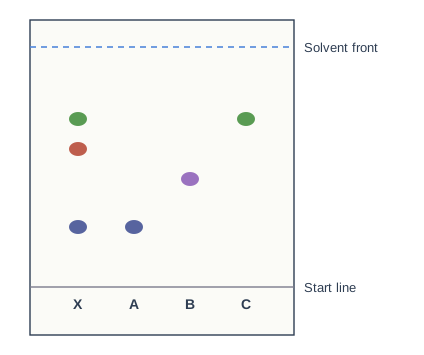
A food colouring X was compared with three known dyes, A, B and C, using paper chromatography. The chromatogram shows the results.

What can you conclude about the dyes in food colouring X? Give reasons for your answers.

Paper chromatogram. The solvent front is 8 cm above the start line. X: 3 spots at 2 cm, 4.6 cm, 5.6 cm; A: one spot at 2 cm; B: one spot at 3.6 cm; C: one spot at 5.6 cm.

Model answer

X contains dyes A and C, because two of its spots have moved the same distance up the paper as A and C. X has three spots, so it contains at least three dyes; the middle spot does not match A, B or C, so X also contains a dye that is not one of the known dyes. X does not contain B.

Explanation

In the same solvent, the same dye always travels the same distance, so matching spot heights identify dyes. The number of spots shows the minimum number of dyes. A spot that matches none of the references must be a different substance.

Mark scheme
  1. 1 mark

    X contains A and C

    both needed; do not accept if B is included

  2. 1 mark

    (because) two of the spots in X are at the same heights / travelled the same distances as A and C

    allow same Rf values as A and C

  3. 1 mark

    X also contains another dye that is not A, B or C, because one spot does not match any of the known dyes

    allow X contains (at least) three dyes and one is unknown

Question 4

4 marks

A student has a mixture of ethanol, water and sand. Ethanol and water mix completely. Ethanol boils at 78 °C and water boils at 100 °C.

Suggest how the student could obtain ethanol from this mixture. Explain your answer.

Model answer

First filter the mixture. The sand is insoluble, so it stays on the filter paper while the ethanol and water pass through. Then use fractional distillation on the filtrate. Ethanol has the lower boiling point, so it evaporates and reaches the top of the fractionating column first and is collected at 78 °C.

Explanation

Separate in stages: remove the insoluble solid by filtration first, then separate the two miscible liquids using their different boiling points. Fractional distillation is better than simple distillation here because the boiling points are fairly close.

Mark scheme
  1. 1 mark

    filter the mixture (to remove the sand)

  2. 1 mark

    the sand is insoluble / its particles cannot pass through the filter paper

  3. 1 mark

    use fractional distillation on the filtrate / liquid

    allow distillation for this mark

  4. 1 mark

    ethanol has the lower boiling point so it distils / is collected first (at 78 °C)

Ready to try the rest? Every answer you write is marked against the mark scheme, so you can see exactly where the marks are.

AI Tutor Hints first, answers after you try

Hi! Stuck? Ask me for a hint and I’ll help you work it out. Once you’ve checked your answer I can explain exactly where the marks are.