
Level:
Correct: 0
Incorrect: 0
Marks: 0/0
Exam Practice
Subject:
Topics:
AQA GCSE Chemistry Smart practice A mixed round aimed at your weak spots
Unit 1
Atomic structure and the periodic table
Unit 2
Bonding, structure, and the properties of matter
Unit 3
Quantitative chemistry
Unit 4
Chemical changes
Unit 5
Energy changes
Unit 6
The rate and extent of chemical change
Unit 7
Organic chemistry
Unit 8
Chemical analysis
Unit 9
Chemistry of the atmosphere
Unit 10
Using resources
Avg
score:
–
Topics
done:
0/124

Graphene and fullerenes

Practise 27 exam-style questions on Graphene and fullerenes for AQA GCSE Chemistry. Write your answer as you would in the exam and get it marked in seconds against the mark scheme, point by point, with an AI tutor on hand if you get stuck.

  • 27 questions
  • 1–6 marks each
  • Instant marking
  • No sign-up needed
20 questions, marked as you go

Sample questions with model answers

Here are 4 of the questions in this topic, each with a model answer, an explanation of why it earns the marks and the mark scheme an examiner would use.

Question 1

2 marks

Graphene is being developed for flexible touchscreens on mobile phones.

Suggest two properties of graphene that make it suitable for this use.

Model answer

Graphene conducts electricity, and it is very thin and strong, so it can bend without breaking.

Explanation

Graphene's delocalised electrons let it conduct, and its strong covalent bonds make it strong even though it is only one atom thick. These properties make it useful in electronics.

Mark scheme
  1. 1 mark

    conducts electricity

    max 2

  2. 1 mark

    very thin / one atom thick

  3. 1 mark

    very strong

    allow does not break / tear easily

  4. 1 mark

    flexible

  5. 1 mark

    transparent / lets light through
Question 2

2 marks

A flat sheet made only of hexagonal rings of carbon atoms cannot curve into a closed shape. Buckminsterfullerene (C₆₀) contains 20 hexagonal rings and 12 rings of five carbon atoms.

Suggest why the rings of five carbon atoms are needed in C₆₀.

Model answer

The rings of five carbon atoms make the sheet of carbon atoms curve. Without them, a sheet of hexagons would stay flat like graphene, but with them it can close up into a hollow sphere.

Explanation

This is why the specification says fullerenes may contain rings of five or seven carbon atoms as well as hexagons. A football uses the same idea: pentagons among hexagons make it round.

Mark scheme
  1. 1 mark

    the five-membered rings make the sheet curve / bend

  2. 1 mark

    so it can close up into a hollow sphere

    allow a hexagons-only sheet stays flat, like graphene

Question 3

3 marks

Scientists are developing fullerenes to deliver drugs to specific places in the body.

Suggest how the structure of fullerenes makes them suitable for this use.

Model answer

Fullerenes are hollow cages of carbon atoms, so drug molecules can be trapped inside them. Because fullerene molecules are extremely small, they can travel through the body and into cells, carrying the drug to where it is needed.

Explanation

Drug delivery is one of the uses of fullerenes named in the specification. The hollow shape is the key structural feature, together with their tiny size.

Mark scheme
  1. 1 mark

    fullerenes have hollow shapes / are hollow cages

  2. 1 mark

    drug molecules can be placed / trapped inside the cage

    allow drug molecules can be attached to the outside

  3. 1 mark

    the molecules are very small, so they can move through the body / enter cells

    allow they are nanoparticles

Question 4

4 marks

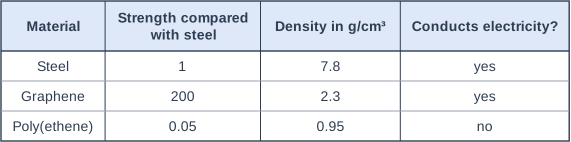
The table shows some properties of steel, graphene and poly(ethene).

A company adds a small amount of graphene to poly(ethene) to make a composite material for car parts. Use the data to suggest the advantages of adding graphene to poly(ethene), and why the composite could be better than steel for car parts.

Table with columns "Material", "Strength compared with steel", "Density in g/cm³", "Conducts electricity?". Material: Steel; Strength compared with steel: 1; Density in g/cm³: 7.8; Conducts electricity?: yes | Material: Graphene; Strength compared with steel: 200; Density in g/cm³: 2.3; Conducts electricity?: yes | Material: Poly(ethene); Strength compared with steel: 0.05; Density in g/cm³: 0.95; Conducts electricity?: no.

Model answer

Graphene is about 4000 times stronger than poly(ethene) (200 compared with 0.05), so adding it makes the composite much stronger than poly(ethene) alone. Graphene's density (2.3 g/cm³) is low and only a small amount is needed, so it adds little mass. The composite would be mostly poly(ethene), with a density far below steel's 7.8 g/cm³, so car parts would be much lighter and the car would use less fuel. Graphene also conducts electricity, which could stop static charge building up on the parts.

Explanation

Composites combine the useful properties of their components. Here graphene provides strength and conductivity, while poly(ethene) keeps the material light. Always quote data to back up suggestions in an evaluation question.

Mark scheme
  1. 1 mark

    graphene is much stronger than poly(ethene), so the composite is stronger than poly(ethene) alone

    max 4; allow use of data (200 compared with 0.05)

  2. 1 mark

    graphene has a low density / only a small amount is needed, so it adds little mass

  3. 1 mark

    graphene conducts electricity, so the composite may conduct (e.g. to stop static building up)

  4. 1 mark

    the composite has a much lower density than steel, so the car parts are lighter

    allow use of data (0.95 and 2.3 compared with 7.8)

  5. 1 mark

    lighter parts mean the car uses less fuel

Ready to try the rest? Every answer you write is marked against the mark scheme, so you can see exactly where the marks are.

AI Tutor Hints first, answers after you try

Hi! Stuck? Ask me for a hint and I’ll help you work it out. Once you’ve checked your answer I can explain exactly where the marks are.