Practise 14 exam-style questions on Metals as conductors for AQA GCSE Chemistry. Write your answer as you would in the exam and get it marked in seconds against the mark scheme, point by point, with an AI tutor on hand if you get stuck.
14 questions
1–5 marks each
Instant marking
No sign-up needed
14 questions, marked as you go
Sample questions with model answers
Here are 4 of the questions in this topic, each with a model answer, an explanation of why it earns the marks and the mark scheme an examiner would use.
Question 1
1 mark
Which one of these statements best explains why metals are good conductors of thermal energy? A Metal atoms are packed closely together. B Delocalised electrons transfer energy through the metal. C Metals have high melting points. D Metal ions are positively charged.
Model answer
B: delocalised electrons transfer energy through the metal.
Explanation
The delocalised electrons that make metals good electrical conductors also make them good thermal conductors, because they can move through the structure and carry energy with them.
Mark scheme
1 mark
B
do not accept more than one letter
Question 2
2 marks
Mercury is a metal that is a liquid at room temperature. Liquid mercury was used in some electrical switches.
Explain why liquid mercury conducts electricity.
Model answer
Mercury is a metal, so even when it is liquid it still contains delocalised electrons. These electrons can move through the liquid and carry charge, so it conducts electricity.
Explanation
Metals conduct because of delocalised electrons, and these are present whether the metal is solid or liquid. This is different from ionic compounds, which only conduct once they are melted or dissolved.
Mark scheme
1 mark
liquid mercury still has delocalised electrons
allow metallic bonding with delocalised electrons in the liquid
1 mark
which move through the liquid and carry charge
do not accept ions carry the charge
Question 3
3 marks
Saucepans have a metal base and a handle made of plastic.
Explain why metal is a good material for the base of the saucepan and why the handle is made of plastic.
Model answer
Metals contain delocalised electrons that move through the metal and transfer thermal energy quickly from the hot hob to the food. Plastic has no delocalised electrons, so it is a poor conductor of thermal energy; the handle stays cool enough to hold safely.
Explanation
Good thermal conduction is wanted where energy must reach the food quickly, and poor conduction where a person holds the pan. Delocalised electrons are the reason metals are good thermal conductors.
Mark scheme
1 mark
metals have delocalised electrons
1 mark
which transfer thermal energy quickly from the hob to the food
allow metal is a good thermal conductor if linked to delocalised electrons
1 mark
plastic has no delocalised electrons, so it is a poor thermal conductor and the handle stays cool enough to hold
allow plastic is an insulator so it does not burn your hand
Question 4
4 marks
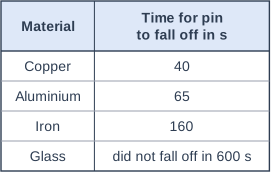
A student fixed a drawing pin to one end of each of four rods using petroleum jelly. The other end of each rod was heated in the same Bunsen flame. The student timed how long it took for each pin to fall off. The table shows the results.
Which material is the best conductor of thermal energy? Explain why the metals conduct thermal energy better than glass. Give one variable the student should control.
Model answer
Copper is the best conductor, because its pin fell off in the shortest time (40 s). Metals contain delocalised electrons that move through the rod and transfer energy quickly from the hot end to the pin. Glass has no delocalised electrons, so energy is transferred very slowly and the pin did not fall off. The student should use rods of the same length and thickness.
Explanation
A shorter time means energy reached the pin faster, so the material is a better conductor. For a fair comparison, everything except the material of the rod should be kept the same.
Mark scheme
1 mark
copper
allow shortest time
1 mark
metals contain delocalised electrons
1 mark
which transfer energy quickly along the rod / glass has no delocalised electrons
1 mark
control variable: length / thickness of the rods, or distance of pin from the flame, or amount of petroleum jelly
any one; do not accept 'same flame' as it is already stated
Ready to try the rest? Every answer you write is marked against the mark scheme, so you can see exactly where the marks are.
Ctrl + Enter to check
AI TutorHints first, answers after you try
Hi! Stuck? Ask me for a hint and I’ll help you work it out. Once you’ve checked your answer I can explain exactly where the marks are.