Practise 23 exam-style questions on Addition polymerisation (chemistry only) for AQA GCSE Chemistry. Write your answer as you would in the exam and get it marked in seconds against the mark scheme, point by point, with an AI tutor on hand if you get stuck.
23 questions
1–6 marks each
Instant marking
No sign-up needed
20 questions, marked as you go
Sample questions with model answers
Here are 4 of the questions in this topic, each with a model answer, an explanation of why it earns the marks and the mark scheme an examiner would use.
Question 1
2 marks
Describe what happens in an addition polymerisation reaction.
Model answer
Many small molecules called monomers, each containing a C=C double bond, join together to form one very large molecule called a polymer. No other product is formed.
Explanation
In addition polymerisation thousands of monomer molecules add on to each other, end to end, as their double bonds open. The key ideas are many small molecules becoming one very large molecule, with nothing else produced.
Mark scheme
1 mark
many small molecules (monomers) join together
max 2
1 mark
to form a very large molecule / long chain (a polymer)
1 mark
the monomers contain C=C double bonds which open up / no other product is formed
Question 2
2 marks
A molecule of poly(propene) is made from 1500 propene molecules. Propene is C₃H₆.
Calculate the relative formula mass (Mr) of this poly(propene) molecule. Relative atomic masses (Ar): H = 1, C = 12
Because no atoms are lost in addition polymerisation, each repeating unit has the same Mr as the monomer. The Mr of the polymer is therefore the Mr of the monomer multiplied by the number of monomers.
Mark scheme
1 mark
Mr of propene = 42
1 mark
42 × 1500 = 63 000
allow ecf from an incorrect Mr; correct answer with no working scores 2 marks
Question 3
3 marks
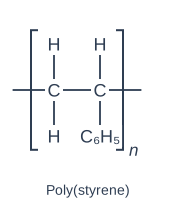
The diagram shows the repeating unit of poly(styrene). In the diagram, C₆H₅ is a group of atoms attached to one of the carbon atoms.
Write the structural formula of the monomer, styrene. Explain how you worked it out from the repeating unit.
Model answer
Styrene is CH₂=CHC₆H₅. To get the monomer, the single bond between the two carbon atoms in the repeating unit is changed to a C=C double bond and the two bonds that extend out through the brackets are removed. The hydrogen atoms and the C₆H₅ group stay attached to the same carbon atoms.
Explanation
The repeating unit and the monomer contain exactly the same atoms. The only differences are the double bond in the monomer and the linking bonds in the polymer. This method works for any addition polymer.
Mark scheme
1 mark
CH₂=CHC₆H₅
allow C₆H₅CH=CH₂
1 mark
the single bond between the two carbon atoms of the repeating unit becomes a C=C double bond
1 mark
the bonds extending out of the brackets are removed / the other atoms stay attached to the same carbon atoms
allow 'the monomer has the same atoms as the repeating unit'
Question 4
4 marks
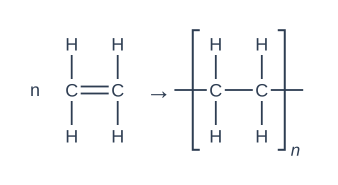
The diagram shows the formation of poly(ethene) from ethene.
Explain what n represents and why this reaction is described as addition polymerisation.
Model answer
n represents a very large number - the number of ethene molecules that join together, which is also the number of repeating units in the polymer chain. Ethene contains a C=C double bond. During the reaction the double bonds open and the ethene molecules add on to each other to form a very long chain. It is addition polymerisation because the monomers simply add together and no other product is formed.
Explanation
The same n appears on both sides because each monomer becomes one repeating unit. 'Addition' means the molecules join without losing any atoms; this is what distinguishes addition polymerisation from condensation polymerisation, where a small molecule such as water is also produced.
Mark scheme
1 mark
n is a (very) large number (of monomer molecules / repeating units)
allow 'thousands'
1 mark
the monomer (ethene) contains a C=C double bond
1 mark
the double bonds open and the monomers join together to form a long chain
allow 'monomers add on to each other'
1 mark
no other product is formed / the polymer is the only product
Ready to try the rest? Every answer you write is marked against the mark scheme, so you can see exactly where the marks are.
Ctrl + Enter to check
AI TutorHints first, answers after you try
Hi! Stuck? Ask me for a hint and I’ll help you work it out. Once you’ve checked your answer I can explain exactly where the marks are.