Practise 21 exam-style questions on Using electrolysis to extract metals for AQA GCSE Chemistry. Write your answer as you would in the exam and get it marked in seconds against the mark scheme, point by point, with an AI tutor on hand if you get stuck.
21 questions
1–6 marks each
Instant marking
No sign-up needed
20 questions, marked as you go
Sample questions with model answers
Here are 4 of the questions in this topic, each with a model answer, an explanation of why it earns the marks and the mark scheme an examiner would use.
Question 1
2 marks
In the manufacture of aluminium, aluminium oxide is mixed with cryolite before it is electrolysed.
Explain why.
Model answer
Aluminium oxide has a very high melting point. Mixing it with cryolite gives a mixture with a much lower melting point, so less energy is needed to melt the electrolyte and keep it molten, which reduces costs.
Explanation
The electrolyte must be molten so that the ions can move. Using a mixture that melts at around 950 °C instead of over 2000 °C saves a large amount of energy.
Mark scheme
1 mark
the mixture has a lower melting point than pure aluminium oxide
allow cryolite lowers the melting point; do not accept lowers the boiling point
1 mark
so less energy is needed (to melt it) / reduces energy costs
allow cheaper
Question 2
2 marks
Explain why aluminium cannot be produced by electrolysing a solution of an aluminium compound in water.
Model answer
In an aqueous solution, hydrogen ions from the water are discharged at the cathode instead of aluminium ions, because aluminium is more reactive than hydrogen. So hydrogen gas is produced rather than aluminium, and the aluminium compound must be electrolysed molten.
Explanation
In aqueous electrolysis, the less reactive of the metal and hydrogen is produced at the cathode. Reactive metals such as aluminium and sodium can only be obtained by electrolysing their molten compounds.
Mark scheme
1 mark
hydrogen would be produced at the cathode instead of aluminium
1 mark
because aluminium is more reactive than hydrogen
allow hydrogen ions from the water are discharged instead of aluminium ions
Question 3
3 marks
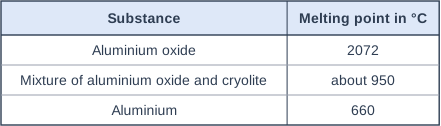
The table shows some melting points. The cell used to extract aluminium operates at about 950 °C.
Explain why a mixture of aluminium oxide and cryolite is electrolysed rather than pure aluminium oxide, and why the aluminium is produced as a liquid.
Model answer
Pure aluminium oxide would have to be heated to over 2072 °C to melt it, which would need a huge amount of energy. The mixture with cryolite is molten at about 950 °C, so much less energy is needed and costs are lower. The cell temperature of 950 °C is above the melting point of aluminium, 660 °C, so the aluminium is formed as a liquid.
Explanation
Comparing temperatures with melting points tells you the state of each substance. Lowering the operating temperature by more than 1000 °C is a very large energy saving.
Mark scheme
1 mark
pure aluminium oxide would need to be heated above 2072 °C (to melt it)
allow a much higher temperature
1 mark
the mixture is molten at about 950 °C, so much less energy is needed / costs are lower
1 mark
950 °C is above the melting point of aluminium (660 °C), so the aluminium is molten
Question 4
4 marks
In the electrolysis of molten aluminium oxide, aluminium oxide is reduced to aluminium.
Explain why the formation of aluminium is a reduction, in terms of oxygen and in terms of electrons. Identify the ions that are oxidised and explain why.
Model answer
Aluminium oxide loses oxygen when it forms aluminium, which is reduction. In terms of electrons, the Al³⁺ ions gain electrons at the cathode (Al³⁺ + 3e⁻ → Al), and gain of electrons is reduction. The oxide ions, O²⁻, are oxidised, because they lose electrons at the anode to form oxygen.
Explanation
Reduction can be defined as loss of oxygen or as gain of electrons; both apply here. Oxidation and reduction always happen together, so while aluminium ions are reduced, oxide ions are oxidised.
Mark scheme
1 mark
aluminium oxide loses oxygen (to form aluminium)
1 mark
aluminium ions gain electrons
allow Al³⁺ + 3e⁻ → Al
1 mark
oxide ions (O²⁻) are oxidised
1 mark
because they lose electrons
allow 2O²⁻ → O₂ + 4e⁻
Ready to try the rest? Every answer you write is marked against the mark scheme, so you can see exactly where the marks are.
Ctrl + Enter to check
AI TutorHints first, answers after you try
Hi! Stuck? Ask me for a hint and I’ll help you work it out. Once you’ve checked your answer I can explain exactly where the marks are.