
Level:
Correct: 0
Incorrect: 0
Marks: 0/0
Exam Practice
Subject:
Topics:
AQA GCSE Chemistry Smart practice A mixed round aimed at your weak spots
Unit 1
Atomic structure and the periodic table
Unit 2
Bonding, structure, and the properties of matter
Unit 3
Quantitative chemistry
Unit 4
Chemical changes
Unit 5
Energy changes
Unit 6
The rate and extent of chemical change
Unit 7
Organic chemistry
Unit 8
Chemical analysis
Unit 9
Chemistry of the atmosphere
Unit 10
Using resources
Avg
score:
–
Topics
done:
0/124

Neutralisation of acids and salt production

Practise 22 exam-style questions on Neutralisation of acids and salt production for AQA GCSE Chemistry. Write your answer as you would in the exam and get it marked in seconds against the mark scheme, point by point, with an AI tutor on hand if you get stuck.

  • 22 questions
  • 1–6 marks each
  • Instant marking
  • No sign-up needed
20 questions, marked as you go

Sample questions with model answers

Here are 4 of the questions in this topic, each with a model answer, an explanation of why it earns the marks and the mark scheme an examiner would use.

Question 1

1 mark

Name the salt formed when dilute hydrochloric acid reacts with calcium hydroxide.

Model answer

Calcium chloride.

Explanation

Hydrochloric acid produces chlorides, and the positive ion (calcium) comes from the calcium hydroxide. The other product is water.

Mark scheme
  1. 1 mark

    calcium chloride

    allow CaCl₂; do not accept calcium chlorate
Question 2

2 marks

A metal carbonate reacts with an acid and gives off a gas.

Describe a test to show that the gas is carbon dioxide. Give the result.

Model answer

Bubble the gas through limewater. If the gas is carbon dioxide, the limewater turns milky.

Explanation

Carbon dioxide reacts with limewater (calcium hydroxide solution) to form insoluble calcium carbonate, which makes the limewater cloudy. A burning splint being put out is not a reliable test, because other gases can do that too.

Mark scheme
  1. 1 mark

    bubble the gas through limewater

    allow shake the gas with limewater; allow calcium hydroxide solution

  2. 1 mark

    the limewater turns milky / cloudy

    allow white precipitate

Question 3

3 marks

Sodium carbonate powder reacts with dilute hydrochloric acid to produce sodium chloride solution, water and carbon dioxide gas.

Write a balanced symbol equation for this reaction. Include state symbols.

Model answer

Na₂CO₃(s) + 2HCl(aq) → 2NaCl(aq) + H₂O(l) + CO₂(g)

Explanation

Sodium carbonate contains two Na⁺ ions, so two NaCl form and two HCl are needed. The question says sodium carbonate is a powder, so it is (s), the salt is in solution (aq), water is (l) and carbon dioxide is (g).

Mark scheme
  1. 1 mark

    correct formulae: Na₂CO₃ + HCl → NaCl + H₂O + CO₂

  2. 1 mark

    balanced: Na₂CO₃ + 2HCl → 2NaCl + H₂O + CO₂

    allow multiples

  3. 1 mark

    state symbols: Na₂CO₃(s), HCl(aq), NaCl(aq), H₂O(l), CO₂(g)

    allow state symbols mark on an equation with correct formulae even if not balanced

Question 4

4 marks

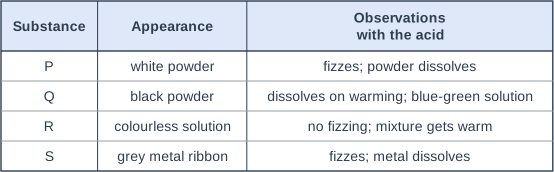
A student added four different substances, P, Q, R and S, to separate samples of dilute hydrochloric acid. The table shows the observations.

Identify which substance is a metal carbonate and which is an alkali. Name the gas produced by P and the gas produced by S.

Table with columns "Substance", "Appearance", "Observations with the acid". Substance: P; Appearance: white powder; Observations with the acid: fizzes; powder dissolves | Substance: Q; Appearance: black powder; Observations with the acid: dissolves on warming; blue-green solution | Substance: R; Appearance: colourless solution; Observations with the acid: no fizzing; mixture gets warm | Substance: S; Appearance: grey metal ribbon; Observations with the acid: fizzes; metal dissolves.

Model answer

P is the metal carbonate and R is the alkali. P produces carbon dioxide and S produces hydrogen.

Explanation

Carbonates fizz with acids because they give off carbon dioxide; metals such as magnesium also fizz, but they give off hydrogen. An alkali is a solution that neutralises the acid without fizzing, but the temperature rises. Q is a metal oxide (copper(II) oxide), which dissolves to form a coloured salt solution.

Mark scheme
  1. 1 mark

    P is the metal carbonate

  2. 1 mark

    R is the alkali

  3. 1 mark

    gas from P is carbon dioxide

    allow CO₂

  4. 1 mark

    gas from S is hydrogen

    allow H₂

Ready to try the rest? Every answer you write is marked against the mark scheme, so you can see exactly where the marks are.

AI Tutor Hints first, answers after you try

Hi! Stuck? Ask me for a hint and I’ll help you work it out. Once you’ve checked your answer I can explain exactly where the marks are.