
Level:
Correct: 0
Incorrect: 0
Marks: 0/0
Exam Practice
Subject:
Topics:
AQA GCSE Chemistry Smart practice A mixed round aimed at your weak spots
Unit 1
Atomic structure and the periodic table
Unit 2
Bonding, structure, and the properties of matter
Unit 3
Quantitative chemistry
Unit 4
Chemical changes
Unit 5
Energy changes
Unit 6
The rate and extent of chemical change
Unit 7
Organic chemistry
Unit 8
Chemical analysis
Unit 9
Chemistry of the atmosphere
Unit 10
Using resources
Avg
score:
–
Topics
done:
0/124

Properties of metals and alloys

Practise 19 exam-style questions on Properties of metals and alloys for AQA GCSE Chemistry. Write your answer as you would in the exam and get it marked in seconds against the mark scheme, point by point, with an AI tutor on hand if you get stuck.

  • 19 questions
  • 1–6 marks each
  • Instant marking
  • No sign-up needed
19 questions, marked as you go

Sample questions with model answers

Here are 4 of the questions in this topic, each with a model answer, an explanation of why it earns the marks and the mark scheme an examiner would use.

Question 1

2 marks

Pure metals are often mixed with other metals to make alloys.

Give the reason this is done and state how the properties of the alloy differ from those of the pure metal.

Model answer

Pure metals are too soft for many uses. Alloys are harder than the pure metals they are made from, so they keep their shape better.

Explanation

In a pure metal the layers of atoms slide over each other easily, making the metal soft. Adding atoms of a different size makes the alloy harder.

Mark scheme
  1. 1 mark

    pure metals are too soft for many uses

    allow pure metals bend / change shape too easily

  2. 1 mark

    alloys are harder (than the pure metal)

    allow stronger / less easily bent
Question 2

3 marks

Explain why alloys are harder than pure metals.

Model answer

In an alloy, the atoms of the added element are a different size from the atoms of the main metal. This distorts the layers of atoms, so it is more difficult for the layers to slide over each other. This makes the alloy harder.

Explanation

The key word is distortion: atoms of a different size break up the neat layers. Students often say the layers 'cannot move'; they can, but much less easily than in a pure metal.

Mark scheme
  1. 1 mark

    the atoms of the other element(s) are a different size

    allow different sized atoms

  2. 1 mark

    this distorts the layers / disrupts the regular arrangement of atoms

  3. 1 mark

    so it is more difficult for the layers to slide over each other

    do not accept 'the layers cannot move at all'; do not accept 'stronger bonds' as the only reason

Question 3

3 marks

Sodium melts at 98 °C and magnesium melts at 650 °C.
In sodium, each atom gives one electron to the sea of delocalised electrons, forming Na⁺ ions.
In magnesium, each atom gives two electrons to the sea of delocalised electrons, forming Mg²⁺ ions.

Suggest why magnesium has a much higher melting point than sodium.

Model answer

Magnesium ions have a 2+ charge, compared with 1+ for sodium ions, and magnesium has twice as many delocalised electrons per atom. This means the electrostatic attraction between the positive ions and the delocalised electrons is stronger in magnesium, so more energy is needed to overcome the metallic bonding and the melting point is higher.

Explanation

The strength of metallic bonding depends on the attraction between the positive ions and the delocalised electrons. More charge on the ions and more delocalised electrons give a stronger attraction.

Mark scheme
  1. 1 mark

    magnesium ions have a larger charge (2+ compared with 1+)

    max 3

  2. 1 mark

    magnesium has more delocalised electrons (per atom)

  3. 1 mark

    so there is stronger electrostatic attraction between the ions and the delocalised electrons / stronger metallic bonding

  4. 1 mark

    so more energy is needed to overcome the metallic bonding

Question 4

4 marks

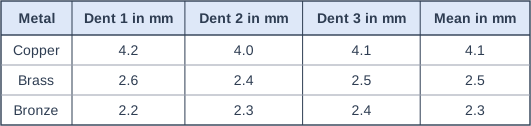
A student tested the hardness of three metals. The student dropped a steel ball onto a sheet of each metal and measured the diameter of the dent made. The table shows the results.

Which metal is the hardest? Explain how the results show this. Give two variables the student should control.

Table with columns "Metal", "Dent 1 in mm", "Dent 2 in mm", "Dent 3 in mm", "Mean in mm". Metal: Copper; Dent 1 in mm: 4.2; Dent 2 in mm: 4.0; Dent 3 in mm: 4.1; Mean in mm: 4.1 | Metal: Brass; Dent 1 in mm: 2.6; Dent 2 in mm: 2.4; Dent 3 in mm: 2.5; Mean in mm: 2.5 | Metal: Bronze; Dent 1 in mm: 2.2; Dent 2 in mm: 2.3; Dent 3 in mm: 2.4; Mean in mm: 2.3.

Model answer

Bronze is the hardest, because it has the smallest mean dent diameter (2.3 mm): a harder metal is dented less by the same impact. The student should drop the same steel ball each time and drop it from the same height.

Explanation

A smaller dent means the metal resisted changing shape more, so it is harder. For a fair test, the impact must be the same each time, so the ball's mass and drop height must be controlled. Both alloys are harder than pure copper.

Mark scheme
  1. 1 mark

    bronze

  2. 1 mark

    it has the smallest (mean) dent diameter

    allow harder metals are dented less

  3. 1 mark

    same mass / size of steel ball

    max 2 marks for control variables

  4. 1 mark

    same height of drop

  5. 1 mark

    same thickness of metal sheet

    allow same surface underneath the sheet

Ready to try the rest? Every answer you write is marked against the mark scheme, so you can see exactly where the marks are.

AI Tutor Hints first, answers after you try

Hi! Stuck? Ask me for a hint and I’ll help you work it out. Once you’ve checked your answer I can explain exactly where the marks are.