
Level:
Correct: 0
Incorrect: 0
Marks: 0/0
Exam Practice
Subject:
Topics:
AQA GCSE Physics Smart practice A mixed round aimed at your weak spots
Unit 1
Energy
Energy changes in a system, and the ways energy is stored before and after such changes
Energy stores and systems
0%
Changes in energy
0%
Energy changes in systems
0%
Power
0%
Conservation and dissipation of energy
Energy transfers in a system
0%
Efficiency
0%
Unit 2
Electricity
Unit 3
Particle model of matter
Unit 4
Atomic structure
Unit 5
Forces
Unit 6
Waves
Unit 7
Magnetism and electromagnetism
Unit 8
Space physics (physics only)
Avg
score:
–
Topics
done:
0/91

Work done and energy transfer

Practise 31 exam-style questions on Work done and energy transfer for AQA GCSE Physics. Write your answer as you would in the exam and get it marked in seconds against the mark scheme, point by point, with an AI tutor on hand if you get stuck.

  • 31 questions
  • 1–6 marks each
  • Instant marking
  • No sign-up needed
20 questions, marked as you go

Sample questions with model answers

Here are 4 of the questions in this topic, each with a model answer, an explanation of why it earns the marks and the mark scheme an examiner would use.

Question 1

2 marks

State what is meant by one joule of work.

Model answer

One joule of work is done when a force of one newton causes a displacement of one metre in the direction of the force.

Explanation

This comes straight from W = F s: 1 J = 1 N × 1 m. Lifting an apple (weight about 1 N) through 1 m needs about 1 J of work.

Mark scheme
  1. 1 mark

    the work done when a force of 1 newton

  2. 1 mark

    causes a displacement of 1 metre (in the direction of the force)

    allow moves an object 1 m along the line of action of the force
Question 2

2 marks

Use the equation for work done to show that 1 joule is equal to 1 newton-metre.

Model answer

Work done = force × distance. Force is measured in newtons and distance in metres, so the unit of work done is N × m = N m. Since work done is measured in joules, 1 J = 1 N m.

Explanation

The units on both sides of an equation must match. This is why a force of 1 N moving an object 1 m does exactly 1 J of work, and why newton-metres and joules can be converted one-for-one.

Mark scheme
  1. 1 mark

    work done = force × distance / W = F s

  2. 1 mark

    unit of force (N) × unit of distance (m) = N m, so 1 J = 1 N × 1 m = 1 N m

Question 3

3 marks

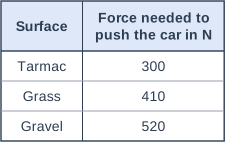
Some students push a car 20 m along three different surfaces at a steady speed. The table shows the force needed on each surface.

Calculate the work done in pushing the car over the gravel.
Explain why more work is done on gravel than on tarmac.

Table with columns "Surface", "Force needed to push the car in N". Surface: Tarmac; Force needed to push the car in N: 300 | Surface: Grass; Force needed to push the car in N: 410 | Surface: Gravel; Force needed to push the car in N: 520.

Model answer

W = F s = 520 N × 20 m = 10 400 J
The distance is the same on both surfaces, but the resistive (friction) forces are bigger on gravel, so a bigger force of 520 N is needed instead of 300 N. More force over the same distance means more work done.

Explanation

At a steady speed the pushing force equals the resistive forces, so a surface with more friction needs a bigger push. Since work done = force × distance, a bigger force over the same distance means more energy is transferred, mostly to thermal energy stores.

Mark scheme
  1. 1 mark

    W = 520 × 20

    an answer of 10 400 (J) scores 2 marks

  2. 1 mark

    W = 10 400 J

    allow 10.4 kJ

  3. 1 mark

    a bigger force is needed on gravel (because there is more friction / resistance) for the same distance

Question 4

5 marks

A car of mass 1200 kg is travelling at 15 m/s. The driver brakes, and a constant braking force of 6000 N stops the car.

Assume that all of the car's kinetic energy is transferred by the work done by the braking force.

Calculate the braking distance of the car.

Model answer

Eₖ = ½ m v² = 0.5 × 1200 kg × (15 m/s)² = 0.5 × 1200 × 225 = 135 000 J
Work done by brakes = kinetic energy = 135 000 J
W = F s
135 000 J = 6000 N × s
s = 135 000 ÷ 6000 = 22.5 m

Explanation

This links two recall equations: the kinetic energy equation gives the energy the brakes must remove, and W = F s gives the distance. Remember to square the speed before multiplying. Because kinetic energy depends on speed squared, doubling the speed would make the braking distance four times longer.

Mark scheme
  1. 1 mark

    Eₖ = 0.5 × 1200 × 15²

    an answer of 22.5 (m) scores 5 marks

  2. 1 mark

    Eₖ = 135 000 (J)

  3. 1 mark

    work done by brakes = kinetic energy (stated or used)

  4. 1 mark

    135 000 = 6000 × s / s = 135 000 ÷ 6000

    allow ecf from an incorrect kinetic energy

  5. 1 mark

    s = 22.5 m

    allow 23 m

Ready to try the rest? Every answer you write is marked against the mark scheme, so you can see exactly where the marks are.

AI Tutor Hints first, answers after you try

Hi! Stuck? Ask me for a hint and I’ll help you work it out. Once you’ve checked your answer I can explain exactly where the marks are.