Practise 36 exam-style questions on Newton's Second Law for AQA GCSE Physics. Write your answer as you would in the exam and get it marked in seconds against the mark scheme, point by point, with an AI tutor on hand if you get stuck.
36 questions
1–6 marks each
Instant marking
No sign-up needed
20 questions, marked as you go
Sample questions with model answers
Here are 4 of the questions in this topic, each with a model answer, an explanation of why it earns the marks and the mark scheme an examiner would use.
Question 1
2 marks
A car of mass 1200 kg accelerates at 2.5 m/s².
Calculate the resultant force on the car.
Model answer
F = m a F = 1200 × 2.5 F = 3000 N
Explanation
Resultant force = mass × acceleration. With the mass in kilograms and the acceleration in m/s², the force comes out in newtons.
Mark scheme
1 mark
F = 1200 × 2.5
an answer of 3000 (N) scores 2 marks
1 mark
3000 (N)
Question 2
2 marks
In an investigation of the acceleration of a trolley, the trolley is pulled along a bench by a string attached to masses hanging over a pulley at the edge of the bench.
Give one hazard in this investigation and suggest how the risk from this hazard could be reduced.
Model answer
The hanging masses could fall and land on someone's feet. Place a box filled with padding under the masses, and keep feet away from the area below them.
Explanation
Risk assessments should name a specific hazard and a precaution that matches it. Falling masses and a trolley shooting off the bench are the main hazards in this practical.
Mark scheme
1 mark
the hanging masses could fall onto someone's feet / the trolley could run off the end of the bench
1 mark
a matching control measure, e.g. put a box of padding / sand tray under the masses; keep feet clear; clamp a buffer / stop at the end of the bench
Question 3
3 marks
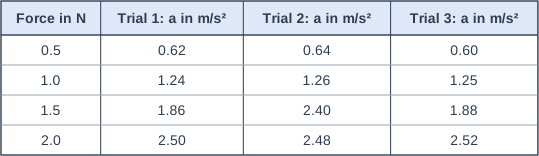
A student measures the acceleration of a trolley for different resultant forces. She repeats each measurement three times. The table shows her results.
Identify the anomalous result. Calculate the mean acceleration for a force of 1.5 N.
Model answer
The anomalous result is 2.40 m/s² (trial 2 for a force of 1.5 N). Mean = (1.86 + 1.88) ÷ 2 = 1.87 m/s²
Explanation
An anomalous result does not fit the pattern of the other repeats, so it is left out when calculating the mean. The other two values for 1.5 N agree closely, and 1.87 m/s² also fits the pattern that the acceleration increases by about 0.62 m/s² for every 0.5 N.
Mark scheme
1 mark
2.40 (m/s²) / the second trial for 1.5 N
1 mark
mean = (1.86 + 1.88) ÷ 2
an answer of 1.87 (m/s²) scores the last 2 marks; including the anomaly, (1.86 + 2.40 + 1.88) ÷ 3 = 2.05, scores 1 of these 2 marks
1 mark
1.87 (m/s²)
Question 4
4 marks
A car travelling at 13 m/s crashes into a wall. The seat belt brings a passenger to rest in 0.13 s.
Estimate the average force exerted on the passenger by the seat belt. Show your working and state any value you have estimated.
Model answer
Mass of an adult passenger ~ 70 kg a = Δv ÷ t = 13 ÷ 0.13 = 100 m/s² F = m a = 70 × 100 ~ 7000 N
Explanation
Very short stopping times give very large decelerations - here about 10 times the acceleration due to gravity. That is why the force from the seat belt is roughly ten times the passenger's weight, and why crumple zones and airbags are designed to make the stopping time longer.
Mark scheme
1 mark
sensible estimate of the mass of an adult passenger, in the range 50 kg to 100 kg
1 mark
a = 13 ÷ 0.13
1 mark
a = 100 (m/s²)
1 mark
F = mass × 100, with an answer consistent with their mass estimate, e.g. ~ 7000 N
a final answer in the range 5000 N to 10 000 N with sensible working scores 4 marks
Ready to try the rest? Every answer you write is marked against the mark scheme, so you can see exactly where the marks are.
Ctrl + Enter to check
AI TutorHints first, answers after you try
Hi! Stuck? Ask me for a hint and I’ll help you work it out. Once you’ve checked your answer I can explain exactly where the marks are.