Practise 22 exam-style questions on Velocity for AQA GCSE Physics. Write your answer as you would in the exam and get it marked in seconds against the mark scheme, point by point, with an AI tutor on hand if you get stuck.
22 questions
1–6 marks each
Instant marking
No sign-up needed
20 questions, marked as you go
Sample questions with model answers
Here are 4 of the questions in this topic, each with a model answer, an explanation of why it earns the marks and the mark scheme an examiner would use.
Question 1
1 mark
An object moves in a circle at a steady rate.
Which of these quantities stays constant: its speed or its velocity?
Model answer
Its speed.
Explanation
In circular motion at a steady rate the speed stays the same, but the direction of motion keeps changing. Because velocity includes direction, the velocity is always changing.
Mark scheme
1 mark
speed
do not accept both
Question 2
2 marks
An aircraft flies due north at 250 m/s relative to the air. A wind is blowing due south at 30 m/s.
Calculate the velocity of the aircraft relative to the ground.
Model answer
The wind blows in the opposite direction to the aircraft, so velocity relative to the ground = 250 − 30 = 220 m/s due north.
Explanation
Velocities are vectors, so velocities in opposite directions are subtracted. A headwind reduces the aircraft's velocity over the ground, while a tailwind would increase it to 280 m/s.
Mark scheme
1 mark
220 m/s
allow 250 − 30; correct answer with no working scores full marks
1 mark
due north
direction needed
Question 3
3 marks
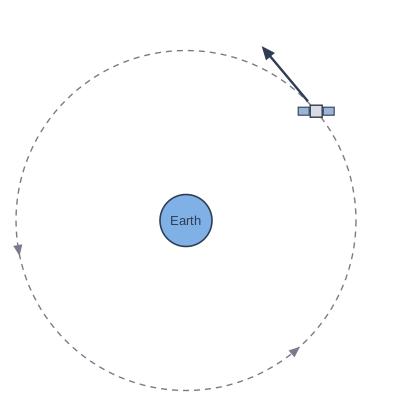
The diagram shows a satellite moving in a circular orbit around the Earth at a constant speed. The arrow shows the direction of its velocity at one moment.
Explain why the velocity of the satellite is changing even though its speed is constant.
Model answer
Velocity is speed in a given direction, so it is a vector. As the satellite moves round its circular orbit, its direction of motion is continuously changing - the velocity arrow always points along the tangent to the circle. Since the direction changes, the velocity changes, even though the speed stays the same.
Explanation
For circular motion at constant speed, the size of the velocity stays the same but its direction keeps turning. A changing velocity means the satellite is accelerating towards the centre of the orbit.
Mark scheme
1 mark
velocity is a vector / is speed in a given direction
1 mark
the direction of motion of the satellite is continuously changing (it is always along the tangent to the orbit)
1 mark
a change in direction means the velocity changes
allow so the satellite is accelerating
Question 4
4 marks
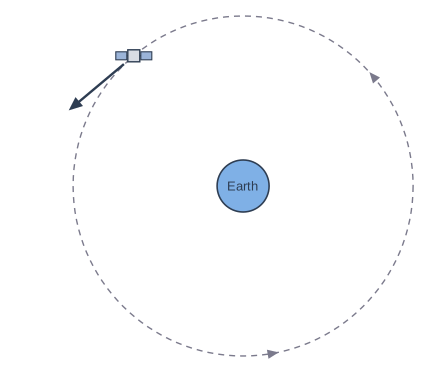
The diagram shows a satellite moving in a circular orbit around the Earth. The radius of the orbit is 6800 km. The satellite moves at a constant speed of 7.7 km/s.
Calculate the time taken for the satellite to complete one orbit. Give your answer in minutes.
Model answer
Distance for one orbit = 2πr = 2 × π × 6800 = 42 726 km t = s ÷ v = 42 726 ÷ 7.7 = 5549 s t = 5549 ÷ 60 = 92.5 minutes
Explanation
The satellite travels one circumference (2πr) in each orbit at constant speed, so t = s ÷ v. Keeping both distance and speed in kilometres gives the time in seconds directly. Although the speed is constant, the velocity is not, because the direction of motion keeps changing.