
Level:
Correct: 0
Incorrect: 0
Marks: 0/0
Exam Practice
Subject:
Topics:
AQA GCSE Physics Smart practice A mixed round aimed at your weak spots
Unit 1
Energy
Energy changes in a system, and the ways energy is stored before and after such changes
Energy stores and systems
0%
Changes in energy
0%
Energy changes in systems
0%
Power
0%
Conservation and dissipation of energy
Energy transfers in a system
0%
Efficiency
0%
Unit 2
Electricity
Unit 3
Particle model of matter
Unit 4
Atomic structure
Unit 5
Forces
Unit 6
Waves
Unit 7
Magnetism and electromagnetism
Unit 8
Space physics (physics only)
Avg
score:
–
Topics
done:
0/91

Mass number, atomic number and isotopes

Practise 30 exam-style questions on Mass number, atomic number and isotopes for AQA GCSE Physics. Write your answer as you would in the exam and get it marked in seconds against the mark scheme, point by point, with an AI tutor on hand if you get stuck.

  • 30 questions
  • 1–6 marks each
  • Instant marking
  • No sign-up needed
20 questions, marked as you go

Sample questions with model answers

Here are 4 of the questions in this topic, each with a model answer, an explanation of why it earns the marks and the mark scheme an examiner would use.

Question 1

2 marks

What are isotopes?

Model answer

Isotopes are atoms of the same element (with the same number of protons) that have different numbers of neutrons.

Explanation

Isotopes have the same atomic number but different mass numbers. A common mistake is to say they have different numbers of protons - that would make them different elements.

Mark scheme
  1. 1 mark

    atoms of the same element / with the same number of protons

    allow same atomic number

  2. 1 mark

    with different numbers of neutrons

    allow different mass numbers; do not accept different numbers of protons or electrons
Question 2

2 marks

An aluminium ion has 13 protons, 14 neutrons and 10 electrons.

Give the overall charge of the ion. Explain your answer.

Model answer

The charge is +3. The ion has 13 protons (13 positive charges) but only 10 electrons (10 negative charges), so it has 3 more positive charges than negative charges. The neutrons have no charge.

Explanation

Subtract the number of electrons from the number of protons to find the charge of an ion. The aluminium atom has lost its 3 outer electrons.

Mark scheme
  1. 1 mark

    +3

    allow 3+

  2. 1 mark

    it has 3 more protons than electrons / it has lost 3 electrons

Question 3

3 marks

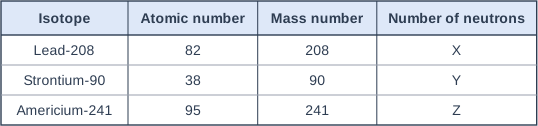
The table shows information about three isotopes. Some values are missing.

Calculate the values of X, Y and Z.

Table with columns "Isotope", "Atomic number", "Mass number", "Number of neutrons". Isotope: Lead-208; Atomic number: 82; Mass number: 208; Number of neutrons: X | Isotope: Strontium-90; Atomic number: 38; Mass number: 90; Number of neutrons: Y | Isotope: Americium-241; Atomic number: 95; Mass number: 241; Number of neutrons: Z.

Model answer

Number of neutrons = mass number − atomic number
X = 208 − 82 = 126
Y = 90 − 38 = 52
Z = 241 − 95 = 146

Explanation

The mass number counts protons and neutrons together, and the atomic number counts protons, so the difference is the number of neutrons. Heavy atoms have many more neutrons than protons.

Mark scheme
  1. 1 mark

    X = 126

    correct answer with no working scores full marks

  2. 1 mark

    Y = 52

  3. 1 mark

    Z = 146

Question 4

5 marks

Hydrogen has three isotopes:

hydrogen-1, with no neutrons
hydrogen-2 (deuterium), with one neutron
hydrogen-3 (tritium), with two neutrons

The atomic number of hydrogen is 1.

Write each isotope in nuclear notation. Describe how the atoms of the three isotopes are similar and how they are different.

Model answer

Hydrogen-1 is ¹₁H, deuterium is ²₁H and tritium is ³₁H.
Similarities: each atom has 1 proton, so they all have atomic number 1 and are all hydrogen. Each atom also has 1 electron, so each is neutral.
Differences: they have 0, 1 and 2 neutrons, so their mass numbers are 1, 2 and 3. A tritium atom has about three times the mass of a hydrogen-1 atom.

Explanation

Isotopes share the same number of protons and (as atoms) the same number of electrons; only the number of neutrons, and so the mass, changes. The notation shows this: the bottom number stays the same and the top number changes.

Mark scheme
  1. 1 mark

    ¹₁H, ²₁H and ³₁H

    max 5; all three needed for this mark; allow mass numbers 1, 2, 3 with atomic number 1

  2. 1 mark

    similar: each has 1 proton (same atomic number)

  3. 1 mark

    similar: each atom has 1 electron (so each is neutral)

  4. 1 mark

    different: they have 0, 1 and 2 neutrons

  5. 1 mark

    different: their masses / mass numbers are different (1, 2, 3), with tritium the heaviest

    allow a tritium atom has about 3 times the mass of a hydrogen-1 atom

  6. 1 mark

    they are all the same element because they have the same number of protons

Ready to try the rest? Every answer you write is marked against the mark scheme, so you can see exactly where the marks are.

AI Tutor Hints first, answers after you try

Hi! Stuck? Ask me for a hint and I’ll help you work it out. Once you’ve checked your answer I can explain exactly where the marks are.