
Level:
Correct: 0
Incorrect: 0
Marks: 0/0
Exam Practice
Subject:
Topics:
AQA GCSE Physics Smart practice A mixed round aimed at your weak spots
Unit 1
Energy
Energy changes in a system, and the ways energy is stored before and after such changes
Energy stores and systems
0%
Changes in energy
0%
Energy changes in systems
0%
Power
0%
Conservation and dissipation of energy
Energy transfers in a system
0%
Efficiency
0%
Unit 2
Electricity
Unit 3
Particle model of matter
Unit 4
Atomic structure
Unit 5
Forces
Unit 6
Waves
Unit 7
Magnetism and electromagnetism
Unit 8
Space physics (physics only)
Avg
score:
–
Topics
done:
0/91

Magnetic fields

Practise 39 exam-style questions on Magnetic fields for AQA GCSE Physics. Write your answer as you would in the exam and get it marked in seconds against the mark scheme, point by point, with an AI tutor on hand if you get stuck.

  • 39 questions
  • 1–6 marks each
  • Instant marking
  • No sign-up needed
20 questions, marked as you go

Sample questions with model answers

Here are 4 of the questions in this topic, each with a model answer, an explanation of why it earns the marks and the mark scheme an examiner would use.

Question 1

2 marks

What is meant by the magnetic field of a magnet?

Model answer

The magnetic field is the region around a magnet where a force acts on another magnet or on a magnetic material such as iron, steel, cobalt or nickel.

Explanation

A field is a region where a non-contact force acts. For a magnetic field, the objects that feel the force are other magnets and the magnetic materials iron, steel, cobalt and nickel.

Mark scheme
  1. 1 mark

    the region (space) around a magnet

  2. 1 mark

    where a force acts on another magnet or on a magnetic material

    allow where a magnetic material (iron, steel, cobalt, nickel) experiences a force
Question 2

2 marks

Scientists imagine a single, free north pole placed just beyond the north pole of a bar magnet.

Describe the direction in which this free north pole would start to move, and explain why.

Model answer

It would start to move away from the magnet's north pole, along the field line. This is because the field direction is defined as the direction of the force on a north pole: the north pole is repelled by the magnet's north pole and attracted towards its south pole.

Explanation

This imaginary north pole is how field direction is defined. Whatever way a north pole would be pushed at a point is the direction of the field there, which is why field lines point away from N and towards S.

Mark scheme
  1. 1 mark

    away from the magnet's north pole, along the field line

    allow towards the south pole along the field line

  2. 1 mark

    the direction of the field is the direction of the force on a north pole / like poles repel

Question 3

3 marks

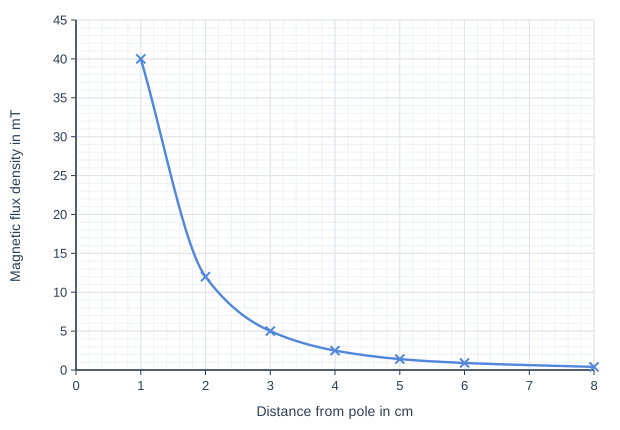
A student uses a magnetic field sensor to measure the magnetic flux density (the strength of the magnetic field) at different distances from one pole of a bar magnet. The graph shows her results.

Describe how the strength of the magnetic field changes with distance from the pole. Use data from the graph.

Line graph of magnetic flux density in mT (y-axis, 0 to 45) against distance from pole in cm (x-axis, 0 to 8). The line is a smooth curve through (1, 40), (2, 12), (3, 5), (4, 2.5), (5, 1.4), (6, 0.9), (8, 0.4).

Model answer

The magnetic field gets weaker as the distance from the pole increases. Close to the pole it falls very steeply, from 40 mT at 1 cm to 12 mT at 2 cm, but further away it falls much more slowly, from 1.4 mT at 5 cm to 0.9 mT at 6 cm.

Explanation

The strength of a magnetic field depends on the distance from the magnet, and it is strongest at the poles. The decrease is not linear: most of the drop happens in the first few centimetres.

Mark scheme
  1. 1 mark

    the field strength decreases as the distance from the pole increases

  2. 1 mark

    it decreases rapidly close to the pole, then more slowly further away

    allow not linear / the curve levels off

  3. 1 mark

    correct data, e.g. 40 mT at 1 cm falls to 12 mT at 2 cm, but only from 1.4 mT to 0.9 mT between 5 cm and 6 cm

    allow any correctly read values used to support the pattern

Question 4

4 marks

A student wants to compare the strengths of two bar magnets, A and B. She has a plotting compass and a metre rule, and works on a bench away from any other magnets.

Describe how she could use the compass and the metre rule to compare the strengths of the two magnets.

Model answer

Let the compass settle so that it points north, along the Earth's field. Place magnet A in line with the compass on the bench, a long way away, and slowly slide it towards the compass along the metre rule until the needle just starts to turn. Measure the distance between the magnet and the compass. Do the same with magnet B, approaching from the same direction. Repeat each measurement three times and find the mean. The magnet that makes the needle turn from further away has the stronger field, so it is the stronger magnet.

Explanation

The needle only moves when the magnet's field is strong enough compared with the Earth's field. Because field strength decreases with distance, a stronger magnet reaches that strength further away.

Mark scheme
  1. 1 mark

    let the compass settle pointing north, then place magnet A in line with the compass a long way away

    max 4

  2. 1 mark

    move the magnet slowly towards the compass until the needle starts to turn (or turns by a chosen angle)

  3. 1 mark

    measure the distance between the magnet and the compass with the metre rule

  4. 1 mark

    repeat with magnet B, keeping the compass and the direction of approach the same

  5. 1 mark

    the magnet that turns the needle from further away is stronger

  6. 1 mark

    repeat each measurement and find a mean

Ready to try the rest? Every answer you write is marked against the mark scheme, so you can see exactly where the marks are.

AI Tutor Hints first, answers after you try

Hi! Stuck? Ask me for a hint and I’ll help you work it out. Once you’ve checked your answer I can explain exactly where the marks are.