
Level:
Correct: 0
Incorrect: 0
Marks: 0/0
Exam Practice
Subject:
Topics:
AQA GCSE Physics Smart practice A mixed round aimed at your weak spots
Unit 1
Energy
Energy changes in a system, and the ways energy is stored before and after such changes
Energy stores and systems
0%
Changes in energy
0%
Energy changes in systems
0%
Power
0%
Conservation and dissipation of energy
Energy transfers in a system
0%
Efficiency
0%
Unit 2
Electricity
Unit 3
Particle model of matter
Unit 4
Atomic structure
Unit 5
Forces
Unit 6
Waves
Unit 7
Magnetism and electromagnetism
Unit 8
Space physics (physics only)
Avg
score:
–
Topics
done:
0/91

Conservation of momentum (HT only)

Practise 24 exam-style questions on Conservation of momentum (HT only) for AQA GCSE Physics. Write your answer as you would in the exam and get it marked in seconds against the mark scheme, point by point, with an AI tutor on hand if you get stuck.

  • 24 questions
  • 1–6 marks each
  • Instant marking
  • No sign-up needed
20 questions, marked as you go

Sample questions with model answers

Here are 4 of the questions in this topic, each with a model answer, an explanation of why it earns the marks and the mark scheme an examiner would use.

Question 1

2 marks

A ball rolls across a grass field. It gradually slows down and stops.

Explain why the momentum of the ball is not conserved.

Model answer

Friction from the grass and air resistance act on the ball. These are external forces, so the ball is not a closed system and its momentum is not conserved - the momentum is transferred to the ground and the air.

Explanation

Conservation of momentum only applies to a closed system, where no external forces act. If the Earth and the air were included in the system, total momentum would be conserved, but the Earth's mass is so large that its change in velocity is too small to notice.

Mark scheme
  1. 1 mark

    friction (from the grass) / air resistance acts on the ball

    allow an external force acts on the ball

  2. 1 mark

    so the ball is not a closed system

    allow momentum is conserved only if no external forces act; allow the momentum is transferred to the grass / Earth
Question 2

3 marks

A cannon of mass 800 kg is stationary. It fires a cannonball of mass 4.0 kg horizontally at a velocity of 150 m/s.

Calculate the velocity of the cannon just after firing.
Give the direction of its motion.

Model answer

Total momentum before = 0, so total momentum after = 0.
Momentum of cannonball = 4.0 × 150 = 600 kg m/s forwards
The cannon must have 600 kg m/s backwards:
800 × v = 600
v = 0.75 m/s in the opposite direction to the cannonball.

Explanation

Before firing, nothing is moving, so the total momentum is zero. After firing, the cannon's momentum must be equal in size and opposite in direction to the cannonball's. The cannon's much larger mass means its recoil velocity is much smaller.

Mark scheme
  1. 1 mark

    momentum of cannonball = 4.0 × 150 = 600 (kg m/s)

    an answer of 0.75 m/s backwards scores 3 marks

  2. 1 mark

    v = 600 ÷ 800 = 0.75 (m/s)

    allow 600 = 800 × v; allow ecf

  3. 1 mark

    in the opposite direction to the cannonball / backwards

    allow −0.75 m/s if forwards is taken as positive

Question 3

3 marks

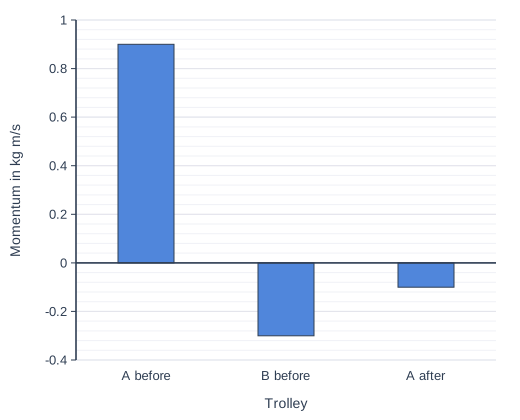
Two trolleys, A and B, move towards each other along a level track. Before they collide, the momentum of each trolley is shown in the bar chart. Trolley B is moving to the left, so its momentum is negative.

The bar chart also shows the momentum of trolley A just after the collision.

Determine the momentum of trolley B just after the collision.

Bar chart of momentum in kg m/s for each trolley: A before 0.9, B before -0.3, A after -0.1.

Model answer

Total momentum before = 0.9 + (−0.3) = 0.6 kg m/s
Momentum is conserved, so total momentum after = 0.6 kg m/s.
Momentum of A after = −0.1 kg m/s
−0.1 + momentum of B = 0.6
Momentum of B after = 0.7 kg m/s (to the right)

Explanation

Signs matter: negative momentum means motion to the left. Trolley A bounces back slightly (−0.1 kg m/s), so trolley B must end up with 0.7 kg m/s to keep the total at 0.6 kg m/s.

Mark scheme
  1. 1 mark

    total momentum before = 0.9 + (−0.3) = 0.6 (kg m/s)

    an answer of 0.7 (kg m/s) scores 3 marks

  2. 1 mark

    total momentum after = 0.6 (kg m/s) / momentum is conserved

    allow −0.1 + p = 0.6

  3. 1 mark

    momentum of B after = 0.6 − (−0.1) = (+)0.7 (kg m/s)

    allow 0.7 kg m/s to the right; allow ecf from their total

Question 4

5 marks

Car A has a mass of 1500 kg. It crashed into the back of car B, which has a mass of 1000 kg and was stationary at traffic lights. The cars locked together. Investigators worked out that the cars moved off together at 9.0 m/s just after the collision.

The speed limit on the road is 13 m/s. Assume the cars form a closed system during the collision.

Use conservation of momentum to determine whether car A was travelling above the speed limit just before the collision.

Model answer

Momentum after = (1500 + 1000) × 9.0 = 22 500 kg m/s
Momentum before = momentum after, and car B had no momentum, so:
1500 × v = 22 500
v = 22 500 ÷ 1500 = 15 m/s
15 m/s is greater than the speed limit of 13 m/s, so car A was speeding.

Explanation

Accident investigators use conservation of momentum backwards: from the motion after the crash they can work out the speed before it. Only car A had momentum before the crash, because car B was stationary.

Mark scheme
  1. 1 mark

    momentum after = (1500 + 1000) × 9.0 = 22 500 (kg m/s)

    a correct conclusion based on a calculated speed of 15 m/s scores 5 marks

  2. 1 mark

    momentum before = 1500 × v

    allow 1500 × v = 22 500

  3. 1 mark

    v = 22 500 ÷ 1500 = 15 (m/s)

    allow ecf

  4. 1 mark

    15 m/s is greater than 13 m/s

    allow ecf from their calculated speed

  5. 1 mark

    so car A was travelling above the speed limit

Ready to try the rest? Every answer you write is marked against the mark scheme, so you can see exactly where the marks are.

AI Tutor Hints first, answers after you try

Hi! Stuck? Ask me for a hint and I’ll help you work it out. Once you’ve checked your answer I can explain exactly where the marks are.