Practise 27 exam-style questions on Reflection of waves (physics only) for AQA GCSE Physics. Write your answer as you would in the exam and get it marked in seconds against the mark scheme, point by point, with an AI tutor on hand if you get stuck.
27 questions
1–6 marks each
Instant marking
No sign-up needed
20 questions, marked as you go
Sample questions with model answers
Here are 4 of the questions in this topic, each with a model answer, an explanation of why it earns the marks and the mark scheme an examiner would use.
Question 1
2 marks
A wave meets the boundary between two different materials.
Name the three things that can happen to the wave at the boundary.
Model answer
The wave can be reflected, absorbed or transmitted.
Explanation
At most boundaries all three happen to some extent: some of the wave's energy bounces back (reflection), some passes through (transmission) and some is transferred to the material (absorption). What happens depends on the materials and on the type and wavelength of the wave.
Mark scheme
2 marks
reflected; absorbed; transmitted
all three = 2 marks; any two = 1 mark; allow refracted for transmitted
Question 2
2 marks
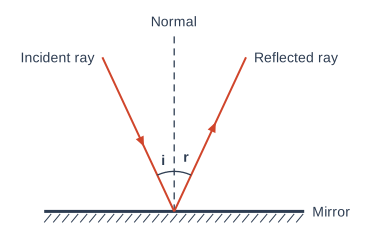
The diagram shows a ray of light reflecting from a plane mirror.
Determine the angle of reflection r and the angle between the incident ray and the reflected ray.
Model answer
The angle of incidence is 25°, so the angle of reflection r = 25°. The angle between the incident ray and the reflected ray = 25° + 25° = 50°.
Explanation
The law of reflection gives r = i. The incident and reflected rays are on opposite sides of the normal, so the angle between them is i + r.
Mark scheme
1 mark
r = 25°
correct answer with no working scores full marks
1 mark
angle between incident and reflected rays = 50°
allow ecf: 2 × their r
Question 3
3 marks
Water waves on the sea approach a harbour. Some waves hit a vertical concrete harbour wall. Others reach a gently sloping beach covered in pebbles.
Compare what happens to the waves at the harbour wall and at the beach.
Model answer
At the vertical concrete wall, the waves are mostly reflected, bouncing back with most of their energy, with the angle of reflection equal to the angle of incidence. At the sloping pebble beach, most of the wave energy is absorbed as the waves break and run up the pebbles, so very little is reflected back out to sea.
Explanation
Hard, flat, vertical surfaces reflect waves well. A gently sloping, uneven beach absorbs the waves' energy, which is why sloping 'beaches' or piles of rocks are sometimes built to protect sea walls.
Mark scheme
1 mark
at the wall, the waves are (mostly) reflected
1 mark
the reflected waves keep most of their energy / angle of reflection equals angle of incidence
allow the wall can make the sea next to it rougher
1 mark
at the beach, most of the wave energy is absorbed (by the pebbles / beach) and little is reflected
Question 4
4 marks
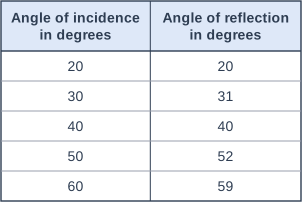
A student measured the angle of reflection for different angles of incidence using a plane mirror. The table shows the results.
Do the results support the law of reflection? Use the data to explain your answer.
Model answer
Yes, the results support the law of reflection. For angles of incidence of 20° and 40°, the angle of reflection is exactly the same. The other results differ by only 1° or 2°, and some are higher and some lower than the angle of incidence. These small differences can be explained by measurement errors, such as the width of the ray or misreading the protractor.
Explanation
When evaluating data, look at whether any differences are small and random (measurement uncertainty) or large and systematic (which would mean the law did not hold). A spread of ±2° is typical of measurements made with a protractor and a ray box.
Mark scheme
1 mark
yes, the results support the law of reflection
1 mark
for 20° and 40° the angles of incidence and reflection are equal
allow any correct reference to equal pairs
1 mark
the other results differ by only 1-2°
allow 30°/31°, 50°/52°, 60°/59° identified as close
1 mark
these small differences are due to measurement error / uncertainty (e.g. width of the ray, reading the protractor)
allow the differences are random, some above and some below
Ready to try the rest? Every answer you write is marked against the mark scheme, so you can see exactly where the marks are.
Ctrl + Enter to check
AI TutorHints first, answers after you try
Hi! Stuck? Ask me for a hint and I’ll help you work it out. Once you’ve checked your answer I can explain exactly where the marks are.