Practise 38 exam-style questions on Visible light (physics only) for AQA GCSE Physics. Write your answer as you would in the exam and get it marked in seconds against the mark scheme, point by point, with an AI tutor on hand if you get stuck.
38 questions
1–6 marks each
Instant marking
No sign-up needed
20 questions, marked as you go
Sample questions with model answers
Here are 4 of the questions in this topic, each with a model answer, an explanation of why it earns the marks and the mark scheme an examiner would use.
Question 1
2 marks
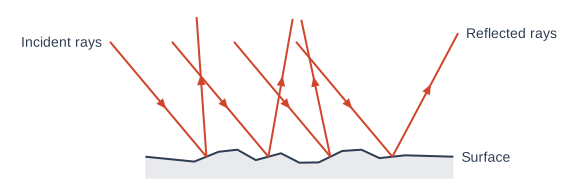
The diagram shows parallel rays of light being reflected from a surface.
Name the type of reflection shown and explain why the reflected rays travel in different directions.
Model answer
This is diffuse reflection. The surface is rough, so each ray hits a small part of the surface that is tilted at a different angle. Each ray is reflected at a different angle, so the reflected rays are scattered in different directions.
Explanation
Every ray still obeys the law of reflection (angle of incidence = angle of reflection) at the bit of surface it hits. On a rough surface those bits face in different directions, so parallel rays come off in many directions.
Mark scheme
1 mark
diffuse reflection
allow scattering
1 mark
the surface is rough / uneven, so each ray hits a part of the surface that faces a different direction
allow the normal is in a different direction for each ray
Question 2
2 marks
What is meant by an opaque object?
Model answer
An opaque object does not transmit any light. The light that falls on it is either reflected or absorbed.
Explanation
The colour of an opaque object comes only from the light it reflects, since none passes through. Transparent and translucent objects, by contrast, transmit light.
Mark scheme
1 mark
an object that does not transmit light / light cannot pass through it
1 mark
the light falling on it is reflected or absorbed
Question 3
3 marks
A beam of white light passes through a red filter and then through a green filter.
Describe what is seen on a white screen placed after the green filter. Explain your answer.
Model answer
The red filter absorbs every colour except red, so only red light reaches the green filter. The green filter only transmits green light, so it absorbs the red light. No light gets through, so the screen stays dark.
Explanation
Each filter removes the colours it absorbs. After the red filter only red is left, and the green filter removes that too, so nothing is transmitted.
Mark scheme
1 mark
the red filter transmits only red light (absorbs the other colours)
1 mark
the green filter absorbs red light / only transmits green
1 mark
so no light reaches the screen / the screen looks dark (black)
Question 4
5 marks
A student says: "A red filter adds red colour to white light, like dye in water."
Explain why the student is wrong. Describe and explain what would be seen if the light coming out of the red filter shone onto a blue book.
Model answer
The student is wrong because the filter does not add any colour. White light already contains all the colours, including red. The red filter absorbs all the other colours and transmits only the red light. If this red light shone onto a blue book, the book would appear black, because it only reflects blue light: it absorbs the red light and so reflects nothing.
Explanation
Filters subtract colours from light; they cannot create new ones. Evidence for this is that filtered light is always dimmer than the original white light, and that a blue object turns black in red light because there is no blue left to reflect.
Mark scheme
1 mark
the filter does not add colour
1 mark
white light already contains all colours / wavelengths (including red)
1 mark
the filter absorbs the other colours and transmits only red light
1 mark
the blue book appears black
allow very dark
1 mark
the book only reflects blue light, so it absorbs the red light and reflects nothing
Ready to try the rest? Every answer you write is marked against the mark scheme, so you can see exactly where the marks are.
Ctrl + Enter to check
AI TutorHints first, answers after you try
Hi! Stuck? Ask me for a hint and I’ll help you work it out. Once you’ve checked your answer I can explain exactly where the marks are.