Level:
Correct: 0
Incorrect: 0
Marks: 0/0
Exam Practice
Subject:
Topics:
AQA GCSE Physics Smart practice A mixed round aimed at your weak spots
Unit 1
Energy
Energy changes in a system, and the ways energy is stored before and after such changes
Energy stores and systems
0%
Changes in energy
0%
Energy changes in systems
0%
Power
0%
Conservation and dissipation of energy
Energy transfers in a system
0%
Efficiency
0%
Unit 2
Electricity
Unit 3
Particle model of matter
Unit 4
Atomic structure
Unit 5
Forces
Unit 6
Waves
Unit 7
Magnetism and electromagnetism
Unit 8
Space physics (physics only)
Avg
score:
–
Topics
done:
0/91

Efficiency

Practise 24 exam-style questions on Efficiency for AQA GCSE Physics. Write your answer as you would in the exam and get it marked in seconds against the mark scheme, point by point, with an AI tutor on hand if you get stuck.

  • 24 questions
  • 1–6 marks each
  • Instant marking
  • No sign-up needed
20 questions, marked as you go

Sample questions with model answers

Here are 4 of the questions in this topic, each with a model answer, an explanation of why it earns the marks and the mark scheme an examiner would use.

Question 1

2 marks

An electric motor has a total power input of 500 W. Its useful power output is 400 W.

Calculate the efficiency of the motor.

Model answer

efficiency = useful power output ÷ total power input
efficiency = 400 ÷ 500
efficiency = 0.80 (or 80%)

Explanation

Efficiency can be calculated from powers as well as energies, because power is just energy transferred per second. The motor transfers 80% of its input power usefully and wastes the other 20%.

Mark scheme
  1. 1 mark

    efficiency = 400 ÷ 500

    an answer of 0.80 or 80% scores 2 marks

  2. 1 mark

    0.80

    allow 0.8 or 80%

Question 2

3 marks

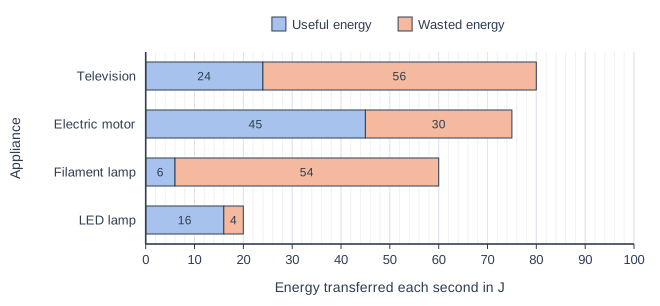
The bar chart shows the useful and wasted energy transferred each second by four appliances.

A student says the electric motor is the most efficient appliance because it transfers the most useful energy each second.

Explain why the student is wrong, and identify the most efficient appliance.

Stacked bar chart with 4 horizontal bars. The value axis (x-axis) is "Energy transferred each second in J", from 0 to 100 marked every 10; the bars are labelled along the y-axis, "Appliance", from top to bottom. Each bar is split into 2 parts, shown in the key: Useful energy (left, blue) and Wasted energy (right, orange). Values: Television: useful energy 24 J, wasted energy 56 J; Electric motor: useful energy 45 J, wasted energy 30 J; Filament lamp: useful energy 6 J, wasted energy 54 J; LED lamp: useful energy 16 J, wasted energy 4 J. The value of each part is printed on it.

Model answer

Efficiency depends on the fraction of the total input energy that is transferred usefully, not on the amount of useful energy. The motor transfers 45 J usefully out of 75 J (efficiency 0.60). The LED lamp transfers only 16 J usefully, but out of a total of 20 J, so its efficiency is 0.80. The LED lamp is the most efficient appliance.

Explanation

An appliance that uses a lot of energy can transfer a lot usefully and still be inefficient. Always calculate useful ÷ total for each appliance before comparing efficiencies.

Mark scheme
  1. 1 mark

    efficiency is the useful energy as a fraction / proportion of the total energy input, not the amount of useful energy

  2. 1 mark

    the LED lamp is the most efficient

  3. 1 mark

    LED lamp efficiency = 16 ÷ 20 = 0.80, which is greater than the motor's 45 ÷ 75 = 0.60

    allow LED transfers 80% usefully compared with 60% for the motor

Question 3

3 marks

Some of the energy transferred by a car's engine is wasted while the car is moving.

Give two ways in which energy is wasted by a moving car, and for each suggest how the wasted energy could be reduced.

Model answer

Energy is wasted doing work against friction between the moving parts of the engine and gearbox; this can be reduced by lubricating the parts with oil. Energy is also wasted doing work against air resistance; this can be reduced by giving the car a more streamlined shape.

Explanation

Each way of wasting energy is a force that dissipates energy as thermal energy. Increasing efficiency means reducing these unwanted transfers so that more of the fuel's energy goes into the car's kinetic store.

Mark scheme
  1. 1 mark

    work done against friction between moving parts (heating the engine / gearbox)

    max 3; credit up to 2 ways wasted and their matching reductions

  2. 1 mark

    reduced by lubricating the moving parts with oil

  3. 1 mark

    work done against air resistance (drag)

  4. 1 mark

    reduced by a more streamlined shape / removing roof racks

  5. 1 mark

    rolling resistance of the tyres

  6. 1 mark

    reduced by keeping the tyres correctly inflated

Question 4

5 marks

A 2.0 kW electric kettle heats 1.0 kg of water from 20 °C to 100 °C in 3.0 minutes.

Specific heat capacity of water = 4200 J/kg °C

Use the equation:
change in thermal energy = mass × specific heat capacity × temperature change

Calculate the efficiency of the kettle.

Model answer

Useful energy to water: ΔE = m c Δθ = 1.0 × 4200 × 80 = 336 000 J
Total energy input: E = P t = 2000 × 180 = 360 000 J
efficiency = 336 000 ÷ 360 000 = 0.93 (93%)

Explanation

The useful output is the increase in the water's thermal store, and the total input is the electrical energy supplied. Remember to convert 2.0 kW to 2000 W and 3.0 minutes to 180 s.

Mark scheme
  1. 1 mark

    ΔE = 1.0 × 4200 × 80

    an answer of 0.93 or 93% scores 5 marks

  2. 1 mark

    useful energy = 336 000 (J)

  3. 1 mark

    total energy input = 2000 × 180 = 360 000 (J)

  4. 1 mark

    efficiency = 336 000 ÷ 360 000

    allow ecf from either energy

  5. 1 mark

    0.93

    allow 0.933 or 93%; allow ecf

Ready to try the rest? Every answer you write is marked against the mark scheme, so you can see exactly where the marks are.

AI Tutor Hints first, answers after you try

Hi! Stuck? Ask me for a hint and I’ll help you work it out. Once you’ve checked your answer I can explain exactly where the marks are.