Practise 32 exam-style questions on Radioactive contamination for AQA GCSE Physics. Write your answer as you would in the exam and get it marked in seconds against the mark scheme, point by point, with an AI tutor on hand if you get stuck.
32 questions
1–6 marks each
Instant marking
No sign-up needed
20 questions, marked as you go
Sample questions with model answers
Here are 4 of the questions in this topic, each with a model answer, an explanation of why it earns the marks and the mark scheme an examiner would use.
Question 1
2 marks
Some foods are exposed to gamma radiation to kill bacteria. A customer is worried that the food will be radioactive.
Explain why the food does not become radioactive.
Model answer
The food is irradiated, not contaminated. The gamma rays pass through the food and kill the bacteria, but no radioactive material is added to it, so the food does not emit any radiation afterwards.
Explanation
A common misconception is that exposure to radiation makes things radioactive. Only radioactive atoms emit radiation, and irradiation does not put any radioactive atoms into the food.
Mark scheme
1 mark
the food is irradiated, not contaminated
1 mark
no radioactive atoms / material are added to the food (the gamma rays just pass into or through it)
allow irradiated objects do not become radioactive
Question 2
2 marks
Explain why contamination of the skin by a beta-emitting material is more hazardous than contamination of the skin by an alpha-emitting material.
Model answer
Beta particles are penetrating enough to pass through the outer layer of dead skin and reach living cells, where they can cause damage. Alpha particles are stopped by the outer layer of dead skin, so they do not reach living cells.
Explanation
On the outside of the body, the hazard depends on whether the radiation can get through the skin. Alpha cannot, beta can; but if the material were swallowed, the alpha emitter would become the more dangerous.
Mark scheme
1 mark
beta particles can penetrate the outer layer of skin to reach living cells
1 mark
alpha particles are stopped by the outer layer of dead skin
Question 3
3 marks
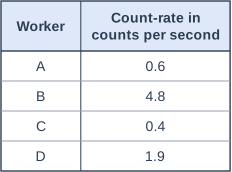
Workers' hands are checked with a Geiger-Müller tube after working with radioactive materials. The background count-rate is 0.5 counts per second. The table shows the readings for four workers.
Identify which workers have contaminated hands and suggest what should happen next.
Model answer
Workers B and D have contaminated hands, because their count-rates (4.8 and 1.9 counts per second) are well above the background count-rate of 0.5 counts per second. A and C read 0.6 and 0.4 counts per second, which is just random variation about background. B and D should wash their hands thoroughly and be checked again until their readings are close to background.
Explanation
Because decay is random, readings slightly above or below background (like 0.6 or 0.4) do not show contamination. Only readings clearly above background do.
Mark scheme
1 mark
B and D
both needed, and no others
1 mark
their count-rates are well above the background count-rate of 0.5 counts per second
allow A and C are close to background (random variation)
1 mark
B and D should wash their hands and be checked again until the reading is close to background
Question 4
4 marks
A small amount of a liquid containing a beta-emitting isotope is spilled on a laboratory bench.
Explain the hazard this causes, and describe what should be done.
Model answer
The spilled liquid contaminates the bench. Its radioactive atoms keep emitting beta particles until the liquid is removed or has decayed, and beta particles can penetrate skin, so anyone working at the bench is exposed. The liquid could also be spread onto hands or clothes and swallowed. People should be kept away while it is cleaned up by someone wearing gloves, with the waste sealed in a labelled container. The bench should then be checked with a Geiger-Müller tube until the count-rate is back to the background level.
Explanation
With contamination, the hazard stays where the radioactive material is, so it must be contained, removed and checked for. A detector reading at background level shows the contamination has been cleaned up.
Mark scheme
1 mark
the bench is contaminated: the isotope keeps emitting beta radiation until it is removed or has decayed
max 4
1 mark
beta particles can penetrate skin, so anyone touching or working at the bench is exposed
1 mark
the liquid could be spread onto hands / clothes or swallowed
1 mark
keep people away and clean it up wearing gloves, putting the waste in a sealed, labelled container
1 mark
check the bench (and hands) with a Geiger-Müller tube until the count-rate is back to background
Ready to try the rest? Every answer you write is marked against the mark scheme, so you can see exactly where the marks are.
Ctrl + Enter to check
AI TutorHints first, answers after you try
Hi! Stuck? Ask me for a hint and I’ll help you work it out. Once you’ve checked your answer I can explain exactly where the marks are.