Practise 32 exam-style questions on Mains electricity for AQA GCSE Physics. Write your answer as you would in the exam and get it marked in seconds against the mark scheme, point by point, with an AI tutor on hand if you get stuck.
32 questions
1–6 marks each
Instant marking
No sign-up needed
20 questions, marked as you go
Sample questions with model answers
Here are 4 of the questions in this topic, each with a model answer, an explanation of why it earns the marks and the mark scheme an examiner would use.
Question 1
2 marks
Describe the function of the neutral wire in a mains circuit.
Model answer
The neutral wire completes the circuit, so the current can flow from the live wire, through the appliance and back along the neutral wire. It is at, or close to, earth potential (0 V).
Explanation
An appliance needs a complete circuit. The live wire provides the alternating potential difference and the neutral wire provides the return path. In normal use the earth wire carries no current at all.
Mark scheme
1 mark
it completes the circuit
allow it carries the current back from the appliance
1 mark
it is at, or close to, earth potential (0 V)
Question 2
2 marks
An electrician uses a tester and finds that one wire in a cable has a potential difference of 230 V relative to earth.
Name this wire and give the colour its insulation should be.
Model answer
It is the live wire, and its insulation should be brown.
Explanation
Only the live wire is at about 230 V relative to earth. The neutral (blue) is at or close to 0 V and the earth wire (green and yellow) is at 0 V.
Mark scheme
1 mark
the live wire
1 mark
brown
Question 3
3 marks
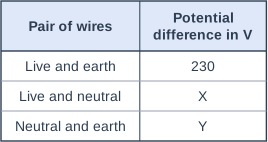
An electrician measures the potential difference between pairs of wires in a correctly wired mains circuit. The table shows the results.
Give the values of X and Y. Explain the value of Y.
Model answer
X = 230 V and Y = 0 V. Y is zero because the neutral wire is at, or close to, earth potential (0 V), and the earth wire is also at 0 V, so there is (almost) no potential difference between them.
Explanation
The live wire is at about 230 V relative to earth. Because the neutral wire is at about 0 V, the potential difference between live and neutral is also about 230 V.
Mark scheme
1 mark
X = 230 (V)
allow about 230 (V)
1 mark
Y = 0 (V)
allow close to 0 (V)
1 mark
the neutral wire is at, or close to, earth potential (0 V), and the earth wire is at 0 V
Question 4
4 marks
A person with a body resistance of 2.3 kΩ touches a bare live wire while standing on the ground.
Calculate the current through the person. A current of about 0.05 A through the body can be fatal. Use your answer to comment on the danger.
Model answer
The person is at earth potential (0 V) and the live wire is at 230 V, so the potential difference across them is 230 V. R = 2.3 kΩ = 2300 Ω I = V ÷ R = 230 ÷ 2300 = 0.10 A This is twice the current of 0.05 A that can be fatal, so touching the live wire could kill.
Explanation
The connection between the live wire and earth through the body is the danger. Any increase in the resistance of that path (dry skin, rubber soles) reduces the current; wet skin reduces the resistance and makes it worse.
Mark scheme
1 mark
the potential difference across the person is 230 V (because they are at earth potential, 0 V)
1 mark
I = 230 ÷ 2300
allow 230 = I × 2300; allow ecf from an incorrect p.d. or conversion
1 mark
0.10 (A)
allow 0.1 (A); an answer of 100 (A) (kΩ not converted) scores 1 mark for this and the previous point
1 mark
0.10 A is twice the current that can be fatal, so the shock could kill
allow ecf: compare their current with 0.05 A
Ready to try the rest? Every answer you write is marked against the mark scheme, so you can see exactly where the marks are.
Ctrl + Enter to check
AI TutorHints first, answers after you try
Hi! Stuck? Ask me for a hint and I’ll help you work it out. Once you’ve checked your answer I can explain exactly where the marks are.