Level:
Correct: 0
Incorrect: 0
Marks: 0/0
Exam Practice
Subject:
Topics:
AQA GCSE Physics Smart practice A mixed round aimed at your weak spots
Unit 1
Energy
Energy changes in a system, and the ways energy is stored before and after such changes
Energy stores and systems
0%
Changes in energy
0%
Energy changes in systems
0%
Power
0%
Conservation and dissipation of energy
Energy transfers in a system
0%
Efficiency
0%
Unit 2
Electricity
Unit 3
Particle model of matter
Unit 4
Atomic structure
Unit 5
Forces
Unit 6
Waves
Unit 7
Magnetism and electromagnetism
Unit 8
Space physics (physics only)
Avg
score:
–
Topics
done:
0/91

Uses of the generator effect (physics only) (HT only)

Practise 22 exam-style questions on Uses of the generator effect (physics only) (HT only) for AQA GCSE Physics. Write your answer as you would in the exam and get it marked in seconds against the mark scheme, point by point, with an AI tutor on hand if you get stuck.

  • 22 questions
  • 1–6 marks each
  • Instant marking
  • No sign-up needed
20 questions, marked as you go

Sample questions with model answers

Here are 4 of the questions in this topic, each with a model answer, an explanation of why it earns the marks and the mark scheme an examiner would use.

Question 1

2 marks

A coil of wire is rotated between the poles of a magnet. The ends of the coil are connected to a lamp, and the lamp lights.

Explain why the lamp lights.

Model answer

As the coil rotates it cuts the magnetic field lines, so a potential difference is induced across the coil. The coil and lamp form a complete circuit, so the induced potential difference drives a current through the lamp.

Explanation

This is the generator effect: moving a conductor through a magnetic field (or changing the field through a coil) induces a potential difference. A current only flows if there is a complete circuit, so the p.d. is induced first and the current follows.

Mark scheme
  1. 1 mark

    the coil cuts (magnetic) field lines / the coil moves relative to the magnetic field, so a potential difference is induced (across the coil)

    allow the magnetic field through the coil changes; allow generator effect for the idea of an induced p.d. only if linked to movement in the field; allow voltage or emf for potential difference

  2. 1 mark

    the coil is part of a complete circuit, so a current is induced (and passes through the lamp)

    do not accept current induced without reference to a complete / closed circuit
Question 2

2 marks

The coil of a dynamo makes 10 complete turns each second.

How many times each second does the output potential difference reach its maximum value? Give a reason for your answer.

Model answer

20 times each second, because the output p.d. of a dynamo reaches a maximum once every half turn, which is twice in every complete turn.

Explanation

The p.d. in the coil peaks once in each direction per turn. In a dynamo the commutator makes both peaks come out in the same direction, so the output has two maxima per turn: 10 turns × 2 = 20.

Mark scheme
  1. 1 mark

    20

  2. 1 mark

    the p.d. reaches a maximum every half turn / twice in each turn

    allow the commutator turns the negative half cycle into a second positive pulse

Question 3

3 marks

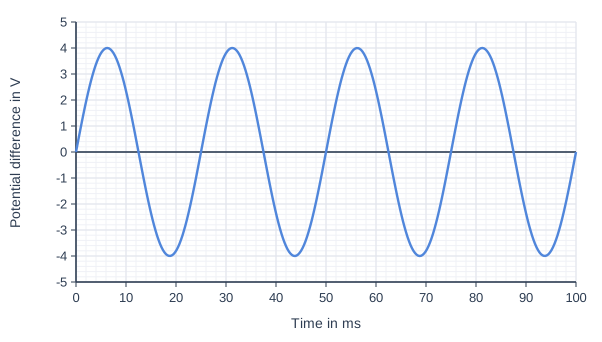
The graph shows the potential difference across the output of an alternator. The coil of the alternator makes one complete turn for each complete cycle of the output.

Determine the number of complete turns the coil makes each second.

Use the equation:
period = 1 ÷ frequency

Graph of potential difference in V (y-axis, -5 to 5) against time in ms (x-axis, 0 to 100), on a grid. A wave is drawn as a smooth, regular sine-shaped curve centred on the zero line: its crests reach 4 V and its troughs -4 V.

Model answer

From the graph, 4 complete cycles take 100 ms, so the period = 25 ms = 0.025 s.
frequency = 1 ÷ period = 1 ÷ 0.025 = 40 Hz
One turn gives one cycle, so the coil makes 40 turns each second.

Explanation

Read the period over several cycles to make it more accurate, then convert milliseconds to seconds before using frequency = 1 ÷ period. For an alternator each complete turn of the coil produces one complete cycle, so the frequency in hertz equals the number of turns per second.

Mark scheme
  1. 1 mark

    period = 25 ms / 0.025 s

    allow 4 cycles in 100 ms; an answer of 40 (turns per second) scores 3 marks

  2. 1 mark

    frequency = 1 ÷ 0.025 = 40 (Hz)

    allow ecf from an incorrect period read from the graph

  3. 1 mark

    40 (turns per second)

    allow ecf: number of turns per second = frequency

Question 4

4 marks

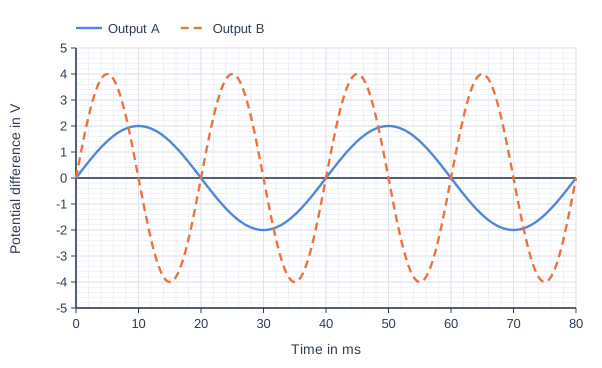
The graph shows the output potential difference of the same alternator at two different settings, A and B.

Only one thing about the alternator was changed between A and B.

Describe how output B is different from output A and explain what change to the alternator caused these differences.

Graph of potential difference in V (y-axis, -5 to 5) against time in ms (x-axis, 0 to 80), on a grid. The wave "Output A" is drawn as a smooth, regular sine-shaped curve centred on the zero line: its crests reach 2 V and its troughs -2 V; it repeats every 40 ms (crests at time = 10 and 50 ms). The wave "Output B" (dashed) is drawn as a smooth, regular sine-shaped curve centred on the zero line: its crests reach 4 V and its troughs -4 V; it repeats every 20 ms (crests at time = 5, 25, 45 and 65 ms).

Model answer

Output B has double the peak potential difference of A (4 V instead of 2 V) and half the period (20 ms instead of 40 ms), so its frequency is twice as high. The coil was rotated twice as fast. Turning faster means the coil cuts the field lines at a greater rate, so a larger p.d. is induced, and it completes more turns each second, so the frequency increases.

Explanation

Rotation speed is the only single change that affects both the peak p.d. and the frequency. A stronger magnet, more turns or a bigger coil would make the peaks taller but leave the period unchanged.

Mark scheme
  1. 1 mark

    the peak potential difference of B is double / greater than that of A

    allow B has a peak p.d. of 4 V and A has 2 V

  2. 1 mark

    the period of B is half that of A / B has double the frequency

    allow B has a period of 20 ms and A 40 ms; allow B has more cycles in the same time

  3. 1 mark

    the coil was rotated faster (twice as fast)

    do not accept a stronger magnet or more turns (these would not change the frequency)

  4. 1 mark

    the coil cuts field lines at a greater rate so a bigger p.d. is induced, and it makes more turns each second so the frequency is higher

    both ideas needed

Ready to try the rest? Every answer you write is marked against the mark scheme, so you can see exactly where the marks are.

AI Tutor Hints first, answers after you try

Hi! Stuck? Ask me for a hint and I’ll help you work it out. Once you’ve checked your answer I can explain exactly where the marks are.