
Level:
Correct: 0
Incorrect: 0
Marks: 0/0
Exam Practice
Subject:
Topics:
AQA GCSE Physics Smart practice A mixed round aimed at your weak spots
Unit 1
Energy
Energy changes in a system, and the ways energy is stored before and after such changes
Energy stores and systems
0%
Changes in energy
0%
Energy changes in systems
0%
Power
0%
Conservation and dissipation of energy
Energy transfers in a system
0%
Efficiency
0%
Unit 2
Electricity
Unit 3
Particle model of matter
Unit 4
Atomic structure
Unit 5
Forces
Unit 6
Waves
Unit 7
Magnetism and electromagnetism
Unit 8
Space physics (physics only)
Avg
score:
–
Topics
done:
0/91

Nuclear fission (physics only)

Practise 31 exam-style questions on Nuclear fission (physics only) for AQA GCSE Physics. Write your answer as you would in the exam and get it marked in seconds against the mark scheme, point by point, with an AI tutor on hand if you get stuck.

  • 31 questions
  • 1–6 marks each
  • Instant marking
  • No sign-up needed
20 questions, marked as you go

Sample questions with model answers

Here are 4 of the questions in this topic, each with a model answer, an explanation of why it earns the marks and the mark scheme an examiner would use.

Question 1

2 marks

When a uranium-235 nucleus undergoes fission, it splits into two smaller nuclei.

Name the other particles and radiation that are released.

Model answer

Two or three neutrons, and gamma rays.

Explanation

As well as the two daughter nuclei, each fission releases two or three neutrons and some gamma radiation. The neutrons are what make a chain reaction possible.

Mark scheme
  1. 1 mark

    two or three neutrons

    allow neutrons

  2. 1 mark

    gamma rays

    ignore energy / heat
Question 2

2 marks

Explain why the used fuel removed from a nuclear reactor is highly radioactive.

Model answer

The used fuel contains the daughter nuclei produced by fission. These are unstable, so they decay and emit radiation, and many have long half-lives, so the waste stays hazardous for a very long time.

Explanation

The two smaller nuclei produced in fission usually have too many neutrons to be stable, so they are radioactive. This is why used nuclear fuel must be stored safely.

Mark scheme
  1. 1 mark

    it contains the daughter nuclei (fission products), which are unstable / radioactive

  2. 1 mark

    they emit radiation, and many have long half-lives so the waste stays hazardous for a long time

    allow they emit alpha, beta or gamma radiation

Question 3

3 marks

Explain the difference between spontaneous fission and induced fission, and why nuclear reactors rely on induced fission.

Model answer

In spontaneous fission a nucleus splits on its own, without absorbing a neutron, and this is very rare. In induced fission the nucleus first absorbs a neutron and then splits. Spontaneous fission happens far too rarely to release useful amounts of energy, but induced fission releases neutrons that cause more fissions, so a chain reaction can be set up and controlled.

Explanation

Reactors depend on neutrons to trigger fission. Because each fission releases more neutrons, induced fission can sustain itself, whereas spontaneous fission cannot be speeded up.

Mark scheme
  1. 1 mark

    spontaneous fission: the nucleus splits without absorbing a neutron; it is rare

  2. 1 mark

    induced fission: the nucleus first absorbs a neutron, then splits

  3. 1 mark

    spontaneous fission is too rare to release useful amounts of energy; induced fission allows a chain reaction, so the rate can be kept high (and controlled)

Question 4

4 marks

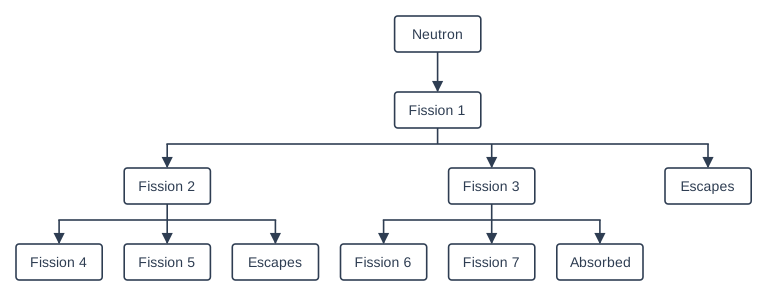
The diagram shows the start of a chain reaction in a sample of uranium-235. A neutron causes fission 1. Each fission releases three neutrons; each arrow shows what happens to one of those neutrons.

Describe what happens to the neutrons from fission 1, and explain whether this chain reaction is growing, steady or dying out.

Flow chart of 11 boxes joined by arrows, read from top to bottom. The first box is "Neutron", which leads to "Fission 1". From "Fission 1", 3 arrows branch out side by side: the left arrow leads to "Fission 2"; the middle arrow leads to "Fission 3"; the right arrow leads to "Escapes". From "Fission 2", 3 arrows branch out side by side: the left arrow leads to "Fission 4"; the middle arrow leads to "Fission 5"; the right arrow leads to "Escapes". From "Fission 3", 3 arrows branch out side by side: the left arrow leads to "Fission 6"; the middle arrow leads to "Fission 7"; the right arrow leads to "Absorbed".

Model answer

Of the three neutrons from fission 1, two go on to cause fissions 2 and 3, and one escapes. Of the six neutrons from fissions 2 and 3, four cause further fissions (4, 5, 6 and 7), one escapes and one is absorbed. The number of fissions goes from 1 to 2 to 4 in successive generations, so the chain reaction is growing: on average two neutrons from each fission cause another fission. If it is not controlled, the rate of fission will keep increasing.

Explanation

To judge a chain reaction, count how many neutrons from each fission cause another fission. More than one means it grows, exactly one means it is steady, and fewer than one means it dies out.

Mark scheme
  1. 1 mark

    from fission 1, two neutrons cause further fissions (2 and 3) and one escapes

  2. 1 mark

    from fissions 2 and 3, four of the six neutrons cause further fissions (4, 5, 6 and 7)

  3. 1 mark

    the number of fissions in each generation increases: 1, 2, 4

  4. 1 mark

    so the chain reaction is growing, because more than one neutron from each fission causes another fission

Ready to try the rest? Every answer you write is marked against the mark scheme, so you can see exactly where the marks are.

AI Tutor Hints first, answers after you try

Hi! Stuck? Ask me for a hint and I’ll help you work it out. Once you’ve checked your answer I can explain exactly where the marks are.