Half-lives and the random nature of radioactive decay
Practise 28 exam-style questions on Half-lives and the random nature of radioactive decay for AQA GCSE Physics. Write your answer as you would in the exam and get it marked in seconds against the mark scheme, point by point, with an AI tutor on hand if you get stuck.
28 questions
1–6 marks each
Instant marking
No sign-up needed
20 questions, marked as you go
Sample questions with model answers
Here are 4 of the questions in this topic, each with a model answer, an explanation of why it earns the marks and the mark scheme an examiner would use.
Question 1
2 marks
Define the half-life of a radioactive isotope in terms of the number of nuclei in a sample.
Model answer
The half-life is the time it takes for the number of nuclei of the isotope in a sample to halve.
Explanation
Half-life is a time: how long it takes for half of the unstable nuclei present to decay. It is the same however many nuclei you start with, so after each half-life the number left is halved again.
Mark scheme
1 mark
the time taken
1 mark
for the number of (undecayed / unstable) nuclei of the isotope in the sample to halve
allow to fall to half its initial value; do not accept "half the time for all the nuclei to decay"
Question 2
2 marks
Explain why it is not possible to state the half-life of a single nucleus.
Model answer
Half-life describes the time for half of a large number of nuclei to decay. A single nucleus either decays or it does not, and when it decays is completely random, so it cannot be predicted.
Explanation
Half-life only has meaning for large numbers, where the randomness averages out. For one nucleus we can only say it has a 50% chance of decaying within one half-life.
Mark scheme
1 mark
half-life is the time for half of a (large) number of nuclei to decay
allow half-life is a statistical / average idea
1 mark
the decay of a single nucleus is random, so you cannot predict when it will decay
allow a single nucleus cannot halve
Question 3
3 marks
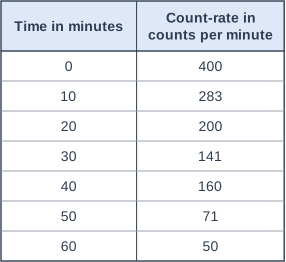
A student recorded the count-rate from a radioactive sample every 10 minutes. The readings have been corrected for background radiation. The table shows the results. One result is anomalous.
Identify the anomalous result and determine the half-life of the isotope. Show how you used the data.
Model answer
The anomalous result is 160 counts per minute at 40 minutes: it is higher than the reading before it, and it should be about 100. The count-rate halves from 400 to 200 counts per minute between 0 and 20 minutes, and from 141 to 71 between 30 and 50 minutes. Half-life = 20 minutes
Explanation
For a decaying source the corrected count-rate should always fall, so a reading that rises is anomalous. Use pairs of values that do not include the anomaly to find the half-life.
Mark scheme
1 mark
the anomalous result is 160 counts per minute at 40 minutes
correct answer with no working scores full marks
1 mark
the count-rate halves from 400 to 200 in 20 minutes
allow 283 to 141 (10 to 30 min) or 141 to 71 (30 to 50 min) or 200 to 100 expected at 40 min
1 mark
half-life = 20 minutes
Question 4
4 marks
Technetium-99m is used in medical imaging. It has a half-life of 6 hours. A patient must be injected with a sample that has an activity of 150 MBq at the time of injection. The sample is prepared 12 hours before the injection.
Calculate the activity the sample must have when it is prepared. Give your answer in becquerels, in standard form.
Model answer
Number of half-lives in 12 hours = 12 ÷ 6 = 2 The activity halves twice, so the starting activity must be 150 × 2 × 2 = 600 MBq 600 MBq = 600 × 10⁶ Bq = 6.0 × 10⁸ Bq
Explanation
Working backwards in time, the activity doubles for each half-life. Mega means 10⁶, so 600 MBq is 6.0 × 10⁸ Bq in standard form.
Mark scheme
1 mark
12 ÷ 6 = 2 half-lives
an answer of 6.0 × 10⁸ (Bq) scores 4 marks
1 mark
the activity must be 4 times larger / 150 × 2 × 2
1 mark
600 MBq
allow ecf
1 mark
6.0 × 10⁸ Bq
allow ecf from an incorrect value in MBq
Ready to try the rest? Every answer you write is marked against the mark scheme, so you can see exactly where the marks are.
Ctrl + Enter to check
AI TutorHints first, answers after you try
Hi! Stuck? Ask me for a hint and I’ll help you work it out. Once you’ve checked your answer I can explain exactly where the marks are.