Practise 31 exam-style questions on Sound waves (physics only) (HT only) for AQA GCSE Physics. Write your answer as you would in the exam and get it marked in seconds against the mark scheme, point by point, with an AI tutor on hand if you get stuck.
31 questions
1–6 marks each
Instant marking
No sign-up needed
20 questions, marked as you go
Sample questions with model answers
Here are 4 of the questions in this topic, each with a model answer, an explanation of why it earns the marks and the mark scheme an examiner would use.
Question 1
2 marks
Four sounds have these frequencies:
5 Hz 50 Hz 5 kHz 50 kHz
Which of these sounds could be heard by a person with normal hearing?
Model answer
50 Hz and 5 kHz. 5 Hz is below the lower limit of 20 Hz, and 50 kHz is above the upper limit of 20 kHz.
Explanation
The normal range of human hearing is 20 Hz to 20 kHz. Check each frequency against both limits, and watch the units: 5 kHz is 5000 Hz, which is well inside the range.
Mark scheme
1 mark
50 Hz
deduct 1 mark for each incorrect frequency included (5 Hz or 50 kHz), to a minimum of 0
1 mark
5 kHz
Question 2
2 marks
A teacher connects a loudspeaker to a signal generator and slowly increases the frequency of the sound. She asks students to raise their hands when they can no longer hear it. Different students stop hearing the sound at different frequencies, all below 20 kHz.
Suggest two reasons why.
Model answer
Different people have different upper limits of hearing; for example, some students may have damaged their hearing by listening to loud music. Also, the loudspeaker may not reproduce high frequencies well, because its cone cannot vibrate easily at those frequencies, so the sound becomes quieter and harder to hear.
Explanation
20 kHz is the upper limit for normal hearing, but many people, even teenagers, cannot hear quite that high. The loudspeaker is also a solid that converts vibrations into sound waves over a limited frequency range.
Mark scheme
1 mark
different people have different upper limits of hearing
max 2; allow some students may have hearing damage (e.g. from loud music)
1 mark
the loudspeaker may not produce high frequencies well / its cone cannot vibrate at high frequencies, so the sound is quieter
1 mark
students further from the loudspeaker receive a quieter sound
1 mark
students' reaction times differ / some do not raise their hands straight away
Question 3
3 marks
A teacher strikes a tuning fork and holds it in the air. The sound is quiet. She then presses the base of the vibrating tuning fork onto a wooden bench, and the sound becomes much louder.
Explain why.
Model answer
When the base touches the bench, the vibrations of the tuning fork are passed into the solid bench, which vibrates at the same frequency. The bench has a much larger surface area than the thin prongs of the fork, so it pushes on much more air and produces sound waves with a larger amplitude, which sound louder.
Explanation
This is an example of vibrations in a solid being converted into sound waves. A large vibrating surface is much better at producing sound than a small one, which is why musical instruments have soundboards or hollow wooden bodies.
Mark scheme
1 mark
the vibrations of the tuning fork are passed into the bench / make the bench vibrate
1 mark
the bench has a much larger surface area than the fork
1 mark
so it makes more air vibrate / produces sound waves with a greater amplitude
allow pushes on more air
Question 4
4 marks
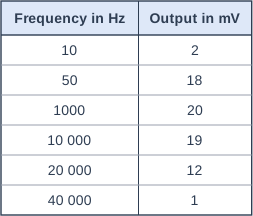
A student tests a microphone. She plays sounds of the same loudness at different frequencies and measures the output from the microphone. The table shows her results.
Suggest the range of frequencies over which the microphone works well. Explain why the output is very small at the highest frequency.
Model answer
The microphone works well from about 50 Hz to about 10 000 Hz, because in this range the output is high and almost the same (18-20 mV) at every frequency. At 40 000 Hz the output is only 1 mV. This is because the diaphragm has mass and stiffness, so it cannot vibrate fast enough to follow such a high-frequency sound wave. Converting sound waves into vibrations of a solid only works over a limited range of frequencies.
Explanation
A microphone, like the ear drum, has a limited frequency range. Outside that range the sound waves still reach it, but the solid diaphragm hardly vibrates, so the output falls.
Mark scheme
1 mark
the microphone works well from about 50 Hz to about 10 000 Hz
allow upper limit between 10 000 Hz and 20 000 Hz
1 mark
because the output is high and almost constant (18-20 mV) in this range
1 mark
at very high frequencies the diaphragm cannot vibrate fast enough (because of its mass / stiffness)
1 mark
the conversion of sound waves into vibrations of a solid only works over a limited frequency range
Ready to try the rest? Every answer you write is marked against the mark scheme, so you can see exactly where the marks are.
Ctrl + Enter to check
AI TutorHints first, answers after you try
Hi! Stuck? Ask me for a hint and I’ll help you work it out. Once you’ve checked your answer I can explain exactly where the marks are.