
Level:
Correct: 0
Incorrect: 0
Marks: 0/0
Exam Practice
Subject:
Topics:
AQA GCSE Physics Smart practice A mixed round aimed at your weak spots
Unit 1
Energy
Energy changes in a system, and the ways energy is stored before and after such changes
Energy stores and systems
0%
Changes in energy
0%
Energy changes in systems
0%
Power
0%
Conservation and dissipation of energy
Energy transfers in a system
0%
Efficiency
0%
Unit 2
Electricity
Unit 3
Particle model of matter
Unit 4
Atomic structure
Unit 5
Forces
Unit 6
Waves
Unit 7
Magnetism and electromagnetism
Unit 8
Space physics (physics only)
Avg
score:
–
Topics
done:
0/91

Energy changes in systems

Practise 34 exam-style questions on Energy changes in systems for AQA GCSE Physics. Write your answer as you would in the exam and get it marked in seconds against the mark scheme, point by point, with an AI tutor on hand if you get stuck.

  • 34 questions
  • 1–6 marks each
  • Instant marking
  • No sign-up needed
20 questions, marked as you go

Sample questions with model answers

Here are 4 of the questions in this topic, each with a model answer, an explanation of why it earns the marks and the mark scheme an examiner would use.

Question 1

2 marks

A 1 kg block of copper and a 1 kg block of aluminium, both at room temperature, are each given 9000 J of energy by heating.

Specific heat capacity of copper = 385 J/kg °C
Specific heat capacity of aluminium = 900 J/kg °C

Which block has the bigger temperature rise? Give a reason for your answer.

Model answer

The copper block has the bigger temperature rise. Copper has a lower specific heat capacity, so less energy is needed to raise the temperature of each kilogram by 1 °C, and the same energy produces a bigger temperature rise (about 23 °C for copper compared with 10 °C for aluminium).

Explanation

For equal masses and equal energy, Δθ = ΔE ÷ (m c), so the temperature rise is inversely proportional to the specific heat capacity. A material with a low specific heat capacity heats up (and cools down) quickly.

Mark scheme
  1. 1 mark

    copper

  2. 1 mark

    copper has a lower specific heat capacity, so less energy is needed to raise the temperature of each kilogram by 1 °C

    allow temperature rise = energy ÷ (m × c), so a smaller c gives a bigger rise; allow calculated values 23 °C and 10 °C
Question 2

2 marks

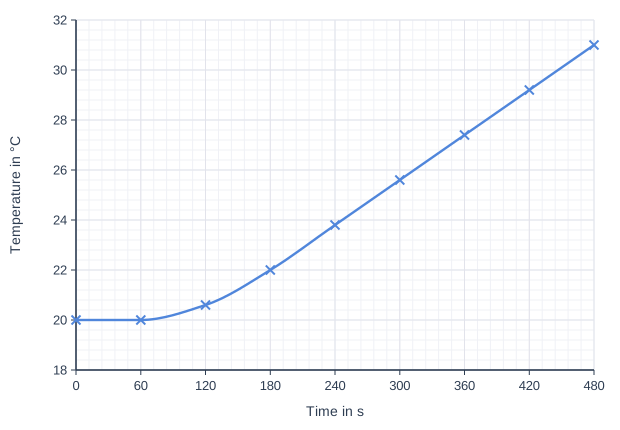
A student heated a metal block with an immersion heater. The graph shows how the temperature of the block changed after the heater was switched on.

The temperature did not start to rise as soon as the heater was switched on.

Suggest why.

Line graph of temperature in °C (y-axis, 18 to 32) against time in s (x-axis, 0 to 480). The line is a smooth curve through (0, 20), (60, 20), (120, 20.6), (180, 22), (240, 23.8), (300, 25.6), (360, 27.4), (420, 29.2), (480, 31).

Model answer

The heater itself has to warm up first, and energy then takes time to be conducted through the metal from the heater to the thermometer. Until it arrives, the block near the thermometer, and the thermometer itself, stay at the starting temperature.

Explanation

This delay is sometimes called thermal lag. It is why the specific heat capacity should be worked out from the straight part of the graph, where the temperature rises steadily, rather than from the start.

Mark scheme
  1. 1 mark

    the heater takes time to heat up / energy takes time to be transferred (by conduction) through the block

  2. 1 mark

    so the part of the block next to the thermometer (and the thermometer) has not yet been heated

    allow the thermometer takes time to reach the temperature of the block

Question 3

3 marks

A cast iron frying pan has a mass of 1.2 kg. It is heated from 20 °C to 100 °C.

Specific heat capacity of cast iron = 450 J/kg °C

Use the equation:
change in thermal energy = mass × specific heat capacity × temperature change

Show that the energy needed is about 43 kJ.

Model answer

Δθ = 100 − 20 = 80 °C
ΔE = m c Δθ
ΔE = 1.2 × 450 × 80
ΔE = 43 200 J = 43.2 kJ, which is about 43 kJ

Explanation

In a show that question the final mark is for a value more precise than the one given. Write out every step so the examiner can see how you reached 43 200 J.

Mark scheme
  1. 1 mark

    temperature change = 80 (°C)

  2. 1 mark

    ΔE = 1.2 × 450 × 80

  3. 1 mark

    ΔE = 43 200 (J)

    allow 43.2 kJ; must see a value more precise than 43 kJ

Question 4

4 marks

A student obtained a value for the specific heat capacity of a metal block that was much higher than the accepted value.

Suggest two improvements to her method, and explain how each would make her value more accurate.

Model answer

First, she could add more insulation, including a lid over the top of the block. This reduces the energy transferred to the surroundings, so more of the energy supplied heats the block and the temperature rise is not too small. Second, she could put a few drops of oil in the thermometer hole. This improves the thermal contact, so the thermometer reads the block's actual temperature.

Explanation

A high value of specific heat capacity means the measured temperature rise was too small for the energy supplied. Good improvements either stop energy escaping or make sure the full temperature rise of the block is measured.

Mark scheme
  1. 1 mark

    improvement: add more insulation / a lid of insulation on top of the block

    max 4; credit any two improvements, each with its matching explanation

  2. 1 mark

    explanation: reduces energy transferred to the surroundings, so more of the energy supplied heats the block

  3. 1 mark

    improvement: put water or oil in the thermometer hole

  4. 1 mark

    explanation: improves thermal contact, so the thermometer reads the block's temperature correctly

  5. 1 mark

    improvement: record the highest temperature reached after the heater is switched off

  6. 1 mark

    explanation: energy is still transferred from the hot heater to the block after switching off, so the full temperature rise is measured

  7. 1 mark

    improvement: use a thermometer with a higher resolution / heat for longer to get a larger temperature rise

  8. 1 mark

    explanation: reduces the (percentage) uncertainty in the temperature change

Ready to try the rest? Every answer you write is marked against the mark scheme, so you can see exactly where the marks are.

AI Tutor Hints first, answers after you try

Hi! Stuck? Ask me for a hint and I’ll help you work it out. Once you’ve checked your answer I can explain exactly where the marks are.