
Level:
Correct: 0
Incorrect: 0
Marks: 0/0
Exam Practice
Subject:
Topics:
AQA GCSE Physics Smart practice A mixed round aimed at your weak spots
Unit 1
Energy
Energy changes in a system, and the ways energy is stored before and after such changes
Energy stores and systems
0%
Changes in energy
0%
Energy changes in systems
0%
Power
0%
Conservation and dissipation of energy
Energy transfers in a system
0%
Efficiency
0%
Unit 2
Electricity
Unit 3
Particle model of matter
Unit 4
Atomic structure
Unit 5
Forces
Unit 6
Waves
Unit 7
Magnetism and electromagnetism
Unit 8
Space physics (physics only)
Avg
score:
–
Topics
done:
0/91

Pressure in a fluid 2 (physics only) (HT only)

Practise 39 exam-style questions on Pressure in a fluid 2 (physics only) (HT only) for AQA GCSE Physics. Write your answer as you would in the exam and get it marked in seconds against the mark scheme, point by point, with an AI tutor on hand if you get stuck.

  • 39 questions
  • 1–6 marks each
  • Instant marking
  • No sign-up needed
20 questions, marked as you go

Sample questions with model answers

Here are 4 of the questions in this topic, each with a model answer, an explanation of why it earns the marks and the mark scheme an examiner would use.

Question 1

2 marks

Explain why the pressure at a point in a liquid increases as the depth of that point below the surface increases.

Model answer

At a greater depth there is a taller column of liquid above the point. This means there is a greater weight of liquid above each square metre, so the force on each square metre, and therefore the pressure, is greater.

Explanation

Pressure in a liquid is caused by the weight of the liquid above. A deeper point has more liquid above it pressing down, so the pressure is bigger. This is why pressure = height of column × density × gravitational field strength.

Mark scheme
  1. 1 mark

    there is a greater height / column of liquid above the point

    allow more liquid above it

  2. 1 mark

    so there is a greater weight of liquid above (pushing down on each square metre)

    allow greater force on the same area; an answer that only quotes p = h ρ g and says p increases as h increases scores 1 mark
Question 2

3 marks

A tall measuring cylinder contains cooking oil to a depth of 45 cm.

Use the equation:
pressure due to a column of liquid = height of column × density of liquid × gravitational field strength

density of cooking oil = 920 kg/m³
gravitational field strength = 9.8 N/kg

Calculate the pressure due to the oil at the bottom of the measuring cylinder.
Give your answer to 2 significant figures.

Model answer

h = 45 cm = 0.45 m
p = h ρ g = 0.45 × 920 × 9.8
p = 4057.2 Pa
p = 4100 Pa (2 s.f.)

Explanation

The height must be in metres before it is put into the equation, otherwise the answer is 100 times too big. Then round only the final answer: 4057.2 to 2 significant figures is 4100, not 4000 or 41.

Mark scheme
  1. 1 mark

    45 cm = 0.45 m

    an answer of 4100 (Pa) scores 3 marks

  2. 1 mark

    p = 0.45 × 920 × 9.8 (= 4057.2)

    allow ecf from an incorrect conversion, e.g. 45 × 920 × 9.8 = 405 720 scores 2 marks if then given correctly to 2 s.f. (410 000)

  3. 1 mark

    4100 (Pa)

    answer must be to 2 significant figures for this mark; allow 4.1 × 10³ Pa; allow 4.1 kPa

Question 3

3 marks

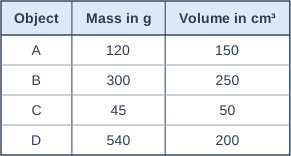
The table shows the mass and volume of four solid objects, A, B, C and D.

The density of water is 1.0 g/cm³.

Determine which of the objects will float in water. Show how you get your answer.

Table with columns "Object", "Mass in g", "Volume in cm³". Object: A; Mass in g: 120; Volume in cm³: 150 | Object: B; Mass in g: 300; Volume in cm³: 250 | Object: C; Mass in g: 45; Volume in cm³: 50 | Object: D; Mass in g: 540; Volume in cm³: 200.

Model answer

Density = mass ÷ volume
A: 120 ÷ 150 = 0.80 g/cm³
B: 300 ÷ 250 = 1.2 g/cm³
C: 45 ÷ 50 = 0.90 g/cm³
D: 540 ÷ 200 = 2.7 g/cm³
A and C float, because their densities are less than 1.0 g/cm³. B and D sink.

Explanation

An object floats if its density is less than the density of the liquid, because it can displace its own weight of liquid while still partly above the surface. B and D are denser than water, so their weight is always greater than the upthrust and they sink.

Mark scheme
  1. 1 mark

    density = mass ÷ volume used for the objects

    max 3; correct answer with no working scores full marks

  2. 1 mark

    densities: A 0.80, B 1.2, C 0.90, D 2.7 (g/cm³)

    all four needed for this mark; allow comparison of mass with volume (mass in g less than volume in cm³) for both of the first two marks

  3. 1 mark

    A and C float because their density is less than the density of water

    both A and C, and no others, for this mark; allow ecf from their densities

Question 4

5 marks

The viewing window of a research submarine has an area of 0.050 m². The window can safely withstand a force of 1.2 × 10⁵ N from the water outside. The air inside the submarine is at atmospheric pressure, so only the pressure due to the water needs to be considered.

Use the equation:
pressure due to a column of liquid = height of column × density of liquid × gravitational field strength

density of seawater = 1030 kg/m³
gravitational field strength = 9.8 N/kg

Calculate the maximum depth at which the submarine can safely operate.
Give your answer to 2 significant figures.

Model answer

Maximum pressure: p = F ÷ A = 1.2 × 10⁵ ÷ 0.050 = 2.4 × 10⁶ Pa
p = h ρ g, so h = p ÷ (ρ g)
h = 2.4 × 10⁶ ÷ (1030 × 9.8) = 2 400 000 ÷ 10 094 = 237.8 m
h = 240 m (2 s.f.)

Explanation

This combines two equations. Use p = F ÷ A to find the largest pressure the window can take, then rearrange p = h ρ g to find the depth at which the water reaches that pressure. Below this depth the force on the window would exceed its safe limit.

Mark scheme
  1. 1 mark

    p = 1.2 × 10⁵ ÷ 0.050

    an answer of 240 (m) scores 5 marks

  2. 1 mark

    p = 2.4 × 10⁶ (Pa)

    allow 2 400 000 Pa

  3. 1 mark

    2.4 × 10⁶ = h × 1030 × 9.8

    allow ecf from their pressure

  4. 1 mark

    h = 2.4 × 10⁶ ÷ (1030 × 9.8) (= 237.8)

    rearrangement; allow ecf

  5. 1 mark

    240 (m)

    answer must be to 2 significant figures; allow ecf from their unrounded depth

Ready to try the rest? Every answer you write is marked against the mark scheme, so you can see exactly where the marks are.

AI Tutor Hints first, answers after you try

Hi! Stuck? Ask me for a hint and I’ll help you work it out. Once you’ve checked your answer I can explain exactly where the marks are.