Level:
Correct: 0
Incorrect: 0
Marks: 0/0
Exam Practice
Subject:
Topics:
AQA GCSE Physics Smart practice A mixed round aimed at your weak spots
Unit 1
Energy
Energy changes in a system, and the ways energy is stored before and after such changes
Energy stores and systems
0%
Changes in energy
0%
Energy changes in systems
0%
Power
0%
Conservation and dissipation of energy
Energy transfers in a system
0%
Efficiency
0%
Unit 2
Electricity
Unit 3
Particle model of matter
Unit 4
Atomic structure
Unit 5
Forces
Unit 6
Waves
Unit 7
Magnetism and electromagnetism
Unit 8
Space physics (physics only)
Avg
score:
–
Topics
done:
0/91

Scalar and vector quantities

Practise 20 exam-style questions on Scalar and vector quantities for AQA GCSE Physics. Write your answer as you would in the exam and get it marked in seconds against the mark scheme, point by point, with an AI tutor on hand if you get stuck.

  • 20 questions
  • 1–6 marks each
  • Instant marking
  • No sign-up needed
20 questions, marked as you go

Sample questions with model answers

Here are 4 of the questions in this topic, each with a model answer, an explanation of why it earns the marks and the mark scheme an examiner would use.

Question 1

2 marks

State what is meant by a vector quantity.

Model answer

A vector quantity has both magnitude (size) and an associated direction.

Explanation

To describe a vector fully you must give its size and its direction, for example '20 N downwards' or '15 m/s north'. Force, velocity, displacement, acceleration and momentum are all vectors.

Mark scheme
  1. 1 mark

    has magnitude / size

  2. 1 mark

    and (an associated) direction

Question 2

2 marks

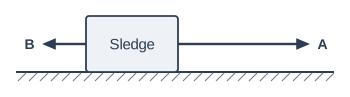
The diagram shows the two horizontal forces, A and B, acting on a sledge. The arrows are drawn to the same scale.

Force A is 30 N.

Determine the size of force B. Give a reason for your answer.

Free body diagram: a box labelled "Sledge" resting on a horizontal surface with 2 force arrows. An arrow labelled A starts at the object and points to the right; an arrow labelled B starts at the object and points to the left. Arrow lengths are in proportion to the forces: B is a third of the length of A.

Model answer

Force B is 10 N. The length of each arrow represents the size of the force, and arrow B is one-third as long as arrow A, so force B = 30 N ÷ 3 = 10 N.

Explanation

When arrows are drawn to the same scale, comparing their lengths compares the sizes of the forces. The arrows also point in opposite directions, which shows the two forces act in opposite directions.

Mark scheme
  1. 1 mark

    10 N

    correct answer with no working scores full marks

  2. 1 mark

    arrow B is one-third of the length of arrow A, and the length of an arrow represents the magnitude of the force

    allow arrow B is a third as long as A

Question 3

3 marks

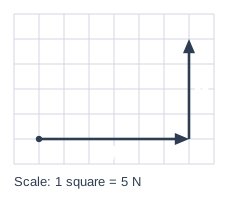
A student represents two forces, P and Q, acting on an object as arrows on squared paper. The diagram shows the arrows, drawn to scale.

Determine the magnitude of force P and the magnitude of force Q.
Describe the direction of force Q compared with the direction of force P.

Scale drawing on a square grid (scale: 1 square = 5 N). A force arrow labelled P is drawn 6 squares long horizontally to the right from a starting point; from its tip a second arrow labelled Q is drawn 4 squares long vertically upwards. No resultant is drawn.

Model answer

Each square represents 5 N.
Arrow P is 6 squares long, so P = 6 × 5 N = 30 N.
Arrow Q is 4 squares long, so Q = 4 × 5 N = 20 N.
P acts horizontally to the right and Q acts vertically upwards, so Q is at right angles (90°) to P.

Explanation

In a scale drawing, count the squares along each arrow and multiply by the scale. The direction of each arrow shows the direction of each force, which is what makes force a vector quantity.

Mark scheme
  1. 1 mark

    P = 30 N

    6 squares × 5 N; correct answer with no working scores full marks

  2. 1 mark

    Q = 20 N

    4 squares × 5 N

  3. 1 mark

    Q acts at right angles / 90° to P

    allow P is to the right and Q is upwards / perpendicular

Question 4

4 marks

Two identical trolleys, each of mass 2.0 kg, move towards each other along a straight track. Each trolley has a speed of 3.0 m/s.

Calculate the total momentum of the two trolleys.
Explain your answer.

Model answer

Momentum of each trolley = mass × velocity = 2.0 kg × 3.0 m/s = 6.0 kg m/s.
Momentum is a vector, and the trolleys move in opposite directions. Taking one direction as positive, one trolley has momentum +6.0 kg m/s and the other −6.0 kg m/s.
Total momentum = 6.0 + (−6.0) = 0 kg m/s.

Explanation

Vectors in opposite directions must be given opposite signs before they are added. Adding the sizes to get 12 kg m/s ignores direction and treats momentum as if it were a scalar. A total momentum of zero does not mean nothing is moving - it means the momenta in the two directions are equal and opposite.

Mark scheme
  1. 1 mark

    momentum of each trolley = 2.0 × 3.0 = 6.0 kg m/s

    an answer of 0 with a correct explanation scores 4 marks

  2. 1 mark

    momentum is a vector and the trolleys move in opposite directions

  3. 1 mark

    so one momentum is +6.0 kg m/s and the other is −6.0 kg m/s / total = 6.0 + (−6.0)

  4. 1 mark

    total momentum = 0

    do not accept 12 kg m/s

Ready to try the rest? Every answer you write is marked against the mark scheme, so you can see exactly where the marks are.

AI Tutor Hints first, answers after you try

Hi! Stuck? Ask me for a hint and I’ll help you work it out. Once you’ve checked your answer I can explain exactly where the marks are.