Practise 35 exam-style questions on Current, resistance and potential difference for AQA GCSE Physics. Write your answer as you would in the exam and get it marked in seconds against the mark scheme, point by point, with an AI tutor on hand if you get stuck.
35 questions
1–6 marks each
Instant marking
No sign-up needed
20 questions, marked as you go
Sample questions with model answers
Here are 4 of the questions in this topic, each with a model answer, an explanation of why it earns the marks and the mark scheme an examiner would use.
Question 1
2 marks
The current in a resistor is 0.25 A. The resistance of the resistor is 48 Ω.
Calculate the potential difference across the resistor.
Model answer
V = I R V = 0.25 × 48 V = 12 V
Explanation
Potential difference = current × resistance. Here no rearranging is needed: multiply the current in amperes by the resistance in ohms to get volts.
Mark scheme
1 mark
V = 0.25 × 48
an answer of 12 (V) scores 2 marks
1 mark
12 (V)
Question 2
2 marks
The potential difference across a resistor at constant temperature is doubled.
Describe and explain what happens to the current through the resistor.
Model answer
The current doubles. At constant temperature the resistance of the resistor does not change, and since I = V ÷ R, the current is directly proportional to the potential difference.
Explanation
When R is constant, the equation V = I R shows V and I are directly proportional. This is only true while the temperature stays the same; a hotter resistor would have a larger resistance.
Mark scheme
1 mark
the current doubles
do not accept the current increases on its own
1 mark
the resistance stays the same, and I = V ÷ R, so the current is (directly) proportional to the potential difference
Question 3
3 marks
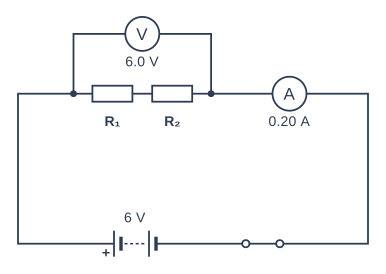
In a practical, a student connects two resistors in series: R₁ has a resistance of 10 Ω and R₂ has a resistance of 20 Ω. The circuit diagram shows the meter readings.
Calculate the total resistance of the two resistors from the meter readings. Explain what the result shows.
Model answer
R = V ÷ I = 6.0 ÷ 0.20 = 30 Ω This is equal to 10 Ω + 20 Ω, which shows that the total resistance of resistors in series is the sum of the individual resistances.
Explanation
The voltmeter is connected across both resistors together, so V ÷ I gives their combined resistance. In series, the charge must pass through each resistor in turn, so the resistances add up.
Mark scheme
1 mark
R = 6.0 ÷ 0.20
allow 6.0 = 0.20 × R; an answer of 30 (Ω) scores the first 2 marks
1 mark
30 (Ω)
1 mark
this equals R₁ + R₂ (10 + 20): the total resistance of resistors in series is the sum of their resistances
allow ecf only if their answer is compared correctly with 30 Ω
Question 4
4 marks
The resistance of a person's body between their hands is about 100 kΩ when the skin is dry, but only about 1.0 kΩ when the skin is wet.
Calculate the current through a person with wet skin who touches a 230 V supply with one hand and an earthed object with the other. Use your answer to explain why it is much more dangerous to touch a live wire with wet hands.
Model answer
I = V ÷ R = 230 ÷ 1000 = 0.23 A With dry skin the current would be 230 ÷ 100 000 = 0.0023 A. Wet skin has a resistance 100 times smaller, so the current is 100 times larger. A current of 0.23 A through the body is large enough to cause a fatal electric shock, so touching a live wire with wet hands is far more dangerous.
Explanation
For the same potential difference, the current is inversely proportional to the resistance. Water lowers the resistance of the skin, so the current through the body is much greater. This is why electrical sockets are not allowed near baths and showers.
Mark scheme
1 mark
I = 230 ÷ 1000
allow 230 = I × 1000; an answer of 0.23 A scores the first 2 marks
1 mark
0.23 (A)
allow 230 mA
1 mark
wet skin has a much lower resistance, so the current is much larger (100 times larger than with dry skin)
allow dry skin current = 0.0023 A / 2.3 mA
1 mark
a larger current through the body is more likely to cause a serious / fatal electric shock
allow can stop the heart / cause burns
Ready to try the rest? Every answer you write is marked against the mark scheme, so you can see exactly where the marks are.
Ctrl + Enter to check
AI TutorHints first, answers after you try
Hi! Stuck? Ask me for a hint and I’ll help you work it out. Once you’ve checked your answer I can explain exactly where the marks are.