Level:
Correct: 0
Incorrect: 0
Marks: 0/0
Exam Practice
Subject:
Topics:
AQA GCSE Physics Smart practice A mixed round aimed at your weak spots
Unit 1
Energy
Energy changes in a system, and the ways energy is stored before and after such changes
Energy stores and systems
0%
Changes in energy
0%
Energy changes in systems
0%
Power
0%
Conservation and dissipation of energy
Energy transfers in a system
0%
Efficiency
0%
Unit 2
Electricity
Unit 3
Particle model of matter
Unit 4
Atomic structure
Unit 5
Forces
Unit 6
Waves
Unit 7
Magnetism and electromagnetism
Unit 8
Space physics (physics only)
Avg
score:
–
Topics
done:
0/91

Perfect black bodies and radiation (physics only)

Practise 38 exam-style questions on Perfect black bodies and radiation (physics only) for AQA GCSE Physics. Write your answer as you would in the exam and get it marked in seconds against the mark scheme, point by point, with an AI tutor on hand if you get stuck.

  • 38 questions
  • 1–6 marks each
  • Instant marking
  • No sign-up needed
20 questions, marked as you go

Sample questions with model answers

Here are 4 of the questions in this topic, each with a model answer, an explanation of why it earns the marks and the mark scheme an examiner would use.

Question 1

2 marks

An ice cube is taken out of a freezer at −18 °C.

A student says that the ice cube does not emit any radiation because it is so cold.

Explain why the student is wrong.

Model answer

All objects emit radiation, whatever their temperature, so the ice cube does emit radiation. Because it is cold, it emits infrared radiation at a lower intensity than a warmer object would.

Explanation

Emission of radiation depends on temperature, but it never stops: even very cold objects emit some infrared radiation. A colder object emits radiation of lower intensity, with most of it at longer wavelengths.

Mark scheme
  1. 1 mark

    all objects emit radiation, whatever their temperature

    allow all bodies emit radiation

  2. 1 mark

    the ice cube does emit (infrared) radiation, but at a lower intensity / less radiation than a warmer object

    allow it emits less radiation because it is at a lower temperature
Question 2

2 marks

On average, the Earth's surface and atmosphere absorb radiation from the Sun at a rate of 240 W/m².

Over several years, the average temperature of the Earth stays constant.

State the average rate at which the Earth emits radiation into space. Give a reason for your answer.

Model answer

240 W/m². The temperature is constant, so the Earth must be emitting radiation at the same rate as it absorbs radiation.

Explanation

A constant temperature means the energy coming in each second equals the energy going out each second. If the Earth emitted less than 240 W/m², it would gain energy and its temperature would rise.

Mark scheme
  1. 1 mark

    240 W/m²

    allow 240 with no unit

  2. 1 mark

    because at a constant temperature the rate of emission equals the rate of absorption

    allow there is no net gain or loss of energy

Question 3

3 marks

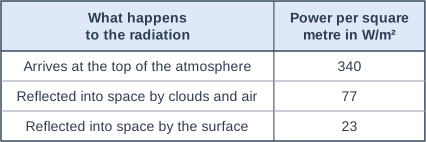
The table shows what happens, on average, to the radiation from the Sun that reaches the top of the Earth's atmosphere.

The rest of the incoming radiation is absorbed by the Earth's surface and atmosphere.

Calculate the percentage of the incoming radiation that is absorbed by the Earth's surface and atmosphere.

Table with columns "What happens to the radiation", "Power per square metre in W/m²". What happens to the radiation: Arrives at the top of the atmosphere; Power per square metre in W/m²: 340 | What happens to the radiation: Reflected into space by clouds and air; Power per square metre in W/m²: 77 | What happens to the radiation: Reflected into space by the surface; Power per square metre in W/m²: 23.

Model answer

Radiation absorbed = 340 − 77 − 23 = 240 W/m²
Percentage absorbed = (240 ÷ 340) × 100
= 70.6% ≈ 71%

Explanation

Radiation that is not reflected back into space is absorbed, so subtract both reflected amounts from the incoming radiation. About 29% of the Sun's radiation is reflected by clouds, the atmosphere and the surface; the other 71% warms the Earth.

Mark scheme
  1. 1 mark

    absorbed = 340 − 77 − 23 = 240 (W/m²)

    an answer of 71 (%) scores 3 marks

  2. 1 mark

    percentage = (240 ÷ 340) × 100

    allow ecf from an incorrect absorbed value

  3. 1 mark

    71 (%)

    allow 70.6 or 70.59 (%); allow ecf; an answer of 29 (%) (the percentage reflected) scores 1 mark

Question 4

4 marks

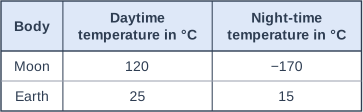
The Moon and the Earth are about the same distance from the Sun. The table shows typical daytime and night-time surface temperatures on the Moon and at one place on the Earth.

The Moon has no atmosphere.

Explain, in terms of the absorption and emission of radiation, why the surface temperature of the Moon changes so much more than the surface temperature of the Earth.

Table with columns "Body", "Daytime temperature in °C", "Night-time temperature in °C". Body: Moon; Daytime temperature in °C: 120; Night-time temperature in °C: −170 | Body: Earth; Daytime temperature in °C: 25; Night-time temperature in °C: 15.

Model answer

The Moon has no atmosphere, so there are no clouds and no greenhouse gases. During the day none of the Sun's radiation is reflected or absorbed before it reaches the surface, so the surface absorbs radiation at a high rate and becomes very hot. At night the infrared radiation emitted by the surface escapes straight into space, so the surface emits much faster than it absorbs and its temperature falls a long way. On the Earth, the atmosphere absorbs infrared from the surface and re-emits some of it back, so the surface cools much less at night.

Explanation

An atmosphere acts like a blanket for radiation: clouds reflect some sunlight in the day and greenhouse gases send infrared back at night. Without one, the balance between absorption and emission swings strongly between day and night, so the temperature range is huge.

Mark scheme
  1. 1 mark

    the Moon has no atmosphere, so there are no greenhouse gases / clouds

    max 4

  2. 1 mark

    at night, infrared radiation emitted by the Moon's surface escapes directly into space

    allow none of it is absorbed and re-emitted back to the surface

  3. 1 mark

    so at night the Moon's surface emits radiation much faster than it absorbs radiation and its temperature falls a lot

  4. 1 mark

    in the day, there are no clouds or atmosphere to reflect or absorb any of the Sun's radiation, so the surface absorbs radiation at a high rate and gets very hot

  5. 1 mark

    on the Earth, the atmosphere absorbs infrared from the surface and re-emits some back, so the surface loses energy more slowly at night

  6. 1 mark

    a day and a night on the Moon each last about two weeks, so there is more time to heat up and cool down

    allow as a further point if linked to absorption or emission

Ready to try the rest? Every answer you write is marked against the mark scheme, so you can see exactly where the marks are.

AI Tutor Hints first, answers after you try

Hi! Stuck? Ask me for a hint and I’ll help you work it out. Once you’ve checked your answer I can explain exactly where the marks are.