Practise 25 exam-style questions on Particle motion in gases for AQA GCSE Physics. Write your answer as you would in the exam and get it marked in seconds against the mark scheme, point by point, with an AI tutor on hand if you get stuck.
25 questions
1–6 marks each
Instant marking
No sign-up needed
20 questions, marked as you go
Sample questions with model answers
Here are 4 of the questions in this topic, each with a model answer, an explanation of why it earns the marks and the mark scheme an examiner would use.
Question 1
2 marks
A sealed glass bottle full of air is put into a freezer.
Describe how the motion of the air molecules inside the bottle changes as the air cools.
Model answer
As the air cools, the average kinetic energy of the molecules decreases, so they move more slowly. They are still in random motion, but they collide with the walls of the bottle less often and with less force.
Explanation
Cooling a gas does not stop its molecules moving; it lowers their average speed. A common mistake is to say the molecules shrink or stop - they stay the same size and keep moving randomly.
Mark scheme
1 mark
the molecules move more slowly (on average) / their average kinetic energy decreases
do not accept the molecules stop moving
1 mark
they collide with the walls of the bottle less often (and with less force)
allow the motion is still random
Question 2
2 marks
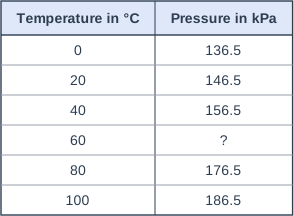
The table shows how the pressure of a gas in a sealed, rigid canister changes with temperature.
Predict the pressure of the gas at 60 °C. Explain how you made your prediction.
Model answer
The pressure goes up by 10 kPa for every 20 °C rise in temperature. 60 °C is 20 °C above 40 °C, so the pressure is 156.5 + 10 = 166.5 kPa.
Explanation
Look for the pattern in the data before predicting: here equal temperature steps give equal pressure increases, so the missing value is halfway between the values at 40 °C and 80 °C.
Mark scheme
1 mark
the pressure increases by 10 kPa for every 20 °C rise in temperature
allow 0.5 kPa per °C; allow the pattern is linear / halfway between 40 °C and 80 °C
1 mark
166.5 (kPa)
allow 166-167 kPa
Question 3
3 marks
A table tennis ball is sealed and contains air. The ball has a small dent in it. When the ball is put into a bowl of hot water, the dent pops out.
Explain why the dent pops out.
Model answer
The hot water heats the air inside the ball, so the air molecules gain kinetic energy and move faster. They collide with the inside wall of the ball more often and with greater force, so the pressure inside the ball increases. The pressure inside becomes greater than the pressure outside, so the dented part of the wall is pushed outwards.
Explanation
The ball's volume hardly changes, so heating the air raises its pressure. The extra outward force on the wall is enough to push the dent back out.
Mark scheme
1 mark
the air inside the ball is heated, so its molecules gain kinetic energy / move faster
1 mark
the molecules collide with the inside of the ball more often and with more force
1 mark
so the pressure inside increases (and becomes greater than outside), pushing the dent outwards
allow larger force on the inside of the dented wall
Question 4
4 marks
Hot jam is poured into a glass jar and a metal lid is screwed on tightly, trapping hot air above the jam. As the jar cools, the centre of the lid is pulled inwards.
Explain why.
Model answer
As the trapped air cools, its molecules lose kinetic energy and move more slowly. They collide with the lid less often and with less force, so the pressure of the air inside the jar decreases (its volume cannot change). The pressure of the atmosphere outside is now greater than the pressure inside, so there is a resultant force on the lid that pushes its centre inwards.
Explanation
At constant volume, lower temperature means lower pressure. The lid moves because the pressures on its two sides are no longer balanced: the outside air pushes harder than the air inside.
Mark scheme
1 mark
the trapped air cools, so its molecules have less kinetic energy / move more slowly
1 mark
the molecules collide with the lid less often and with less force
allow fewer collisions per second
1 mark
so the pressure of the air inside the jar decreases (the volume is constant)
1 mark
the air pressure outside is now greater than inside, so there is a resultant force pushing the lid inwards
allow atmospheric pressure pushes the lid in
Ready to try the rest? Every answer you write is marked against the mark scheme, so you can see exactly where the marks are.
Ctrl + Enter to check
AI TutorHints first, answers after you try
Hi! Stuck? Ask me for a hint and I’ll help you work it out. Once you’ve checked your answer I can explain exactly where the marks are.