Practise 25 exam-style questions on Transverse and longitudinal waves for AQA GCSE Physics. Write your answer as you would in the exam and get it marked in seconds against the mark scheme, point by point, with an AI tutor on hand if you get stuck.
25 questions
1–6 marks each
Instant marking
No sign-up needed
20 questions, marked as you go
Sample questions with model answers
Here are 4 of the questions in this topic, each with a model answer, an explanation of why it earns the marks and the mark scheme an examiner would use.
Question 1
1 mark
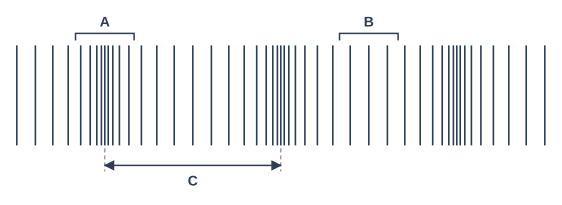
The diagram shows a longitudinal wave travelling along a stretched spring.
Which letter shows a rarefaction?
Model answer
B - the region where the coils are spread out furthest apart.
Explanation
A rarefaction is a region where the coils (or particles) are spread out furthest apart. A compression, such as A, is where they are bunched closest together. C shows one wavelength, from the centre of one compression to the centre of the next.
Mark scheme
1 mark
B
Question 2
2 marks
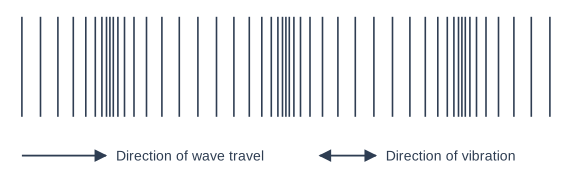
The diagram shows a wave. The arrows show the direction of vibration and the direction of wave travel.
What type of wave is shown? Give a reason for your answer.
Model answer
It is a longitudinal wave, because the direction of vibration is parallel to the direction in which the wave travels. The coils are bunched together in compressions and spread out in rarefactions.
Explanation
Look at the arrows: both are horizontal, so the vibrations are along the direction of travel. In a transverse wave the vibration arrow would be at right angles to the travel arrow.
Mark scheme
1 mark
longitudinal
1 mark
the vibrations are parallel to the direction of wave travel
allow it has compressions and rarefactions
Question 3
3 marks
A worker on a railway puts his ear against a steel rail. He can hear a train that is a long way off, because sound travels through the steel rail.
Describe how the sound wave travels through the rail. Refer to the motion of the atoms in the steel.
Model answer
The sound travels through the rail as a longitudinal wave. The atoms in the steel vibrate backwards and forwards along the length of the rail, parallel to the direction in which the wave travels. Each atom passes its vibration on to the next atom, forming compressions and rarefactions that travel along the rail, while the atoms themselves stay in roughly the same positions.
Explanation
Sound can travel through solids, liquids and gases because they all contain particles that can vibrate. In a solid the atoms are held tightly together, so the vibrations are passed on very quickly - sound travels much faster in steel than in air.
Mark scheme
1 mark
the sound travels as a longitudinal wave
1 mark
the atoms vibrate backwards and forwards parallel to the direction the wave travels (along the rail)
1 mark
each atom passes the vibration on to the next / the atoms do not travel along the rail
allow the energy is passed along the rail, not the steel; allow compressions and rarefactions travel along the rail
Question 4
4 marks
A loudspeaker contains a cone that vibrates backwards and forwards.
Explain how the vibrating cone produces a sound wave in the air in front of it.
Model answer
When the cone moves forwards, it pushes the air particles in front of it closer together, forming a compression. When the cone moves backwards, the air particles spread out, forming a rarefaction. Because the cone vibrates continuously, it produces a series of compressions and rarefactions. The air particles pass these vibrations on to their neighbours, so a longitudinal wave travels away from the loudspeaker while each particle only vibrates backwards and forwards.
Explanation
The particles vibrate parallel to the direction of travel, which is why sound is longitudinal. Each vibration of the cone makes one compression and one rarefaction, so the frequency of the sound equals the frequency of the cone's vibration.
Mark scheme
1 mark
when the cone moves forwards it pushes air particles closer together
1 mark
forming a compression
allow a region of higher pressure
1 mark
when the cone moves backwards the air particles spread out, forming a rarefaction
allow a region of lower pressure
1 mark
the air particles pass the vibrations on, so a series of compressions and rarefactions (a longitudinal wave) travels away from the cone
allow the particles vibrate parallel to the direction the wave travels
Ready to try the rest? Every answer you write is marked against the mark scheme, so you can see exactly where the marks are.
Ctrl + Enter to check
AI TutorHints first, answers after you try
Hi! Stuck? Ask me for a hint and I’ll help you work it out. Once you’ve checked your answer I can explain exactly where the marks are.