
Level:
Correct: 0
Incorrect: 0
Marks: 0/0
Exam Practice
Subject:
Topics:
AQA GCSE Physics Smart practice A mixed round aimed at your weak spots
Unit 1
Energy
Energy changes in a system, and the ways energy is stored before and after such changes
Energy stores and systems
0%
Changes in energy
0%
Energy changes in systems
0%
Power
0%
Conservation and dissipation of energy
Energy transfers in a system
0%
Efficiency
0%
Unit 2
Electricity
Unit 3
Particle model of matter
Unit 4
Atomic structure
Unit 5
Forces
Unit 6
Waves
Unit 7
Magnetism and electromagnetism
Unit 8
Space physics (physics only)
Avg
score:
–
Topics
done:
0/91

Microphones (physics only) (HT only)

Practise 22 exam-style questions on Microphones (physics only) (HT only) for AQA GCSE Physics. Write your answer as you would in the exam and get it marked in seconds against the mark scheme, point by point, with an AI tutor on hand if you get stuck.

  • 22 questions
  • 1–6 marks each
  • Instant marking
  • No sign-up needed
20 questions, marked as you go

Sample questions with model answers

Here are 4 of the questions in this topic, each with a model answer, an explanation of why it earns the marks and the mark scheme an examiner would use.

Question 1

2 marks

The diaphragm of a microphone is a thin, flexible sheet.

Explain why the diaphragm vibrates when a sound wave reaches it.

Model answer

A sound wave is made of compressions and rarefactions, so the air pressure on the diaphragm keeps rising and falling. The higher pressure pushes the diaphragm in and the lower pressure lets it move back out, so it vibrates back and forth.

Explanation

Sound is a longitudinal wave of pressure variations. The diaphragm is light and flexible so these small pressure changes are enough to move it, and it vibrates at the same frequency as the sound.

Mark scheme
  1. 1 mark

    a sound wave is a series of compressions and rarefactions / pressure variations in the air

    allow the air pressure on the diaphragm keeps changing

  2. 1 mark

    the changing pressure pushes the diaphragm in and then lets it move out (so it moves back and forth)

    allow higher pressure pushes it inwards, lower pressure lets it move outwards
Question 2

2 marks

A moving-coil microphone is connected to an oscilloscope in a completely silent room. No potential difference is shown.

A student says: "The microphone contains a magnet, so it should produce a potential difference all the time."

Explain why no potential difference is produced.

Model answer

With no sound there are no pressure variations, so the diaphragm and coil stay still. A potential difference is only induced when the coil moves relative to the magnetic field and cuts field lines, so although the magnet is there, no p.d. is induced.

Explanation

A magnetic field on its own does not induce a potential difference. The generator effect needs relative movement, or a changing field, so the microphone only produces a signal when sound makes the coil move.

Mark scheme
  1. 1 mark

    there is no sound, so the diaphragm and coil do not move

  2. 1 mark

    a p.d. is only induced when the coil moves relative to the magnetic field / cuts field lines

    allow there is no change in the magnetic field through the coil

Question 3

3 marks

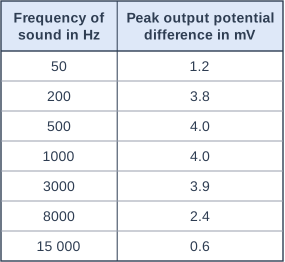
A sound engineer tests a microphone. She plays sounds of different frequencies at the same loudness and measures the peak output potential difference. The table shows her results.

The microphone will be used to record a violin. The notes played on the violin have frequencies between 200 Hz and 3000 Hz.

Evaluate whether this microphone is suitable for recording the violin. Use data from the table.

Table with columns "Frequency of sound in Hz", "Peak output potential difference in mV". Frequency of sound in Hz: 50; Peak output potential difference in mV: 1.2 | Frequency of sound in Hz: 200; Peak output potential difference in mV: 3.8 | Frequency of sound in Hz: 500; Peak output potential difference in mV: 4.0 | Frequency of sound in Hz: 1000; Peak output potential difference in mV: 4.0 | Frequency of sound in Hz: 3000; Peak output potential difference in mV: 3.9 | Frequency of sound in Hz: 8000; Peak output potential difference in mV: 2.4 | Frequency of sound in Hz: 15 000; Peak output potential difference in mV: 0.6.

Model answer

Between 200 Hz and 3000 Hz the output potential difference only changes from 3.8 mV to 4.0 mV, so it is almost constant. This means violin notes of the same loudness will give almost the same output, so the recording will be accurate and the microphone is suitable. However, the engineer only tested a few frequencies in this range, so the output could dip between them, and she only tested one loudness.

Explanation

A good microphone produces the same size output for sounds of the same loudness at every frequency it needs to record. Look at the data inside the required range, then consider any limitations in the evidence.

Mark scheme
  1. 1 mark

    between 200 Hz and 3000 Hz the output is almost constant / between 3.8 mV and 4.0 mV

  2. 1 mark

    so notes of the same loudness give (almost) the same output / the recording will be accurate, so it is suitable

    allow it would not make some notes sound louder than others

  3. 1 mark

    but only a few frequencies were tested, so the output could dip between the tested values

    allow only one loudness was tested / the results were not repeated

Question 4

4 marks

A moving-coil microphone and a moving-coil loudspeaker both contain a coil and a permanent magnet.

Compare how a microphone and a loudspeaker work.

Model answer

A microphone uses the generator effect: sound waves make the coil move in the magnetic field, which induces a potential difference, so it converts the pressure variations in sound into variations in current. A loudspeaker uses the motor effect: a varying current in the coil in the magnetic field produces a varying force that makes the cone vibrate, so it converts variations in current into pressure variations, which are sound waves. They do opposite jobs.

Explanation

The two devices have the same parts but work in reverse. In a microphone, movement causes a current (generator effect); in a loudspeaker, a current causes movement (motor effect).

Mark scheme
  1. 1 mark

    a microphone uses the generator effect

    allow electromagnetic induction

  2. 1 mark

    a microphone converts the pressure variations of sound waves into variations in current

    allow sound into an electrical signal

  3. 1 mark

    a loudspeaker uses the motor effect

  4. 1 mark

    a loudspeaker converts variations in current into pressure variations / sound waves

    allow the varying current in the coil causes a varying force that makes the cone vibrate

Ready to try the rest? Every answer you write is marked against the mark scheme, so you can see exactly where the marks are.

AI Tutor Hints first, answers after you try

Hi! Stuck? Ask me for a hint and I’ll help you work it out. Once you’ve checked your answer I can explain exactly where the marks are.