
Level:
Correct: 0
Incorrect: 0
Marks: 0/0
Exam Practice
Subject:
Topics:
AQA GCSE Physics Smart practice A mixed round aimed at your weak spots
Unit 1
Energy
Energy changes in a system, and the ways energy is stored before and after such changes
Energy stores and systems
0%
Changes in energy
0%
Energy changes in systems
0%
Power
0%
Conservation and dissipation of energy
Energy transfers in a system
0%
Efficiency
0%
Unit 2
Electricity
Unit 3
Particle model of matter
Unit 4
Atomic structure
Unit 5
Forces
Unit 6
Waves
Unit 7
Magnetism and electromagnetism
Unit 8
Space physics (physics only)
Avg
score:
–
Topics
done:
0/91

Reaction time

Practise 26 exam-style questions on Reaction time for AQA GCSE Physics. Write your answer as you would in the exam and get it marked in seconds against the mark scheme, point by point, with an AI tutor on hand if you get stuck.

  • 26 questions
  • 1–6 marks each
  • Instant marking
  • No sign-up needed
20 questions, marked as you go

Sample questions with model answers

Here are 4 of the questions in this topic, each with a model answer, an explanation of why it earns the marks and the mark scheme an examiner would use.

Question 1

2 marks

Give two factors that can increase a driver's reaction time.

Model answer

Tiredness and drinking alcohol.

Explanation

Tiredness, alcohol and drugs all slow down how quickly the brain processes information and sends signals to the muscles. Distractions, such as a mobile phone, mean the driver takes longer to notice a hazard in the first place.

Mark scheme
  1. 1 mark

    tiredness

    max 2; any two from the list

  2. 1 mark

    (drinking) alcohol

  3. 1 mark

    (taking) drugs

    allow some medicines

  4. 1 mark

    distractions, e.g. using a mobile phone, talking to passengers
Question 2

2 marks

Reaction times measured using the ruler-drop test vary from one attempt to the next.

Explain why a student should repeat the test several times and calculate a mean.

Model answer

A person's reaction time changes from one attempt to the next, so any single result may be unusually long or short. Repeating the test and calculating a mean reduces the effect of these random variations and gives a more representative value of the reaction time. It also makes anomalous results easier to spot.

Explanation

Repeating measurements does not remove systematic errors, but it does reduce the effect of random errors. A mean of about ten attempts is much more reliable than a single catch.

Mark scheme
  1. 1 mark

    a person's reaction time varies (random variation / random errors)

  2. 1 mark

    a mean reduces the effect of random errors / gives a more representative (accurate) value

    allow repeats make it easier to spot and remove anomalous results

Question 3

3 marks

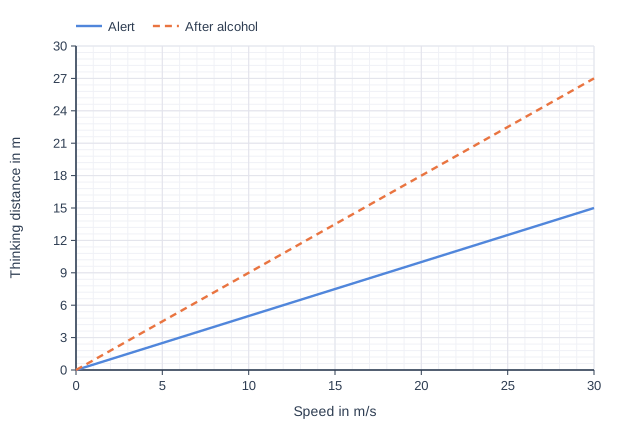
The graph shows how the thinking distance of a driver depends on speed. One line is for the driver when alert. The other line is for the same driver after drinking alcohol.

Use the graph to determine the reaction time of the driver after drinking alcohol.

Line graph of thinking distance in m (y-axis, 0 to 30) against speed in m/s (x-axis, 0 to 30). "Alert" joins the points (0, 0), (30, 15). "After alcohol" (dashed) joins the points (0, 0), (30, 27).

Model answer

Thinking distance = speed × reaction time, so reaction time = thinking distance ÷ speed (the gradient of the line).
From the alcohol line: at 30 m/s the thinking distance is 27 m.
Reaction time = 27 ÷ 30 = 0.9 s

Explanation

Because thinking distance = speed × reaction time, a graph of thinking distance against speed is a straight line through the origin whose gradient is the reaction time. A steeper line means a longer reaction time.

Mark scheme
  1. 1 mark

    reaction time = thinking distance ÷ speed / gradient of the line

    an answer of 0.9 (s) scores 3 marks

  2. 1 mark

    a correct pair of values from the alcohol line, e.g. 27 m at 30 m/s

    allow 9 m at 10 m/s, 18 m at 20 m/s

  3. 1 mark

    0.9 (s)

    allow 0.85 to 0.95

Question 4

4 marks

Two drivers, P and Q, are each driving identical cars at 13 m/s when the car in front, 22 m ahead, stops suddenly. Driver P has a reaction time of 0.40 s. Driver Q has a reaction time of 0.90 s. The braking distance of each car is 14 m.

Determine whether each driver can stop without hitting the car in front.

Model answer

Driver P: thinking distance = 13 × 0.40 = 5.2 m; stopping distance = 5.2 + 14 = 19.2 m
Driver Q: thinking distance = 13 × 0.90 = 11.7 m; stopping distance = 11.7 + 14 = 25.7 m
P stops in time because 19.2 m is less than 22 m. Q hits the car in front because 25.7 m is more than 22 m.

Explanation

The cars, speeds and braking distances are identical, so the only difference is the reaction time. An extra half-second of reaction time adds 6.5 m to the stopping distance, which is enough to cause a crash.

Mark scheme
  1. 1 mark

    P: thinking distance = 13 × 0.40 = 5.2 (m)

    correct answer with no working scores full marks

  2. 1 mark

    Q: thinking distance = 13 × 0.90 = 11.7 (m)

  3. 1 mark

    stopping distances: P = 5.2 + 14 = 19.2 (m) and Q = 11.7 + 14 = 25.7 (m)

    allow ecf

  4. 1 mark

    P stops in time (19.2 m < 22 m) but Q does not (25.7 m > 22 m)

    allow ecf from their stopping distances

Ready to try the rest? Every answer you write is marked against the mark scheme, so you can see exactly where the marks are.

AI Tutor Hints first, answers after you try

Hi! Stuck? Ask me for a hint and I’ll help you work it out. Once you’ve checked your answer I can explain exactly where the marks are.