Level:
Correct: 0
Incorrect: 0
Marks: 0/0
Exam Practice
Subject:
Topics:
AQA GCSE Physics Smart practice A mixed round aimed at your weak spots
Unit 1
Energy
Energy changes in a system, and the ways energy is stored before and after such changes
Energy stores and systems
0%
Changes in energy
0%
Energy changes in systems
0%
Power
0%
Conservation and dissipation of energy
Energy transfers in a system
0%
Efficiency
0%
Unit 2
Electricity
Unit 3
Particle model of matter
Unit 4
Atomic structure
Unit 5
Forces
Unit 6
Waves
Unit 7
Magnetism and electromagnetism
Unit 8
Space physics (physics only)
Avg
score:
–
Topics
done:
0/91

Changes in momentum (physics only) (HT only)

Practise 29 exam-style questions on Changes in momentum (physics only) (HT only) for AQA GCSE Physics. Write your answer as you would in the exam and get it marked in seconds against the mark scheme, point by point, with an AI tutor on hand if you get stuck.

  • 29 questions
  • 1–6 marks each
  • Instant marking
  • No sign-up needed
20 questions, marked as you go

Sample questions with model answers

Here are 4 of the questions in this topic, each with a model answer, an explanation of why it earns the marks and the mark scheme an examiner would use.

Question 1

2 marks

A trolley of mass 2.0 kg is moving at 3.0 m/s. A force acts on it in its direction of motion and its velocity increases to 5.0 m/s.

Calculate the change in momentum of the trolley.

Model answer

Change in momentum = m × Δv
= 2.0 × (5.0 − 3.0)
= 2.0 × 2.0
= 4.0 kg m/s

Explanation

The change in momentum is the final momentum minus the initial momentum: 10 kg m/s − 6.0 kg m/s = 4.0 kg m/s. A common mistake is to calculate only the final momentum.

Mark scheme
  1. 1 mark

    Δp = 2.0 × (5.0 − 3.0)

    allow (2.0 × 5.0) − (2.0 × 3.0); an answer of 4.0 (kg m/s) scores 2 marks

  2. 1 mark

    4.0 (kg m/s)

    allow 4 (kg m/s)

Question 2

3 marks

A footballer kicks a stationary ball of mass 0.45 kg. The ball leaves her foot at 24 m/s. Her foot is in contact with the ball for 12 ms.

Use the equation:
force = (mass × change in velocity) ÷ time taken

Calculate the average force on the ball.

Model answer

t = 12 ms = 0.012 s
F = m Δv ÷ Δt
F = 0.45 × 24 ÷ 0.012
F = 10.8 ÷ 0.012
F = 900 N

Explanation

The ball's change in momentum is 0.45 × 24 = 10.8 kg m/s. Because this happens in a very short time, the force is large. Remember that 1 ms = 0.001 s.

Mark scheme
  1. 1 mark

    12 ms = 0.012 s

    an answer of 900 (N) scores 3 marks; an answer of 0.9 scores 2 marks

  2. 1 mark

    F = 0.45 × 24 ÷ 0.012

    allow ecf from an incorrect time conversion

  3. 1 mark

    900 (N)

    allow ecf

Question 3

3 marks

A hammer head of mass 0.50 kg is moving at 8.0 m/s when it hits a nail. The hammer head comes to rest in 2.0 ms.

Use the equation:
force = (mass × change in velocity) ÷ time taken

Calculate the average force exerted on the hammer head by the nail.

Model answer

t = 2.0 ms = 0.0020 s
F = m Δv ÷ Δt = 0.50 × 8.0 ÷ 0.0020
F = 4.0 ÷ 0.0020 = 2000 N

Explanation

A steel hammer stops in a very short time, so the force is very large - that is what drives the nail in. This is the opposite of a safety feature, where the aim is to make the stopping time as long as possible.

Mark scheme
  1. 1 mark

    2.0 ms = 0.0020 s

    an answer of 2000 (N) scores 3 marks; an answer of 2 scores 2 marks

  2. 1 mark

    F = 0.50 × 8.0 ÷ 0.0020

    allow ecf from an incorrect time conversion

  3. 1 mark

    2000 (N)

    allow ecf

Question 4

4 marks

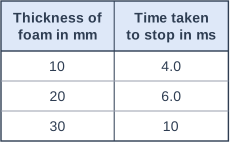
A cycle helmet manufacturer tests helmets with foam linings of different thicknesses. A head-shaped test mass of 5.0 kg wearing the helmet is dropped onto a hard surface. It hits the surface at 6.0 m/s and is brought to rest. The table shows the time taken to stop for each thickness of foam.

A helmet passes the test if the average force on the test mass is less than 4000 N.

Use the equation:
force = (mass × change in velocity) ÷ time taken

Determine which helmets pass the test.

Table with columns "Thickness of foam in mm", "Time taken to stop in ms". Thickness of foam in mm: 10; Time taken to stop in ms: 4.0 | Thickness of foam in mm: 20; Time taken to stop in ms: 6.0 | Thickness of foam in mm: 30; Time taken to stop in ms: 10.

Model answer

Change in momentum = 5.0 × 6.0 = 30 kg m/s
10 mm: F = 30 ÷ 0.0040 = 7500 N
20 mm: F = 30 ÷ 0.0060 = 5000 N
30 mm: F = 30 ÷ 0.010 = 3000 N
Only the helmet with 30 mm of foam gives a force less than 4000 N, so only that helmet passes.

Explanation

Each helmet has the same change in momentum, so the helmet that makes the stopping time longest gives the smallest force. Thicker foam crushes over a greater distance and so takes longer to stop the head. Remember to convert milliseconds to seconds.

Mark scheme
  1. 1 mark

    change in momentum = 5.0 × 6.0 = 30 (kg m/s)

    correct answer with no working scores full marks

  2. 1 mark

    times converted to seconds: 0.0040 s, 0.0060 s, 0.010 s

    allow if seen in any force calculation

  3. 1 mark

    forces: 10 mm 7500 N, 20 mm 5000 N, 30 mm 3000 N

    allow ecf; all three needed

  4. 1 mark

    only the helmet with 30 mm of foam passes

    allow ecf from their forces

Ready to try the rest? Every answer you write is marked against the mark scheme, so you can see exactly where the marks are.

AI Tutor Hints first, answers after you try

Hi! Stuck? Ask me for a hint and I’ll help you work it out. Once you’ve checked your answer I can explain exactly where the marks are.