
Level:
Correct: 0
Incorrect: 0
Marks: 0/0
Exam Practice
Subject:
Topics:
AQA GCSE Physics Smart practice A mixed round aimed at your weak spots
Unit 1
Energy
Energy changes in a system, and the ways energy is stored before and after such changes
Energy stores and systems
0%
Changes in energy
0%
Energy changes in systems
0%
Power
0%
Conservation and dissipation of energy
Energy transfers in a system
0%
Efficiency
0%
Unit 2
Electricity
Unit 3
Particle model of matter
Unit 4
Atomic structure
Unit 5
Forces
Unit 6
Waves
Unit 7
Magnetism and electromagnetism
Unit 8
Space physics (physics only)
Avg
score:
–
Topics
done:
0/91

Acceleration

Practise 40 exam-style questions on Acceleration for AQA GCSE Physics. Write your answer as you would in the exam and get it marked in seconds against the mark scheme, point by point, with an AI tutor on hand if you get stuck.

  • 40 questions
  • 1–6 marks each
  • Instant marking
  • No sign-up needed
20 questions, marked as you go

Sample questions with model answers

Here are 4 of the questions in this topic, each with a model answer, an explanation of why it earns the marks and the mark scheme an examiner would use.

Question 1

2 marks

A car is decelerating at 2.5 m/s².

Explain what this means.

Model answer

The car is slowing down: its velocity decreases by 2.5 m/s every second.

Explanation

An object that slows down is decelerating. A deceleration of 2.5 m/s² is the same as an acceleration of −2.5 m/s² when the direction of motion is taken as positive.

Mark scheme
  1. 1 mark

    the car is slowing down

  2. 1 mark

    its velocity decreases by 2.5 m/s every second

    allow its speed decreases by 2.5 m/s each second
Question 2

2 marks

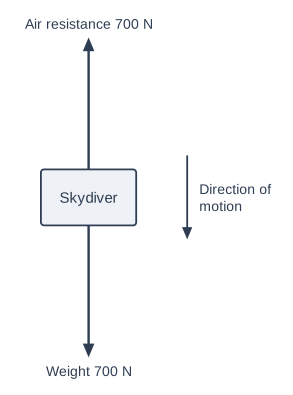
The diagram shows the forces acting on a skydiver at a later point in her fall.

State how the skydiver is moving at this point. Give a reason for your answer.

Free body diagram: a box labelled "Skydiver" with 2 force arrows. An arrow labelled "Weight 700 N" starts at the object and points downwards; an arrow labelled "Air resistance 700 N" starts at the object and points upwards. Arrow lengths are in proportion to the forces: "Air resistance 700 N" is the same length as "Weight 700 N". A separate arrow labelled "Direction of motion" points downwards.

Model answer

She is falling at a constant velocity (her terminal velocity), because the weight and the air resistance are equal, so the resultant force on her is zero.

Explanation

Balanced forces do not mean an object is stationary - they mean its velocity is not changing. A skydiver with balanced forces keeps falling at a steady speed, called terminal velocity.

Mark scheme
  1. 1 mark

    at a constant velocity (terminal velocity)

    allow constant speed downwards; do not accept 'stationary'

  2. 1 mark

    the forces are balanced / the resultant force is zero

Question 3

3 marks

A car is travelling at 20 m/s when the driver brakes. The car decelerates uniformly at 5.0 m/s² until it stops.

Use the equation:
(final velocity)² − (initial velocity)² = 2 × acceleration × distance

Calculate the braking distance of the car.

Model answer

v² − u² = 2 a s
0² − 20² = 2 × (−5.0) × s
−400 = −10 × s
s = 40 m

Explanation

The final velocity is zero because the car stops, and the acceleration is negative because the car is slowing down. Because distance depends on velocity squared, doubling the speed would make the braking distance four times as long.

Mark scheme
  1. 1 mark

    0² − 20² = 2 × (−5.0) × s

    allow 20² = 2 × 5.0 × s; an answer of 40 (m) scores 3 marks

  2. 1 mark

    s = 400 ÷ 10

    rearrangement

  3. 1 mark

    40 (m)

    ignore a negative sign if the working is otherwise correct

Question 4

4 marks

A student wants to show that a marble dropped into a tall tube of wallpaper paste reaches a terminal velocity. She puts rubber bands around the tube at equal intervals of 10 cm, starting some way below the surface. She has a stopwatch and a metre rule.

Describe how she could use this equipment to show that the marble reaches a terminal velocity and to find its value.

Model answer

Check with the metre rule that the bands are 10 cm apart. Drop the marble into the paste and use the lap function of the stopwatch to record the time at which it passes each band. Work out the time taken to fall each 10 cm. When the times for successive 10 cm intervals become equal, the marble is falling at a constant velocity - its terminal velocity. Calculate it as 0.10 m divided by the time for one interval (or use several equal intervals together for a more accurate value), and repeat the experiment to find a mean.

Explanation

Equal times for equal distances show constant velocity. The paste is very viscous, so the marble reaches terminal velocity quickly and moves slowly enough to be timed by hand.

Mark scheme
  1. 1 mark

    check the spacing of the bands with the metre rule (10 cm apart)

    max 4

  2. 1 mark

    drop the marble and record the time at which it passes each band (e.g. using the lap function on the stopwatch)

  3. 1 mark

    calculate the time taken to fall between each pair of bands

  4. 1 mark

    when the time for each 10 cm becomes the same, the marble has reached terminal velocity

  5. 1 mark

    terminal velocity = 0.10 m ÷ time between two bands (or total distance ÷ time over several equal intervals)

  6. 1 mark

    repeat with the marble several times and calculate mean times

Ready to try the rest? Every answer you write is marked against the mark scheme, so you can see exactly where the marks are.

AI Tutor Hints first, answers after you try

Hi! Stuck? Ask me for a hint and I’ll help you work it out. Once you’ve checked your answer I can explain exactly where the marks are.