Practise 40 exam-style questions on Series and parallel circuits for AQA GCSE Physics. Write your answer as you would in the exam and get it marked in seconds against the mark scheme, point by point, with an AI tutor on hand if you get stuck.
40 questions
1–6 marks each
Instant marking
No sign-up needed
20 questions, marked as you go
Sample questions with model answers
Here are 4 of the questions in this topic, each with a model answer, an explanation of why it earns the marks and the mark scheme an examiner would use.
Question 1
2 marks
Describe what is meant by components connected in parallel.
Model answer
Components in parallel are each connected on their own separate branch between the same two points, so there is more than one path for the current, which splits between the branches.
Explanation
In series, components are connected one after another in a single loop. In parallel, each component has its own branch, so each has the full potential difference across it and the branch currents add up to the total current.
Mark scheme
1 mark
each component is on a separate branch / connected directly across the supply (between the same two points)
allow side by side between two junctions
1 mark
the current splits between the branches / there is more than one path for the current
Question 2
2 marks
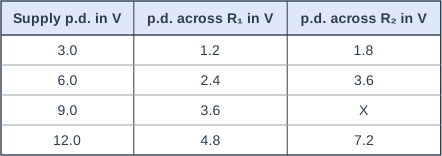
A student connected two resistors in series to a variable power supply. For different supply settings she measured the potential difference across the supply, across resistor R₁ and across resistor R₂. The table shows her results.
Determine the value of X. Give a reason for your answer.
Model answer
X = 9.0 − 3.6 = 5.4 V, because in a series circuit the potential differences across the components add up to the supply potential difference.
Explanation
Every row of the table follows the series rule: V₁ + V₂ = supply p.d. The ratio V₂ ÷ V₁ is also the same (1.5) in every row, because the ratio of the potential differences equals the ratio of the resistances.
Mark scheme
1 mark
5.4 (V)
correct answer with no working scores full marks
1 mark
the potential differences across the resistors add up to the supply potential difference (9.0 − 3.6)
allow R₂ always has 1.5 times the p.d. of R₁
Question 3
3 marks
Two identical lamps are connected in parallel with a battery. A third identical lamp is then added in parallel.
Explain what happens to the brightness of the first two lamps and to the current from the battery.
Model answer
The first two lamps stay at the same brightness, because each lamp in parallel still has the full battery potential difference across it, so the current through each one is unchanged. The current from the battery increases, because there is now an extra branch and the total current is the sum of the three branch currents.
Explanation
Adding a branch in parallel gives the charge another path, so the total resistance falls and the battery supplies more current. In practice a real battery may struggle to supply the larger current, but we treat its potential difference as constant.
Mark scheme
1 mark
the brightness of the first two lamps does not change
1 mark
each lamp still has the full battery p.d. across it, so the current through each is unchanged
1 mark
the current from the battery increases, because the total current is the sum of the branch currents
allow increases by half / by one lamp's current
Question 4
4 marks
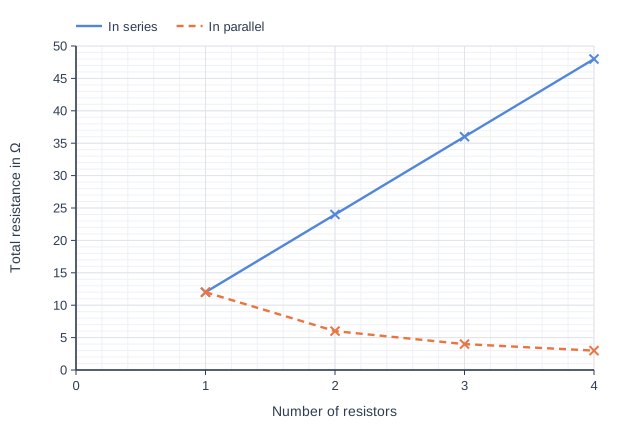
A student measured the total resistance of different numbers of identical 12 Ω resistors, first connected in series and then connected in parallel. The graph shows her results.
Describe the pattern for each arrangement and explain the difference between them.
Model answer
In series, the total resistance increases steadily: each extra resistor adds 12 Ω, so the total is directly proportional to the number of resistors. In parallel, the total resistance decreases as resistors are added and is always less than the 12 Ω of one resistor: two give 6 Ω, three give 4 Ω and four give 3 Ω. In series the current has to pass through every resistor in turn, so their resistances add up. In parallel each extra resistor provides another path for the current, so a larger total current flows for the same potential difference and the total resistance falls.
Explanation
The series line is straight (resistance proportional to number); the parallel curve falls, getting flatter, with n identical resistors giving one nth of the resistance of one. You do not need to calculate parallel resistances, but you should explain the trend.
Mark scheme
1 mark
series: the total resistance increases (in proportion) as more resistors are added / each extra resistor adds 12 Ω
1 mark
parallel: the total resistance decreases as more resistors are added, and is always less than one resistor (e.g. two give 6 Ω)
1 mark
in series the current must pass through every resistor in turn, so the resistances add up
1 mark
in parallel each extra resistor adds another path, so more current flows for the same p.d.
Ready to try the rest? Every answer you write is marked against the mark scheme, so you can see exactly where the marks are.
Ctrl + Enter to check
AI TutorHints first, answers after you try
Hi! Stuck? Ask me for a hint and I’ll help you work it out. Once you’ve checked your answer I can explain exactly where the marks are.