Practise 23 exam-style questions on Power for AQA GCSE Physics. Write your answer as you would in the exam and get it marked in seconds against the mark scheme, point by point, with an AI tutor on hand if you get stuck.
23 questions
1–6 marks each
Instant marking
No sign-up needed
20 questions, marked as you go
Sample questions with model answers
Here are 4 of the questions in this topic, each with a model answer, an explanation of why it earns the marks and the mark scheme an examiner would use.
Question 1
1 mark
Give the unit of power.
Model answer
The watt (W).
Explanation
One watt is one joule of energy transferred every second. Larger powers are often given in kilowatts (1 kW = 1000 W).
Mark scheme
1 mark
watt
allow W; allow joules per second / J/s
Question 2
2 marks
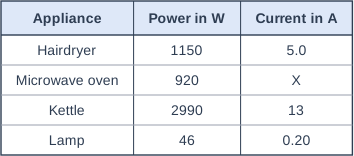
The table shows the power of some appliances that are connected to the 230 V mains supply, and the current in each one.
Calculate the value of X.
Model answer
P = V I, so I = P ÷ V X = 920 ÷ 230 = 4.0 A
Explanation
Every appliance has the same 230 V across it, so the current is proportional to the power. The kettle, with the largest power, has by far the largest current.
Mark scheme
1 mark
X = 920 ÷ 230
allow 920 = 230 × I; an answer of 4.0 scores 2 marks
1 mark
4.0 (A)
allow 4 (A)
Question 3
3 marks
An electric kettle has a power of 2.5 kW. It is switched on for 3.0 minutes.
Calculate the energy transferred by the kettle.
Model answer
P = 2.5 kW = 2500 W t = 3.0 × 60 = 180 s E = P t = 2500 × 180 E = 450 000 J
Explanation
Power is the energy transferred per second, so energy = power × time. Use watts and seconds to get the energy in joules.
Mark scheme
1 mark
P = 2500 W and t = 180 s
both needed; an answer of 450 000 (J) scores 3 marks
1 mark
E = 2500 × 180
allow ecf from incorrect conversions
1 mark
450 000 (J)
allow 4.5 × 10⁵ (J); allow 450 kJ
Question 4
5 marks
A 12 V car headlamp has a power of 55 W when it is lit.
Calculate the current in the headlamp and its resistance when lit. Give both answers to 2 significant figures.
Model answer
P = V I, so I = P ÷ V = 55 ÷ 12 = 4.583... A = 4.6 A (2 s.f.) V = I R, so R = V ÷ I = 12 ÷ 4.583... = 2.618... Ω = 2.6 Ω (2 s.f.)
Explanation
Find the current from P = V I first, then the resistance from V = I R. Keep the unrounded current in your calculator for the second step and round both answers only at the end.
Mark scheme
1 mark
55 = 12 × I
an answer of 4.6 A and 2.6 Ω scores 5 marks
1 mark
I = 4.58 (A)
allow 4.6 (A)
1 mark
R = 12 ÷ 4.58
allow 55 = 4.58² × R; allow ecf from their current
1 mark
R = 2.62 (Ω)
allow 2.6 (Ω); allow 2.61 (Ω) from using 4.6 A; allow ecf
1 mark
both answers given to 2 significant figures: 4.6 A and 2.6 Ω
Ready to try the rest? Every answer you write is marked against the mark scheme, so you can see exactly where the marks are.
Ctrl + Enter to check
AI TutorHints first, answers after you try
Hi! Stuck? Ask me for a hint and I’ll help you work it out. Once you’ve checked your answer I can explain exactly where the marks are.