
Level:
Correct: 0
Incorrect: 0
Marks: 0/0
Exam Practice
Subject:
Topics:
AQA GCSE Physics Smart practice A mixed round aimed at your weak spots
Unit 1
Energy
Energy changes in a system, and the ways energy is stored before and after such changes
Energy stores and systems
0%
Changes in energy
0%
Energy changes in systems
0%
Power
0%
Conservation and dissipation of energy
Energy transfers in a system
0%
Efficiency
0%
Unit 2
Electricity
Unit 3
Particle model of matter
Unit 4
Atomic structure
Unit 5
Forces
Unit 6
Waves
Unit 7
Magnetism and electromagnetism
Unit 8
Space physics (physics only)
Avg
score:
–
Topics
done:
0/91

Temperature changes in a system and specific heat capacity

Practise 29 exam-style questions on Temperature changes in a system and specific heat capacity for AQA GCSE Physics. Write your answer as you would in the exam and get it marked in seconds against the mark scheme, point by point, with an AI tutor on hand if you get stuck.

  • 29 questions
  • 1–6 marks each
  • Instant marking
  • No sign-up needed
20 questions, marked as you go

Sample questions with model answers

Here are 4 of the questions in this topic, each with a model answer, an explanation of why it earns the marks and the mark scheme an examiner would use.

Question 1

2 marks

When a substance is heated, the increase in its temperature depends on the energy supplied to it.

Give two other factors that the temperature increase depends on.

Model answer

The mass of the substance and the type of material (its specific heat capacity).

Explanation

For the same energy input, a larger mass has a smaller temperature rise, and a material with a higher specific heat capacity has a smaller temperature rise. This is summed up by ΔE = m c Δθ.

Mark scheme
  1. 1 mark

    the mass of the substance

  2. 1 mark

    the type of material / the specific heat capacity of the substance

    do not accept 'the starting temperature'
Question 2

3 marks

A hot water bottle contains 1.5 kg of water at 70 °C. The water cools to 30 °C.
The specific heat capacity of water is 4200 J/kg °C.

Use the equation:
change in thermal energy = mass × specific heat capacity × temperature change

Calculate the energy transferred from the water to the surroundings.

Model answer

Δθ = 70 − 30 = 40 °C
ΔE = m × c × Δθ = 1.5 × 4200 × 40
ΔE = 252 000 J

Explanation

The temperature change is the difference between the starting and final temperatures - do not use 70 °C or 30 °C on its own. Water's high specific heat capacity means it releases a lot of energy as it cools, which is why it is used in hot water bottles.

Mark scheme
  1. 1 mark

    temperature change = 70 − 30 = 40 (°C)

    an answer of 252 000 (J) scores 3 marks

  2. 1 mark

    ΔE = 1.5 × 4200 × 40

    allow ecf from an incorrect temperature change

  3. 1 mark

    252 000 (J)

    allow 252 kJ or 2.52 × 10⁵ J; allow ecf

Question 3

3 marks

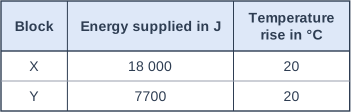
A student finds the specific heat capacity of two metal blocks, X and Y. Each block has a mass of 1.0 kg. The table shows her results.

The specific heat capacities of some metals are:
aluminium 900 J/kg °C, iron 450 J/kg °C, copper 385 J/kg °C, lead 130 J/kg °C

Use the equation:
change in thermal energy = mass × specific heat capacity × temperature change

Calculate the specific heat capacity of block Y and identify the metal it is made from.

Table with columns "Block", "Energy supplied in J", "Temperature rise in °C". Block: X; Energy supplied in J: 18 000; Temperature rise in °C: 20 | Block: Y; Energy supplied in J: 7700; Temperature rise in °C: 20.

Model answer

For block Y: ΔE = m × c × Δθ
7700 = 1.0 × c × 20
c = 7700 ÷ 20 = 385 J/kg °C
This matches copper.

Explanation

Rearrange ΔE = m c Δθ to find c from the energy supplied and the temperature rise. Specific heat capacity is a property of the material, so it can be used to identify it. (Block X gives 900 J/kg °C, so it is aluminium.)

Mark scheme
  1. 1 mark

    7700 = 1.0 × c × 20

    correct answer with no working scores full marks

  2. 1 mark

    c = 385 (J/kg °C)

  3. 1 mark

    copper

Question 4

5 marks

An immersion heater with a power of 3.0 kW heats 150 kg of water in a hot water tank from 15 °C to 55 °C. This takes 2.5 hours.
The specific heat capacity of water is 4200 J/kg °C.

Use the equation:
change in thermal energy = mass × specific heat capacity × temperature change

Calculate the efficiency of the heater.

Model answer

Useful energy: ΔE = m × c × Δθ = 150 × 4200 × (55 − 15) = 150 × 4200 × 40 = 25 200 000 J
Time: t = 2.5 × 60 × 60 = 9000 s
Energy input: E = P × t = 3000 × 9000 = 27 000 000 J
Efficiency = useful energy output ÷ total energy input = 25 200 000 ÷ 27 000 000 = 0.93 (93%)

Explanation

The useful energy is the increase in the thermal energy store of the water, from ΔE = m c Δθ. The total input is found from E = P t with power in watts and time in seconds. The rest is wasted, for example heating the tank and the air around it.

Mark scheme
  1. 1 mark

    ΔE = 150 × 4200 × 40

    an answer of 0.93 or 93% scores 5 marks

  2. 1 mark

    useful energy = 25 200 000 (J)

  3. 1 mark

    t = 9000 (s)

  4. 1 mark

    energy input = 3000 × 9000 = 27 000 000 (J)

    allow ecf from an incorrect time

  5. 1 mark

    efficiency = 25 200 000 ÷ 27 000 000 = 0.93 / 93%

    allow 0.933 or 93.3%; allow ecf

Ready to try the rest? Every answer you write is marked against the mark scheme, so you can see exactly where the marks are.

AI Tutor Hints first, answers after you try

Hi! Stuck? Ask me for a hint and I’ll help you work it out. Once you’ve checked your answer I can explain exactly where the marks are.