
Level:
Correct: 0
Incorrect: 0
Marks: 0/0
Exam Practice
Subject:
Topics:
AQA GCSE Physics Smart practice A mixed round aimed at your weak spots
Unit 1
Energy
Energy changes in a system, and the ways energy is stored before and after such changes
Energy stores and systems
0%
Changes in energy
0%
Energy changes in systems
0%
Power
0%
Conservation and dissipation of energy
Energy transfers in a system
0%
Efficiency
0%
Unit 2
Electricity
Unit 3
Particle model of matter
Unit 4
Atomic structure
Unit 5
Forces
Unit 6
Waves
Unit 7
Magnetism and electromagnetism
Unit 8
Space physics (physics only)
Avg
score:
–
Topics
done:
0/91

Orbital motion, natural and artificial satellites

Practise 25 exam-style questions on Orbital motion, natural and artificial satellites for AQA GCSE Physics. Write your answer as you would in the exam and get it marked in seconds against the mark scheme, point by point, with an AI tutor on hand if you get stuck.

  • 25 questions
  • 1–6 marks each
  • Instant marking
  • No sign-up needed
20 questions, marked as you go

Sample questions with model answers

Here are 4 of the questions in this topic, each with a model answer, an explanation of why it earns the marks and the mark scheme an examiner would use.

Question 1

2 marks

Give two uses of artificial satellites.

Model answer

Communications, such as satellite TV and phone signals, and navigation, such as GPS (also weather forecasting and space telescopes).

Explanation

Artificial satellites are placed in orbit because from high above the Earth they can send signals over long distances, see large areas of the Earth, or observe space without the atmosphere getting in the way.

Mark scheme
  1. 1 mark

    communications (e.g. phone, TV, internet)

    max 2

  2. 1 mark

    weather forecasting / monitoring

  3. 1 mark

    navigation / GPS / satnav

  4. 1 mark

    observing / mapping the Earth (e.g. climate, crops, disasters)

  5. 1 mark

    space telescopes / observing the universe / scientific research

    allow military / spying
Question 2

3 marks

For each object below, state whether it is a planet, a moon or an artificial satellite.

Titan, which orbits Saturn
Neptune, which orbits the Sun
The International Space Station, which orbits the Earth

Model answer

Titan is a moon (a natural satellite of Saturn). Neptune is a planet. The International Space Station is an artificial satellite.

Explanation

Classify by what the object orbits and whether it is natural. Planets orbit the Sun; moons are natural objects orbiting planets; artificial satellites are made by people.

Mark scheme
  1. 1 mark

    Titan: moon

    allow natural satellite

  2. 1 mark

    Neptune: planet

  3. 1 mark

    International Space Station: artificial satellite

Question 3

3 marks

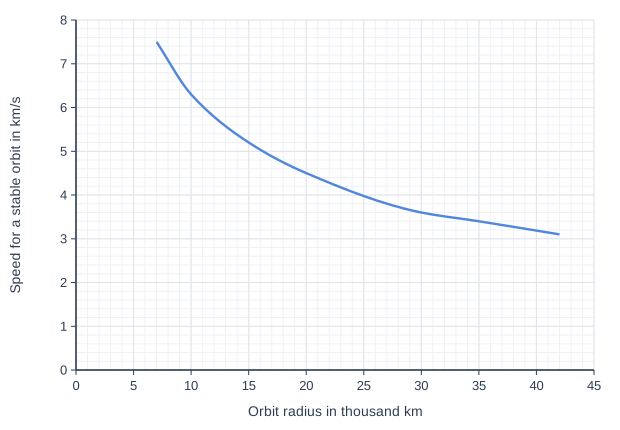
The graph shows the speed needed for a stable circular orbit around the Earth at different orbit radii.

A satellite is at an orbit radius of 25 000 km, but it is travelling at 5.0 km/s.

Use the graph to explain whether the satellite will stay in a circular orbit of radius 25 000 km.

Line graph of speed for a stable orbit in km/s (y-axis, 0 to 8) against orbit radius in thousand km (x-axis, 0 to 45). The line is a smooth curve through (7, 7.5), (10, 6.3), (15, 5.2), (20, 4.5), (30, 3.6), (35, 3.4), (42, 3.1).

Model answer

From the graph, the speed needed for a stable circular orbit at 25 000 km is about 4.0 km/s. The satellite is travelling at 5.0 km/s, which is faster than this, so it will not stay in a circular orbit at 25 000 km. It will move outwards, so the radius of its orbit will increase.

Explanation

Each orbit radius has its own speed for a stable orbit. If a satellite is too fast for its radius, gravity is not strong enough to keep it on that circle, so it moves further out. If the speed changes, the radius must change.

Mark scheme
  1. 1 mark

    the speed needed at 25 000 km is about 4.0 km/s

    allow 3.9-4.1 km/s

  2. 1 mark

    5.0 km/s is faster than the speed needed for that radius

    allow ecf from an incorrect reading

  3. 1 mark

    so it will not stay at 25 000 km: it will move outwards to a larger orbit

    allow its orbit radius will increase

Question 4

4 marks

The Moon moves in an approximately circular orbit of radius 384 000 km around the Earth, at a speed of 1.02 km/s.

Calculate the time taken for the Moon to complete one orbit. Give your answer in days, to 2 significant figures.

The circumference of a circle = 2 × π × radius
1 day = 86 400 s

Model answer

distance for one orbit = 2 × π × 384 000 km = 2.41 × 10⁶ km
time = distance ÷ speed = 2.41 × 10⁶ ÷ 1.02 = 2.37 × 10⁶ s
time in days = 2.37 × 10⁶ ÷ 86 400 = 27.4 days
time = 27 days (2 s.f.)

Explanation

Keeping the distance in km and the speed in km/s gives the time in seconds directly. Then divide by the number of seconds in a day. The answer matches the Moon's monthly cycle.

Mark scheme
  1. 1 mark

    distance = 2 × π × 384 000 = 2.41 × 10⁶ km

    allow 2.41 × 10⁹ m; an answer of 27 (days) scores 4 marks

  2. 1 mark

    time = 2.41 × 10⁶ ÷ 1.02

    allow 2.41 × 10⁹ ÷ 1020; allow ecf

  3. 1 mark

    = 2.37 × 10⁶ (s)

    allow 2 365 000 s

  4. 1 mark

    2.37 × 10⁶ ÷ 86 400 = 27 (days)

    answer to 2 significant figures; allow 27.4 for 3 marks only; allow ecf

Ready to try the rest? Every answer you write is marked against the mark scheme, so you can see exactly where the marks are.

AI Tutor Hints first, answers after you try

Hi! Stuck? Ask me for a hint and I’ll help you work it out. Once you’ve checked your answer I can explain exactly where the marks are.