
Level:
Correct: 0
Incorrect: 0
Marks: 0/0
Exam Practice
Subject:
Topics:
AQA GCSE Physics Smart practice A mixed round aimed at your weak spots
Unit 1
Energy
Energy changes in a system, and the ways energy is stored before and after such changes
Energy stores and systems
0%
Changes in energy
0%
Energy changes in systems
0%
Power
0%
Conservation and dissipation of energy
Energy transfers in a system
0%
Efficiency
0%
Unit 2
Electricity
Unit 3
Particle model of matter
Unit 4
Atomic structure
Unit 5
Forces
Unit 6
Waves
Unit 7
Magnetism and electromagnetism
Unit 8
Space physics (physics only)
Avg
score:
–
Topics
done:
0/91

Properties of electromagnetic waves 1

Practise 30 exam-style questions on Properties of electromagnetic waves 1 for AQA GCSE Physics. Write your answer as you would in the exam and get it marked in seconds against the mark scheme, point by point, with an AI tutor on hand if you get stuck.

  • 30 questions
  • 1–6 marks each
  • Instant marking
  • No sign-up needed
20 questions, marked as you go

Sample questions with model answers

Here are 4 of the questions in this topic, each with a model answer, an explanation of why it earns the marks and the mark scheme an examiner would use.

Question 1

2 marks

Explain why light changes direction when it passes at an angle from air into glass.

Model answer

Light travels more slowly in glass than in air. When light crosses the boundary at an angle, this change in speed makes it change direction, bending towards the normal.

Explanation

Refraction is caused by the difference in the speed of a wave in different substances. If the light meets the boundary at an angle, one side of each wavefront slows down before the other, so the wave turns. If it meets the boundary along the normal, the speed still changes but the direction does not.

Mark scheme
  1. 1 mark

    light travels more slowly in glass than in air

    allow light slows down when it enters the glass; allow the speed of light is different in the two materials

  2. 1 mark

    the change in speed (at an angle to the boundary) causes the change in direction

    allow one side of the wavefront slows down before the other side
Question 2

2 marks

When white light enters a glass prism, violet light is refracted more than red light.

Explain what this shows about the speed of different colours of light in glass.

Model answer

It shows that the speed of light in glass depends on its colour (wavelength). Violet light bends more, so it must slow down more than red light: violet light travels more slowly in glass than red light.

Explanation

Refraction is caused by a change in speed, and a bigger change in speed causes a bigger change in direction. Because the colours bend by different amounts, they must travel at different speeds in glass, even though all colours travel at the same speed in a vacuum.

Mark scheme
  1. 1 mark

    the speed of light in glass depends on its colour / wavelength

  2. 1 mark

    violet light travels more slowly in glass than red light

    allow violet light slows down more than red light

Question 3

3 marks

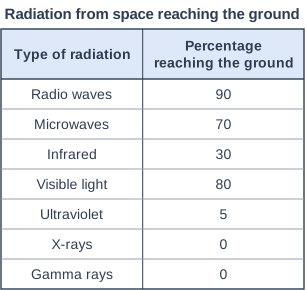
The table shows typical percentages of different types of electromagnetic radiation from space that pass through the Earth's atmosphere and reach the ground.

Use the data in the table to describe how the atmosphere affects the different types of electromagnetic radiation.

Radiation from space reaching the ground. Table with columns "Type of radiation", "Percentage reaching the ground". Type of radiation: Radio waves; Percentage reaching the ground: 90 | Type of radiation: Microwaves; Percentage reaching the ground: 70 | Type of radiation: Infrared; Percentage reaching the ground: 30 | Type of radiation: Visible light; Percentage reaching the ground: 80 | Type of radiation: Ultraviolet; Percentage reaching the ground: 5 | Type of radiation: X-rays; Percentage reaching the ground: 0 | Type of radiation: Gamma rays; Percentage reaching the ground: 0.

Model answer

The atmosphere transmits most radio waves (90%) and visible light (80%). It absorbs much of the infrared, as only 30% reaches the ground. It absorbs almost all ultraviolet (only 5% gets through) and all X-rays and gamma rays, so the shortest wavelengths do not reach the ground at all.

Explanation

The data show that the atmosphere does not treat all electromagnetic waves the same way: whether waves are absorbed or transmitted depends on their wavelength. This is why visible light and radio telescopes can work on the ground but some other kinds of telescope cannot.

Mark scheme
  1. 1 mark

    the atmosphere transmits most radio waves and visible light

    must use the data, e.g. 90% of radio waves and 80% of visible light reach the ground

  2. 1 mark

    it absorbs most of the infrared / only 30% of infrared gets through

    allow it absorbs some microwaves (70% get through)

  3. 1 mark

    it absorbs (almost) all ultraviolet, X-rays and gamma rays / the shortest wavelengths

    allow only 5% of ultraviolet and 0% of X-rays and gamma rays reach the ground

Question 4

4 marks

Light with a wavelength of 600 nm in air passes into a glass block.

The speed of light in air is 3.0 × 10⁸ m/s.
The speed of light in the glass is 2.0 × 10⁸ m/s.
The frequency of the light does not change when it enters the glass.

Calculate the wavelength of the light in the glass, in nm.

Model answer

In air: f = v ÷ λ = 3.0 × 10⁸ ÷ 6.0 × 10⁻⁷ = 5.0 × 10¹⁴ Hz
The frequency is the same in glass.
In glass: λ = v ÷ f = 2.0 × 10⁸ ÷ 5.0 × 10¹⁴ = 4.0 × 10⁻⁷ m = 400 nm

Explanation

When light enters a new medium its frequency stays the same, so a change in speed must change the wavelength. The speed in glass is two thirds of the speed in air, so the wavelength becomes two thirds as long: 600 nm × 2/3 = 400 nm.

Mark scheme
  1. 1 mark

    f = 3.0 × 10⁸ ÷ 6.0 × 10⁻⁷

    an answer of 400 (nm) scores 4 marks; allow the ratio method: λ in glass = 600 × (2.0 × 10⁸ ÷ 3.0 × 10⁸) for full marks

  2. 1 mark

    f = 5.0 × 10¹⁴ Hz

  3. 1 mark

    λ = 2.0 × 10⁸ ÷ 5.0 × 10¹⁴

    allow ecf from an incorrect frequency

  4. 1 mark

    λ = 4.0 × 10⁻⁷ m = 400 (nm)

    4.0 × 10⁻⁷ m without conversion to nm scores 3 marks

Ready to try the rest? Every answer you write is marked against the mark scheme, so you can see exactly where the marks are.

AI Tutor Hints first, answers after you try

Hi! Stuck? Ask me for a hint and I’ll help you work it out. Once you’ve checked your answer I can explain exactly where the marks are.