Practise 41 exam-style questions on Energy transfers in everyday appliances for AQA GCSE Physics. Write your answer as you would in the exam and get it marked in seconds against the mark scheme, point by point, with an AI tutor on hand if you get stuck.
41 questions
1–6 marks each
Instant marking
No sign-up needed
20 questions, marked as you go
Sample questions with model answers
Here are 4 of the questions in this topic, each with a model answer, an explanation of why it earns the marks and the mark scheme an examiner would use.
Question 1
2 marks
A car battery has a potential difference of 12 V. A charge of 50 C flows from the battery through the car's headlamps.
Calculate the energy transferred.
Model answer
E = Q × V E = 50 × 12 E = 600 J
Explanation
Each coulomb of charge that flows through a 12 V supply transfers 12 J of energy, so 50 C transfers 50 × 12 = 600 J. Use energy transferred = charge flow × potential difference.
Mark scheme
1 mark
E = 50 × 12
an answer of 600 (J) scores 2 marks
1 mark
600 (J)
Question 2
2 marks
An electric kettle has a power of 3000 W. An electric desk fan has a power of only 40 W.
Suggest why the kettle needs a much higher power than the fan.
Model answer
The kettle has to transfer a large amount of energy to the thermal energy store of the water to raise its temperature to boiling, and it must do this in a few minutes, so it needs to transfer energy at a high rate. The fan only needs to transfer a small amount of energy each second to the kinetic energy store of its blades and the air.
Explanation
The power rating of an appliance matches the change in energy stores it is designed to produce. Heating water quickly needs a large energy transfer per second, while keeping fan blades turning needs very little.
Mark scheme
1 mark
the kettle must transfer a large amount of energy to the thermal energy store of the water
max 2
1 mark
in a short time / quickly
1 mark
the fan only needs to transfer a small amount of energy each second to the kinetic energy store of the blades / air
Question 3
3 marks
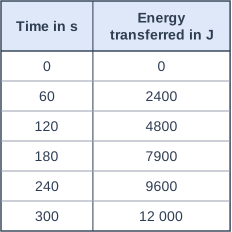
A student connects a small heater to a joulemeter and records the energy transferred every 60 s. The table shows the results.
Identify the anomalous result and determine the power of the heater.
Model answer
The anomalous result is 7900 J at 180 s - the energy should increase by 2400 J every 60 s, so it should be 7200 J. P = E ÷ t = 12 000 ÷ 300 = 40 W
Explanation
With a constant power, equal times give equal amounts of energy, so the readings should go up by the same amount every 60 s. The anomaly does not fit this pattern and should be left out when calculating the power.
Mark scheme
1 mark
7900 J (at 180 s) is anomalous
1 mark
use of any correct pair of values that excludes the anomaly, e.g. 12 000 ÷ 300 or 2400 ÷ 60
an answer of 40 (W) scores these 2 marks
1 mark
40 (W)
do not accept a power calculated using the anomalous result (e.g. 7900 ÷ 180 = 44 W)
Question 4
4 marks
A digital watch runs from a 1.5 V cell. The current in the watch circuit is 20 μA.
Calculate the energy transferred by the watch in one day (24 hours). Give your answer to 2 significant figures.
Model answer
I = 20 μA = 2.0 × 10⁻⁵ A t = 24 × 60 × 60 = 86 400 s P = V × I = 1.5 × 2.0 × 10⁻⁵ = 3.0 × 10⁻⁵ W E = P × t = 3.0 × 10⁻⁵ × 86 400 = 2.592 J E = 2.6 J (2 s.f.)
Explanation
Micro means × 10⁻⁶, so 20 μA = 2.0 × 10⁻⁵ A. The watch has a tiny power, which is why its cell lasts for years. You can find the power and multiply by the time, or find the charge (Q = I t) and multiply by the potential difference.
Mark scheme
1 mark
I = 2.0 × 10⁻⁵ (A) and t = 86 400 (s)
both conversions needed for this mark; an answer of 2.6 (J) scores 4 marks