Different half-lives of radioactive isotopes (physics only)
Practise 19 exam-style questions on Different half-lives of radioactive isotopes (physics only) for AQA GCSE Physics. Write your answer as you would in the exam and get it marked in seconds against the mark scheme, point by point, with an AI tutor on hand if you get stuck.
19 questions
1–6 marks each
Instant marking
No sign-up needed
19 questions, marked as you go
Sample questions with model answers
Here are 4 of the questions in this topic, each with a model answer, an explanation of why it earns the marks and the mark scheme an examiner would use.
Question 1
2 marks
Explain why an isotope with a half-life of a few minutes does not present a long-term hazard.
Model answer
With a half-life of a few minutes, the activity halves every few minutes. After about an hour many half-lives have passed, so almost none of the isotope is left and its activity is negligible.
Explanation
An isotope with a short half-life may be very hazardous at first, because its activity is high, but the hazard disappears quickly. This is why short half-life isotopes are chosen for medical tracers.
Mark scheme
1 mark
its nuclei decay very quickly / the activity halves every few minutes
1 mark
so after a short time (e.g. an hour, many half-lives) its activity is negligible / almost none of the isotope remains
Question 2
3 marks
Some scientists say that, in nuclear waste, isotopes with medium half-lives of a few tens of years (such as strontium-90, half-life 29 years) can be more of a problem than isotopes with very short or very long half-lives.
Suggest why.
Model answer
Isotopes with very short half-lives are intensely radioactive but decay away within days, so they soon stop being a hazard. Isotopes with very long half-lives last for a very long time, but their nuclei decay so slowly that their activity is low. Isotopes like strontium-90 have a fairly high activity and also remain radioactive for many decades, so they are a significant hazard for a whole human lifetime.
Explanation
The hazard depends on both how intense the radiation is (activity) and how long it lasts. For the same number of nuclei, a shorter half-life means a higher activity, so isotopes in the middle of the range combine fairly high activity with a long duration.
Mark scheme
1 mark
isotopes with very short half-lives decay away quickly, so they are soon no longer a hazard
1 mark
isotopes with very long half-lives have a low activity (decay very slowly)
1 mark
medium half-life isotopes have a fairly high activity and stay radioactive for many decades / a human lifetime
Question 3
3 marks
A school has a radium-226 source that it bought 50 years ago. Radium-226 has a half-life of 1600 years.
Explain why the source must still be stored carefully, and why it cannot simply be thrown away with ordinary waste.
Model answer
Fifty years is only about 1/32 of the 1600-year half-life, so the activity of the source has hardly fallen since it was bought. It will stay radioactive for thousands of years. If it were thrown away with ordinary waste it could contaminate the environment or harm people, so it must be kept in its shielded store and disposed of by specialists.
Explanation
A long half-life means a long-lasting hazard. The age of a source only matters when compared with its half-life.
Mark scheme
1 mark
50 years is only a small fraction of the half-life, so the activity has hardly decreased
1 mark
it will remain radioactive / hazardous for thousands of years
1 mark
if thrown away it could contaminate the environment / people, so it must be disposed of by specialists
Question 4
4 marks
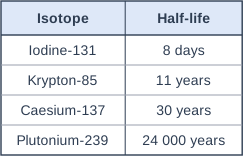
The table shows some radioactive isotopes found in used nuclear fuel.
Explain which isotope will contribute almost nothing to the hazard after one year, and which isotope will have almost the same activity in 1000 years as it has now.
Model answer
Iodine-131 will contribute almost nothing after one year: 365 ÷ 8 ≈ 45 half-lives, so its activity becomes far too small to matter. Plutonium-239 will have almost the same activity in 1000 years: 1000 years is only about 1/24 of its 24 000-year half-life, so very little of it decays in that time.
Explanation
Compare the time involved with the half-life. If the time is many half-lives, the isotope has effectively gone; if it is a small fraction of one half-life, the activity has barely changed.
Mark scheme
1 mark
iodine-131
1 mark
one year is about 45 half-lives of iodine-131, so its activity becomes negligible
allow many half-lives
1 mark
plutonium-239
1 mark
1000 years is much less than one half-life (about 1/24 of a half-life), so its activity hardly changes
Ready to try the rest? Every answer you write is marked against the mark scheme, so you can see exactly where the marks are.
Ctrl + Enter to check
AI TutorHints first, answers after you try
Hi! Stuck? Ask me for a hint and I’ll help you work it out. Once you’ve checked your answer I can explain exactly where the marks are.