
Level:
Correct: 0
Incorrect: 0
Marks: 0/0
Exam Practice
Subject:
Topics:
AQA GCSE Physics Smart practice A mixed round aimed at your weak spots
Unit 1
Energy
Energy changes in a system, and the ways energy is stored before and after such changes
Energy stores and systems
0%
Changes in energy
0%
Energy changes in systems
0%
Power
0%
Conservation and dissipation of energy
Energy transfers in a system
0%
Efficiency
0%
Unit 2
Electricity
Unit 3
Particle model of matter
Unit 4
Atomic structure
Unit 5
Forces
Unit 6
Waves
Unit 7
Magnetism and electromagnetism
Unit 8
Space physics (physics only)
Avg
score:
–
Topics
done:
0/91

Internal energy

Practise 24 exam-style questions on Internal energy for AQA GCSE Physics. Write your answer as you would in the exam and get it marked in seconds against the mark scheme, point by point, with an AI tutor on hand if you get stuck.

  • 24 questions
  • 1–6 marks each
  • Instant marking
  • No sign-up needed
20 questions, marked as you go

Sample questions with model answers

Here are 4 of the questions in this topic, each with a model answer, an explanation of why it earns the marks and the mark scheme an examiner would use.

Question 1

2 marks

Heating a substance increases the energy of its particles.

State the two possible effects this can have on the substance.

Model answer

Heating either raises the temperature of the substance or makes it change state, for example melting or boiling.

Explanation

Heating always increases internal energy. If the energy increases the kinetic energy of the particles, the temperature rises; if it increases their potential energy, the substance changes state at a constant temperature.

Mark scheme
  1. 1 mark

    its temperature increases

  2. 1 mark

    it changes state (e.g. melts or boils)
Question 2

2 marks

Two beakers contain water from the same tap. The water in beaker A is at 60 °C and the water in beaker B is at 20 °C.

Compare the motion of the water particles in the two beakers.

Model answer

The particles in beaker A move faster on average than those in beaker B, so they have a greater average kinetic energy, because the water in A is at a higher temperature.

Explanation

Temperature is a measure of the average kinetic energy of the particles. The hotter the water, the faster its particles move about.

Mark scheme
  1. 1 mark

    the particles in beaker A move faster (on average)

  2. 1 mark

    so they have more kinetic energy (on average) than the particles in beaker B

Question 3

3 marks

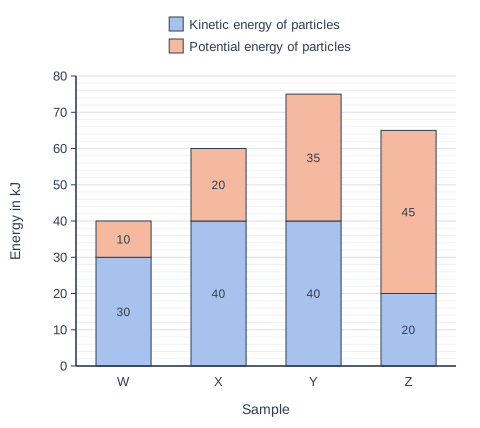
The chart shows the total kinetic energy and the total potential energy of the particles in four samples, W, X, Y and Z.

Samples X and Y contain the same mass of the same substance at the same temperature. Suggest why sample Y has more potential energy than sample X.

Stacked bar chart with 4 vertical bars. The value axis (y-axis) is "Energy in kJ", from 0 to 80 marked every 10; the bars are labelled along the x-axis, "Sample", from left to right. Each bar is split into 2 parts, shown in the key: Kinetic energy of particles (bottom, blue) and Potential energy of particles (top, orange). Values: W: kinetic energy of particles 30 kJ, potential energy of particles 10 kJ; X: kinetic energy of particles 40 kJ, potential energy of particles 20 kJ; Y: kinetic energy of particles 40 kJ, potential energy of particles 35 kJ; Z: kinetic energy of particles 20 kJ, potential energy of particles 45 kJ. The value of each part is printed on it.

Model answer

X and Y are at the same temperature, so their particles have the same kinetic energy (40 kJ each). Y must be in a different state from X - for example, Y is liquid and X is solid at the melting point. Energy had to be supplied to change the state, and this increased the potential energy of the particles, so Y has more potential energy.

Explanation

At a melting or boiling point, a substance can exist in two states at the same temperature. The state with the more widely spaced, freer particles has more potential energy and so more internal energy.

Mark scheme
  1. 1 mark

    they are at the same temperature, so their particles have the same kinetic energy (both 40 kJ)

  2. 1 mark

    Y is in a different state from X, e.g. Y is a liquid and X is a solid

    allow Y is a gas and X is a liquid

  3. 1 mark

    energy was needed to change the state, which increased the potential energy of the particles / the particles in Y are further apart

Question 4

5 marks

A cup of water at 20 °C is put in a freezer. It cools to 0 °C, freezes, and then cools further to −18 °C.

Describe what happens to the temperature of the water, the kinetic energy and potential energy of its particles, and its internal energy during this process.

Model answer

While the water cools from 20 °C to 0 °C, energy is transferred to the freezer, the kinetic energy of the particles decreases and the temperature falls. At 0 °C the water freezes and the temperature stays constant: the kinetic energy of the particles does not change, but their potential energy decreases as they become fixed in a regular arrangement. Once it has all frozen, the ice cools to −18 °C as the kinetic energy of its particles decreases. Throughout the whole process the internal energy of the water decreases, because energy is continually being transferred to the surroundings.

Explanation

Cooling is the reverse of heating: internal energy always decreases. Whether the temperature falls or stays constant depends on whether the kinetic energy or the potential energy of the particles is decreasing.

Mark scheme
  1. 1 mark

    from 20 °C to 0 °C the temperature falls because the kinetic energy of the particles decreases

    max 5

  2. 1 mark

    at 0 °C the temperature stays constant while the water freezes

  3. 1 mark

    during freezing the potential energy of the particles decreases (as they become fixed in place / bonds form)

  4. 1 mark

    during freezing the kinetic energy of the particles stays the same

  5. 1 mark

    the ice then cools to −18 °C as the kinetic energy of its particles decreases

  6. 1 mark

    the internal energy decreases throughout, because energy is transferred to the surroundings (the freezer)

Ready to try the rest? Every answer you write is marked against the mark scheme, so you can see exactly where the marks are.

AI Tutor Hints first, answers after you try

Hi! Stuck? Ask me for a hint and I’ll help you work it out. Once you’ve checked your answer I can explain exactly where the marks are.