Practise 40 exam-style questions on Speed for AQA GCSE Physics. Write your answer as you would in the exam and get it marked in seconds against the mark scheme, point by point, with an AI tutor on hand if you get stuck.
40 questions
1–6 marks each
Instant marking
No sign-up needed
20 questions, marked as you go
Sample questions with model answers
Here are 4 of the questions in this topic, each with a model answer, an explanation of why it earns the marks and the mark scheme an examiner would use.
Question 1
1 mark
Estimate the typical speed, in m/s, of a car driving through a town.
Model answer
About 13 m/s (about 30 mph).
Explanation
Speed limits in towns are usually 20 mph or 30 mph, which are about 9 m/s and 13 m/s. Being able to estimate everyday speeds is needed for stopping distance and kinetic energy estimates.
Mark scheme
1 mark
13 m/s
allow 8-15 m/s; unit required
Question 2
2 marks
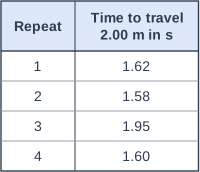
A student times a toy car as it travels 2.00 m across the floor. She repeats the measurement four times. The table shows her results.
Identify the anomalous result and suggest one possible cause of it.
Model answer
The anomalous result is 1.95 s (repeat 3). It may have been caused by the student stopping the stopwatch late.
Explanation
The other three times agree to within 0.04 s, so 1.95 s does not fit the pattern. Anomalous results should be checked by repeating the measurement and left out of the mean.
Mark scheme
1 mark
1.95 s / repeat 3
1 mark
a valid cause, e.g. the stopwatch was stopped late (reaction time), the car was not released from the same point, the car hit something or slowed down
allow the car was not given the same push
Question 3
3 marks
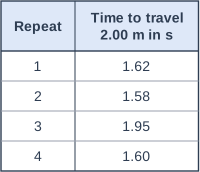
A student times a toy car as it travels 2.00 m across the floor. She repeats the measurement four times. The table shows her results.
Use the results to calculate the mean speed of the toy car.
Model answer
The 1.95 s result is anomalous, so leave it out. Mean time = (1.62 + 1.58 + 1.60) ÷ 3 = 1.60 s v = s ÷ t = 2.00 ÷ 1.60 = 1.25 m/s
Explanation
Before calculating a mean, check for anomalous results: 1.95 s is much larger than the other three, which agree closely. Including it would make the mean time too long and the speed too low.
Mark scheme
1 mark
mean time = (1.62 + 1.58 + 1.60) ÷ 3 = 1.60 (s)
the anomalous 1.95 s must be left out; an answer of 1.25 (m/s) scores 3 marks
1 mark
v = 2.00 ÷ 1.60
allow ecf from their mean time
1 mark
1.25 (m/s)
including 1.95 s gives a mean of 1.69 s and a speed of 1.19 m/s: max 2
Question 4
4 marks
An elite athlete runs a marathon of 42.2 km in a time of 2 hours 30 minutes.
Calculate the athlete's average speed in m/s and compare it with the typical speed of a person running.
Model answer
Time = 2 h 30 min = 2.5 × 3600 = 9000 s Distance = 42.2 km = 42 200 m v = s ÷ t = 42 200 ÷ 9000 = 4.7 m/s This is about 1.6 times the typical running speed of 3 m/s, because the athlete is very fit and highly trained.
Explanation
Convert hours and minutes into seconds carefully: 2 hours 30 minutes is 2.5 hours, not 2.3 hours. Factors such as fitness, age and training affect how fast a person can run, so an elite athlete can keep up a much higher speed than a typical runner.
Mark scheme
1 mark
time = 2 h 30 min = 9000 s and distance = 42 200 m
correct answer with no working scores full marks
1 mark
v = 42 200 ÷ 9000
allow ecf from incorrect conversions
1 mark
4.7 (m/s)
allow 4.69 m/s
1 mark
faster than the typical running speed of about 3 m/s (about 1.6 times), because the athlete is very fit / trained
allow ecf from their speed; comparison must use a typical value of 2-5 m/s
Ready to try the rest? Every answer you write is marked against the mark scheme, so you can see exactly where the marks are.
Ctrl + Enter to check
AI TutorHints first, answers after you try
Hi! Stuck? Ask me for a hint and I’ll help you work it out. Once you’ve checked your answer I can explain exactly where the marks are.