Practise 35 exam-style questions on Static charge (physics only) for AQA GCSE Physics. Write your answer as you would in the exam and get it marked in seconds against the mark scheme, point by point, with an AI tutor on hand if you get stuck.
35 questions
1–6 marks each
Instant marking
No sign-up needed
20 questions, marked as you go
Sample questions with model answers
Here are 4 of the questions in this topic, each with a model answer, an explanation of why it earns the marks and the mark scheme an examiner would use.
Question 1
2 marks
Explain why a polythene rod becomes negatively charged when it is rubbed with a woollen cloth.
Model answer
When the rod is rubbed, electrons are transferred from the woollen cloth to the polythene rod. Electrons are negatively charged, so the rod now has more electrons than protons and has an overall negative charge.
Explanation
Rubbing moves electrons from one insulator to the other. The material that gains electrons becomes negatively charged. No positive charge moves - protons stay in the nuclei of the atoms.
Mark scheme
1 mark
electrons are transferred from the cloth to the rod
allow electrons are rubbed off the cloth onto the rod
1 mark
the rod gains (negatively charged) electrons, so it has more electrons than protons
do not accept the rod gains negative protons / gains negative charge without reference to electrons
Question 2
2 marks
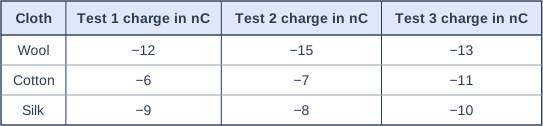
A student rubs a polythene rod 20 times with a cloth and then measures the charge on the rod. She does three tests with each of three different cloths. The table shows her results.
Suggest two reasons why the results for the same cloth were not all the same.
Model answer
She may not have rubbed the rod in exactly the same way each time, for example with different pressure or speed, so different numbers of electrons were transferred. Also, some charge may have leaked away into the air or through her hand before she measured it.
Explanation
Charging by rubbing is hard to control, so repeat results vary because of random errors. Repeating tests and calculating a mean reduces the effect of these errors.
Mark scheme
1 mark
she may not have rubbed the same way each time (different pressure / speed / length of rub)
max 2
1 mark
some charge may have leaked away (to the air or through her hand) before it was measured
1 mark
the rod may not have been fully discharged before the next test
1 mark
the humidity / dampness of the air may have changed between tests
Question 3
3 marks
A cloth loses 3.0 × 10¹¹ electrons when it is rubbed against a plastic rod. Each electron has a charge of −1.6 × 10⁻¹⁹ C.
Calculate the size of the charge on the cloth. State whether this charge is positive or negative.
Model answer
Charge = number of electrons × charge on one electron = 3.0 × 10¹¹ × 1.6 × 10⁻¹⁹ = 4.8 × 10⁻⁸ C The cloth has lost electrons, so the charge is positive.
Explanation
Multiply the number of electrons by the charge on each one. The cloth has lost negative electrons, so it is left with a positive charge of this size.
Mark scheme
1 mark
charge = 3.0 × 10¹¹ × 1.6 × 10⁻¹⁹
an answer of 4.8 × 10⁻⁸ C scores the first 2 marks
1 mark
4.8 × 10⁻⁸ (C)
allow 48 nC
1 mark
positive
allow +4.8 × 10⁻⁸ C for this mark
Question 4
4 marks
In one type of inkjet printer, tiny drops of ink are given a negative charge. The drops then pass between two metal plates. One plate is positively charged and the other is negatively charged.
Explain how the plates can be used to direct the drops of ink to the right place on the paper.
Model answer
Each negatively charged drop is repelled by the negative plate and attracted to the positive plate, so it is pushed sideways towards the positive plate as it passes between them. By changing the amount of charge on each drop, or on the plates, the printer controls how far each drop is deflected, so it lands in the right place on the paper.
Explanation
Charged objects experience forces from other charged objects without touching them. The bigger the charges, the bigger the forces, so the deflection of each drop can be controlled precisely.
Mark scheme
1 mark
the negatively charged drops are repelled by the negative plate
1 mark
and attracted to the positive plate
1 mark
so the drops are deflected / pushed sideways towards the positive plate
1 mark
changing the size of the charge on the drops / plates changes how far the drops are deflected
allow reversing the charges on the plates deflects the drops the other way
Ready to try the rest? Every answer you write is marked against the mark scheme, so you can see exactly where the marks are.
Ctrl + Enter to check
AI TutorHints first, answers after you try
Hi! Stuck? Ask me for a hint and I’ll help you work it out. Once you’ve checked your answer I can explain exactly where the marks are.