Practise 40 exam-style questions on Resistors for AQA GCSE Physics. Write your answer as you would in the exam and get it marked in seconds against the mark scheme, point by point, with an AI tutor on hand if you get stuck.
40 questions
1–6 marks each
Instant marking
No sign-up needed
20 questions, marked as you go
Sample questions with model answers
Here are 4 of the questions in this topic, each with a model answer, an explanation of why it earns the marks and the mark scheme an examiner would use.
Question 1
2 marks
What is meant by an ohmic conductor?
Model answer
An ohmic conductor is one in which the current is directly proportional to the potential difference across it, provided the temperature stays constant. Its resistance stays the same as the current changes.
Explanation
The I–V graph for an ohmic conductor is a straight line through the origin. A fixed resistor at constant temperature is ohmic; a filament lamp is not, because it heats up and its resistance changes.
Mark scheme
1 mark
the current through it is directly proportional to the potential difference across it
allow its resistance stays constant as the current changes
1 mark
at constant temperature
Question 2
2 marks
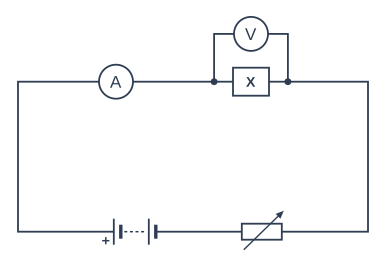
The circuit diagram shows the circuit used to find the I–V characteristic of component X.
Explain the purpose of the variable resistor in this circuit.
Model answer
Changing the resistance of the variable resistor changes the current in the circuit, and so changes the current through X and the potential difference across it. This allows a range of pairs of current and potential difference readings to be taken to plot the I–V graph.
Explanation
An I–V characteristic needs many readings at different potential differences. The variable resistor (or a variable power supply) provides that control. The ammeter in series and voltmeter in parallel measure the current through X and the potential difference across it.
Mark scheme
1 mark
to change the current through X / the potential difference across X
1 mark
so that several / a range of pairs of current and potential difference readings can be taken
Question 3
3 marks
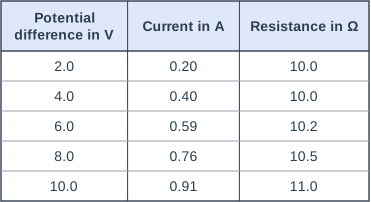
A student measured the resistance of a resistor at different potential differences. She left the circuit switched on throughout. The table shows her results.
Explain why the resistance increases at the higher potential differences, and suggest how she could change her method so that the resistor stays at a constant temperature.
Model answer
As the potential difference increases, the current increases, and the larger current heats the resistor. The resistance increases as the temperature rises, so the values at 8.0 V and 10.0 V are higher. She should switch off between readings so the resistor can cool, and use smaller currents, so that its temperature stays constant.
Explanation
A resistor is only ohmic at constant temperature. The results at low potential differences show a constant 10 Ω, but heating at larger currents makes the resistance creep upwards, so temperature must be controlled.
Mark scheme
1 mark
at higher potential differences the current is larger, which heats the resistor
allow leaving the circuit on heats the resistor
1 mark
the resistance increases as the temperature of the resistor increases
1 mark
switch off between readings (to let it cool) / use smaller potential differences or currents
allow place the resistor in a beaker of water at constant temperature
Question 4
4 marks
The filament of a 12 V car headlamp bulb has a resistance of 2.0 Ω when it is cold and 24 Ω when it is lit normally.
Calculate the current in the bulb at the moment it is switched on and when it is lit normally. Use your answers to suggest why filament bulbs most often fail at the moment they are switched on.
Model answer
At switch-on: I = V ÷ R = 12 ÷ 2.0 = 6.0 A When lit: I = V ÷ R = 12 ÷ 24 = 0.50 A The current at the moment of switching on is 12 times larger than the normal current, because the cold filament has a low resistance. This large surge of current heats the filament very rapidly, which stresses the thin wire and can make it break.
Explanation
The resistance of a filament lamp depends strongly on its temperature. A cold filament has a much lower resistance, so there is a brief surge of current at switch-on until the filament heats up and its resistance rises.
Mark scheme
1 mark
at switch-on: I = 12 ÷ 2.0 = 6.0 (A)
correct answer with no working scores full marks
1 mark
when lit: I = 12 ÷ 24 = 0.50 (A)
1 mark
the current at switch-on is much larger (12 times larger)
allow ecf from their values
1 mark
this large current heats the filament very quickly, which can make it break / melt
Ready to try the rest? Every answer you write is marked against the mark scheme, so you can see exactly where the marks are.
Ctrl + Enter to check
AI TutorHints first, answers after you try
Hi! Stuck? Ask me for a hint and I’ll help you work it out. Once you’ve checked your answer I can explain exactly where the marks are.