Level:
Correct: 0
Incorrect: 0
Marks: 0/0
Exam Practice
Subject:
Topics:
AQA GCSE Physics Smart practice A mixed round aimed at your weak spots
Unit 1
Energy
Energy changes in a system, and the ways energy is stored before and after such changes
Energy stores and systems
0%
Changes in energy
0%
Energy changes in systems
0%
Power
0%
Conservation and dissipation of energy
Energy transfers in a system
0%
Efficiency
0%
Unit 2
Electricity
Unit 3
Particle model of matter
Unit 4
Atomic structure
Unit 5
Forces
Unit 6
Waves
Unit 7
Magnetism and electromagnetism
Unit 8
Space physics (physics only)
Avg
score:
–
Topics
done:
0/91

National and global energy resources

Practise 40 exam-style questions on National and global energy resources for AQA GCSE Physics. Write your answer as you would in the exam and get it marked in seconds against the mark scheme, point by point, with an AI tutor on hand if you get stuck.

  • 40 questions
  • 1–6 marks each
  • Instant marking
  • No sign-up needed
20 questions, marked as you go

Sample questions with model answers

Here are 4 of the questions in this topic, each with a model answer, an explanation of why it earns the marks and the mark scheme an examiner would use.

Question 1

2 marks

The flow chart shows how some energy resources are classified.

Name an energy resource that could go in box A and an energy resource that could go in box B.
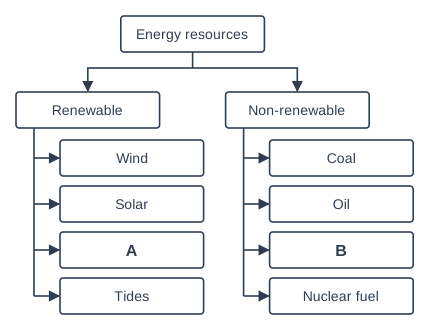
Flow chart of 11 boxes joined by arrows, read from top to bottom. The first box is "Energy resources". From "Energy resources", 2 arrows branch out side by side: the left arrow leads to "Renewable"; the right arrow leads to "Non-renewable". From "Renewable", arrows lead to a column of 4 boxes, listed from top to bottom: "Wind", "Solar", box A and "Tides". From "Non-renewable", arrows lead to a column of 4 boxes, listed from top to bottom: "Coal", "Oil", box B and "Nuclear fuel".

Model answer

Box A: hydroelectricity (or waves, geothermal or bio-fuel).
Box B: natural gas.

Explanation

The non-renewable resources are the three fossil fuels (coal, oil and natural gas) and nuclear fuel, so the missing one is natural gas. The renewable resources are wind, solar, tides, waves, hydroelectricity, geothermal and bio-fuel.

Mark scheme
  1. 1 mark

    A: any one of hydroelectricity, waves, geothermal, bio-fuel

    do not accept wind, solar or tides (already shown)

  2. 1 mark

    B: natural gas

    allow gas

Question 2

2 marks

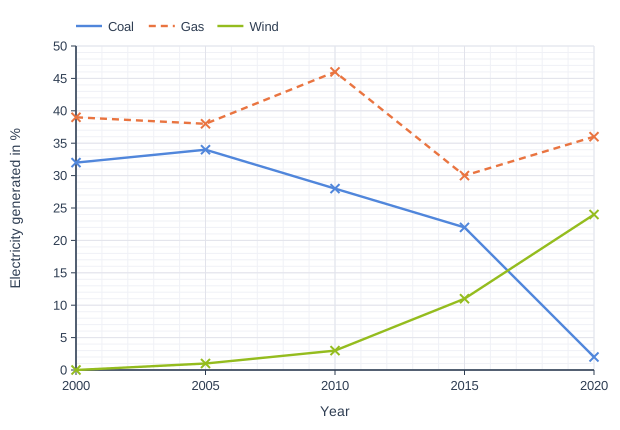
The graph shows the percentage of a country's electricity generated using coal, gas and wind between 2000 and 2020.

Describe the trend in the use of coal over this period.

Line graph of electricity generated in % (y-axis, 0 to 50) against year (x-axis, 2000 to 2020). "Coal" joins the points (2000, 32), (2005, 34), (2010, 28), (2015, 22), (2020, 2). "Gas" (dashed) joins the points (2000, 39), (2005, 38), (2010, 46), (2015, 30), (2020, 36). "Wind" joins the points (2000, 0), (2005, 1), (2010, 3), (2015, 11), (2020, 24).

Model answer

The use of coal rose slightly from 32% in 2000 to 34% in 2005, then decreased, falling steeply after 2015 to only 2% in 2020.

Explanation

A good description of a trend gives the overall direction and uses values from the graph to support it. Describing the steepest part of the change adds detail.

Mark scheme
  1. 1 mark

    overall the use of coal decreased (after rising slightly to 2005)

  2. 1 mark

    use of data: from 32% in 2000 (34% in 2005) to 2% in 2020 / the fall was fastest between 2015 and 2020

    allow any correct values read from the graph

Question 3

3 marks

Nuclear power stations produce radioactive waste.

Explain why this waste is an environmental problem.

Model answer

Radioactive waste emits ionising radiation, which can damage cells and cause cancer in living things. Some of the waste stays radioactive for thousands of years, so it must be sealed and stored safely, for example deep underground, for a very long time. This is difficult and expensive, and leaks could contaminate the environment.

Explanation

Nuclear power releases no carbon dioxide when generating, but its waste is a long-term problem. Deciding where to store it involves political and social issues as well as science.

Mark scheme
  1. 1 mark

    the waste emits (ionising) radiation, which is harmful to living things / can cause cancer

  2. 1 mark

    some of the waste stays radioactive for thousands of years

    allow it has a long half-life

  3. 1 mark

    so it must be stored safely (e.g. deep underground) for a very long time, which is difficult and expensive

Question 4

5 marks

Scientists agree that burning fossil fuels is causing climate change. However, the world is not stopping its use of fossil fuels quickly.

Explain why science has been able to identify this problem but has not been able to solve it. Refer to political, social, economic and ethical considerations in your answer.

Model answer

Scientists can measure the increase in carbon dioxide in the atmosphere and show that it is linked to rising global temperatures, so science has identified the problem. However, solving it is not just a scientific decision. Economically, fossil fuels are cheap and replacing power stations, heating systems and vehicles costs a great deal. Politically, governments must agree internationally, and some countries rely on income from selling fossil fuels or want to use their own reserves for energy security. Socially, many people do not want higher energy bills, changes to their lifestyle or wind farms near their homes, and jobs in fossil fuel industries would be lost. Ethically, developing countries argue that they should be allowed to use cheap fossil fuels to improve living standards, as richer countries did in the past. So science can identify the issue, but other considerations decide how quickly it is dealt with.

Explanation

The AQA specification asks you to show that science can identify environmental issues but does not always have the power to deal with them. The best answers give a specific example for each type of consideration rather than general statements.

Mark scheme
  1. 1 mark

    science can measure carbon dioxide levels and link them to rising global temperatures (so it can identify the problem)

    max 5

  2. 1 mark

    economic: alternatives are expensive to build / fossil fuels are cheap and existing power stations and vehicles would need replacing

  3. 1 mark

    political: governments must agree internationally; some countries depend on fossil fuel income or want energy security; decisions are affected by elections

  4. 1 mark

    social: people do not want higher energy bills, to give up cars / change lifestyles, or to have wind farms near their homes; jobs in fossil fuel industries would be lost

  5. 1 mark

    ethical: developing countries argue they should be allowed to use cheap fossil fuels to grow, as richer countries did / it is unfair on future generations not to act

  6. 1 mark

    so the decision about which energy resources to use is not made by scientists alone

Ready to try the rest? Every answer you write is marked against the mark scheme, so you can see exactly where the marks are.

AI Tutor Hints first, answers after you try

Hi! Stuck? Ask me for a hint and I’ll help you work it out. Once you’ve checked your answer I can explain exactly where the marks are.